
Enchanting Owl.
Bird News Items
1. "It's hard to ignore birds" - Let's begin in chilly Nebraska with a paean to birdwatching: It doesn’t take long to realize that birds are everywhere in Nebraska, and that there are a lot of them. Nebraska’s official state bird list includes 469 species as of September 2024 — around 350 of those species show up annually, and about 200 regularly breed in the state. Nebraska plays an important role for birds, especially during migration. Millions pass through our skies every year, stopping in wetlands, prairies and rivers along the way. For instance, you don’t have to be a birder to be impressed by the migration of sandhill cranes along the Platte River every spring. Even people who have never opened a bird guide will pull over their cars just to watch the sky as thousands of cranes fly overhead at once, bugling loudly and making their ancient sounds. How could a person resist? (via Nebraskaland)
2. From the Antarctic, very concerning news: Emperor penguins, the world’s largest and perhaps most recognizable penguin species, have joined the list of wildlife endangered by global warming, the International Union for Conservation of Nature announced on Thursday. In an update of its Red List, a comprehensive and authoritative listing of global species based on their extinction risk, the group also said that Antarctic fur seals had moved into the endangered category and that southern elephant seals had moved to vulnerable. In the case of penguins and fur seals, the changes were largely driven by shifts in sea ice levels and food availability linked to global warming, researchers said. (via The New York Times)
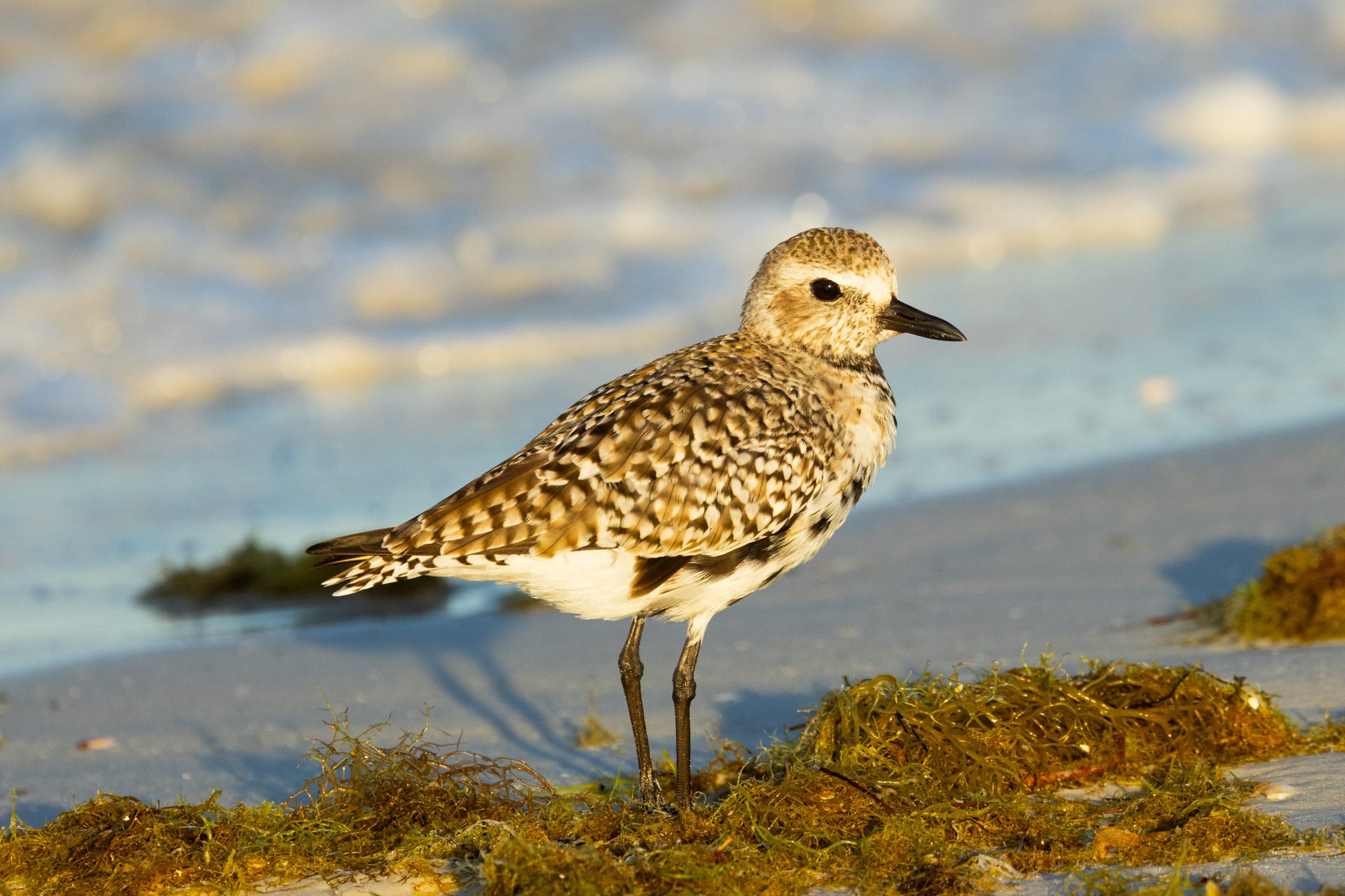
By Hap Ellis, Black-bellied Plover - Longboat Key, FL.
3. Back in the day (1932, to be exact), the Australian government declared "war" on Emus - but the Emus out foxed them: When it comes to strange animals, no place in the world is quite like Australia—literally. For example, almost 90 percent of Australia’s mammals and 45 percent of its birds are endemic to the continent, which is one of the highest rates in the world. Among those unique animal gems is the emu (Dromaius novaehollandiae), a flightless bird that can grow up to six feet tall and is the second-largest bird in the world (behind Africa’s common ostrich). From the perspective of the emu, humans are the newcomers. Emus are a member of the ratite family (which also includes ostriches, rheas, cassowaries, and kiwis, among others), and their ancient lineage has been around for nearly 80 million years, making them the oldest bird family and a direct link to the age of dinosaurs. Emus have also remained largely unchanged for tens of millions of years and have survived a number of large-scale challenges to the species, including the initial human settlement of the continent 65,000 to 40,000 years ago, the arrival of the dingo some 5,000 years ago, and British colonization of the continent in the early 19th century. With this battle-hardened past, the emu faced down yet another threat to its existence in the 1930s—wheat farming. (via Popular Mechanics)
4. "(S)mall protected areas, by themselves, aren't enough" - a look at tropical and subtropical forest issues: An analysis of 50 datasets from more than 1,000 individual parcels of tropical and subtropical forest show that avian species richness declines fastest when those pieces of habitat are surrounded by areas that woodland birds find inhospitable. The study by an international collaboration that included Matthew Betts of the Oregon State University College of Forestry suggests the conservation value of forest remnants could be greatly increased simply by working to give the areas around habitat patches more tree cover. Findings of the project led by scientists in Brazil and at Slippery Rock University in Pennsylvania were published in theProceedings of the National Academies of Sciences. (via Oregon State University Newsroom)
5. "Bringing hope to a dire situation" - an overview of the "race to conserve the native Hawaiian manu nahele (forest birds)": Birds, Not Mosquitoes (BNM), an initiative by American Bird Conservancy and many other partners, is committed to halting the extinction of some of the rarest birds in the world: Hawaiian forest birds. Hawaiʻi’s birds face a conservation crisis: Of the more than 50 native honeycreepers that once flourished in Hawaiʻi’s forests, only 17 species remain. Those that are left — the ʻAkikiki, Kiwikiu, ʻAkekeʻe, and ʻIʻiwi, among others — are at severe risk from mosquito-borne avian malaria, a deadly disease that is hastening the decline of these vulnerable birds. (via ABC Birds)
6. Some enchanting evening? How about some "enchanting masked owl": A traditional owner on a north Australian island has captured rare photos of an “enchanting” masked owl, adding to a limited knowledge base surrounding the endemic and culturally significant bird. Local avid birdwatcher Craig Kurrujuwa Winston first heard the Tiwi Islands masked owl — or pinjoma, as it’s known in Indigenous culture — was in the vicinity when his little brother spotted it earlier this year. Days later at around 9pm, Mr Winston saw the bird perched in his Melville Island yard, scoping out a brushtail possum. Before Mr Winston logged his sighting of the “enchanting” creature on iNaturalist, there were no images of the Tiwi Islands masked owl listed on the citizen science database. (via ABC News)
* More on this owl for those interested: Australian Masked-Owl - Tyto novaehollandiae (via Birds of the World)
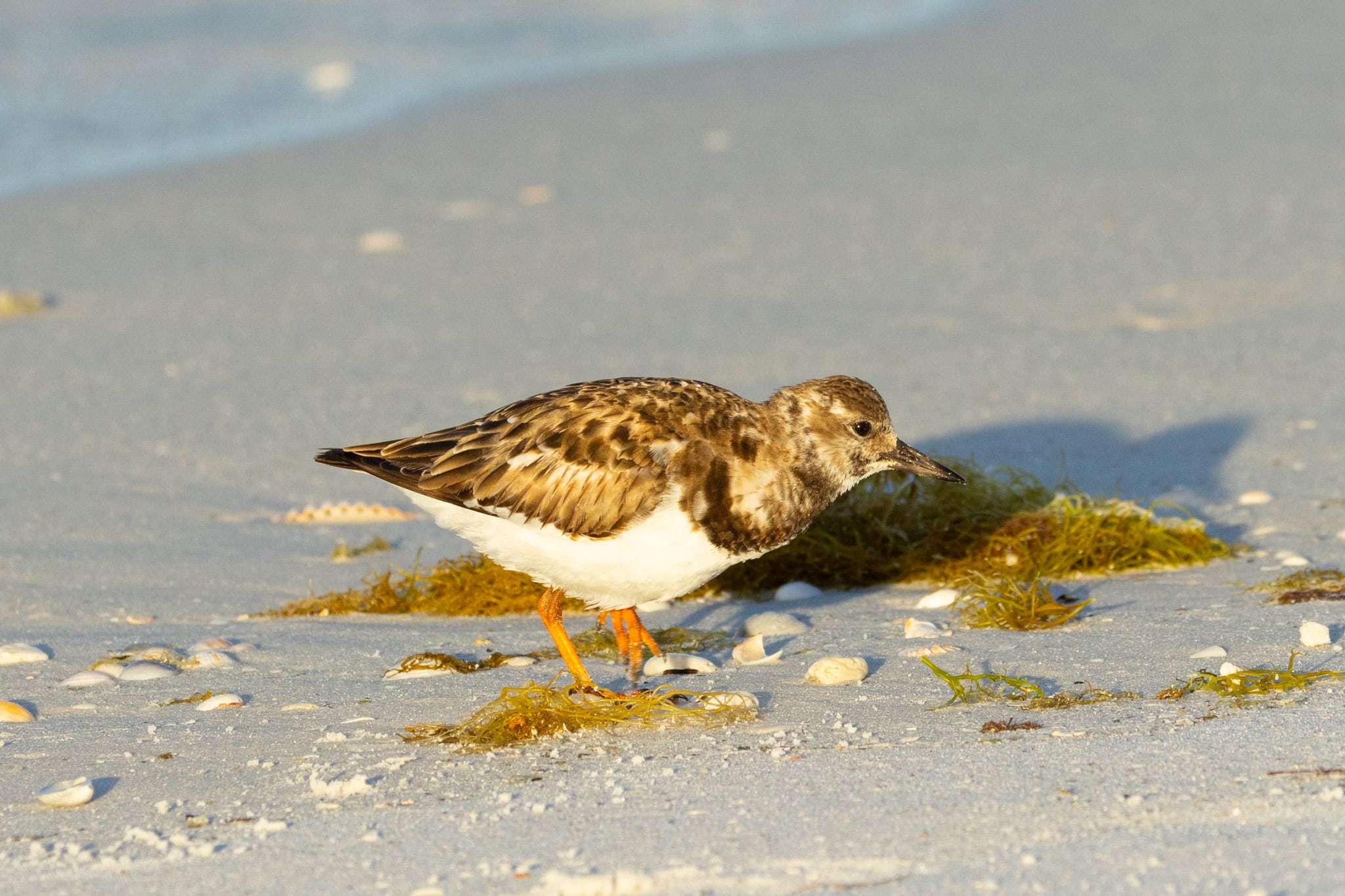
By Hap Ellis, Ruddy Turnstone - Longboat Key, FL.
7. To the Adirondacks, with one of our favorite nature writers (and bird bander): Yesterday was like getting up on Christmas morning to new fallen snow, and it was still coming down, but this is April and the 90,000 birds that just flew north last week didn’t like the looks of it. More than 200 descended on my feeders. The slate colored juncos and evening grosbeaks were the majority on the flock but there were 25 common grackles and a flock of red-winged blackbirds. A few song sparrows and fox sparrows were in the mix. The blue jays had left here last week and only three or four were left here. One lone American robin was here, and it had just looked at the nesting site under the porch roof the day before now; it was looking for a bare spot to flip leaves looking for a worm. I swept out the feeding area and scattered seed for the seed eaters; the robin would have to fend for himself. (via Adirondack Explorer)
8. Birds & Climate change - a primer: As spring progresses, billions of birds are set to take flight on migratory journeys in search of their summer breeding grounds. Of the more than 650 species of North American breeding birds, more than half migrate each year. The vast majority take flight at night, and some fly hundreds or even thousands of miles nonstop. Bird migration typically peaks between mid-April and mid-May across the U.S. as hundreds of different species head north. Migratory birds are highly attuned to the environmental cues (such as temperature, rainfall, day length, and plant growth) that they use to align their spring arrival with blooming plants, abundant food, and ideal temperatures in their breeding grounds. But this environmental sensitivity also makes birds vulnerable to rapid climate change. Shorter winters,spring warming, and earlier first spring. (via Climate Central)
9. The early bird gets the worm, the saying goes; but exactly how do Robins actually get that worm?: We all know the early bird gets the worm, but how does he find it? That American Robin in your neighborhood park—how did it dig up the juicy nightcrawler dangling from its bill? After all, worms live mostly underground where we can’t see them. A study back in 1965 concluded that robins do so exclusively by sight, the idea being that worm burrows provide peepholes into the underground world. Robins seem to peer down into the burrows and jam their bills in those that are occupied, the paper said. But three decades later, a similar study reached a much different conclusion: It produced evidence that American Robins rely on their hearing to find buried food. (via Audubon)
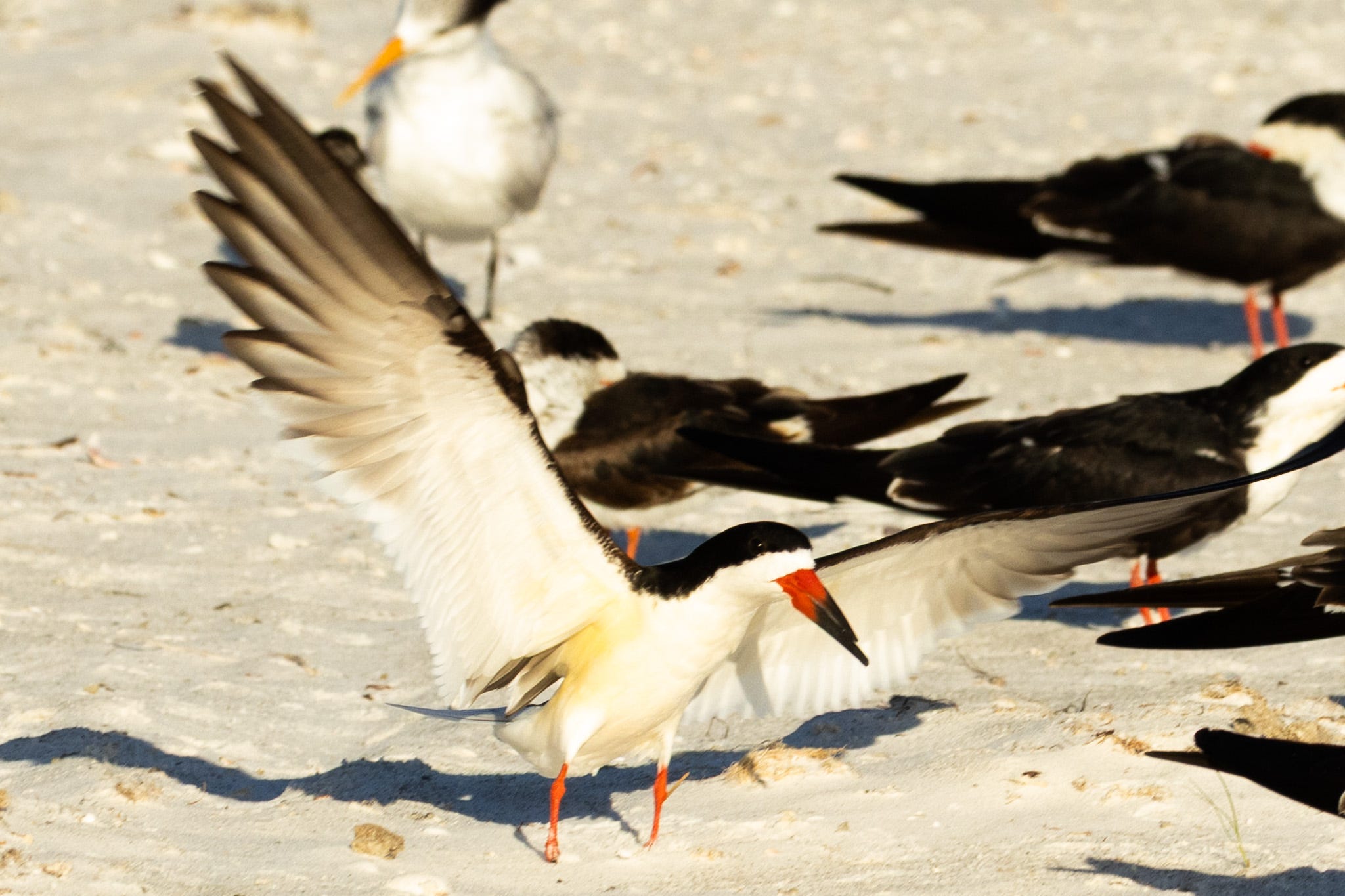
By Hap Ellis, Black Skimmer - Longboat Key, FL.
10. Unveiling the secrets of the chimney swifts: At dusk in August 2025, a group gathered in the parking lot of Housatonic Valley Regional High School in Connecticut to watch the sky fill with a flurry of birds, their cigar-shaped bodies dipping and swirling around the school’s chimney. Sunny Kellner, wildlife rehabilitation manager for the Sharon Audubon Center, held a Chimney Swift in her gloved hand, then released it to join the living vortex. Kellner and her staff had worked tirelessly to care for this creature—as they do each year for dozens of swifts whose nests similarly fall to the ground. “People always ask, ‘How do you know the birds that you rehab survive?’” Kellner says. Her team has now set out to get an answer. The center worked with Audubon biologists to tag rehabbed swifts with radio transmitters, hoping to learn how their patients fare and understand more about the species’ behavior. “There are a whole lot of question marks that follow that little swift up into the air,” says Eileen Fielding, Sharon Audubon Center director. (via Audubon Magazine)
11. What happens when you apply electricity to piezoelectric materials? Robots fly like birds: A bird banking in a crosswind doesn’t rely on spinning blades. Its wings flex, twist and respond instantly to its environment. Engineers at Rutgers University have taken a major step toward building bird-like drones that move the same way, flapping their wings like real birds, using electricity-driven materials instead of conventional electromagnetic motors to power them. In a study published in Aerospace Science and Technology, aerospace researchers Xin Shan and Onur Bilgen describe a “solid state” bird-like drone, typically referred to as an ornithopter, whose flexible wings flap and twist without motors, gears or mechanical linkages. Instead, the system relies on the piezoelectric effect, special materials that change shape when voltage is applied. (via Rutgers Newsroom)
12. And speaking of robotic birds, there is a mechanical sage grouse! Why? Well, check this out...": How well can a robotic bird mimic a real one? That’s what Grand Teton National Park is trying to find out with mechanical sage grouse replicas built to influence the behaviors of real sage grouse, whose numbers have long been declining across the American West. Sage grouse, which are about the size of chickens, are the largest grouse in North America. They’re known for their round bodies, superior camouflage and, on males, pointed tail feathers and yellow chest sacs that inflate during mating dances. Since 1965, their populations have dropped by 80% across the West, and at a breeding site inside Grand Teton, the male sage grouse count dropped from 73 in 1950 to three last year, according to WyoFile. Male sage grouse strut and fluff their spiky tail feathers in an elaborate courtship ritual every spring. Robotic birds made by the RoboBroncs, the local robotics team at Jackson Hole High School, simulate this activity in an attempt to draw in the real ones. The robotic grouse are made to look lifelike, with real feathers provided by the Wyoming Game and Fish Department. (via SF Gate)
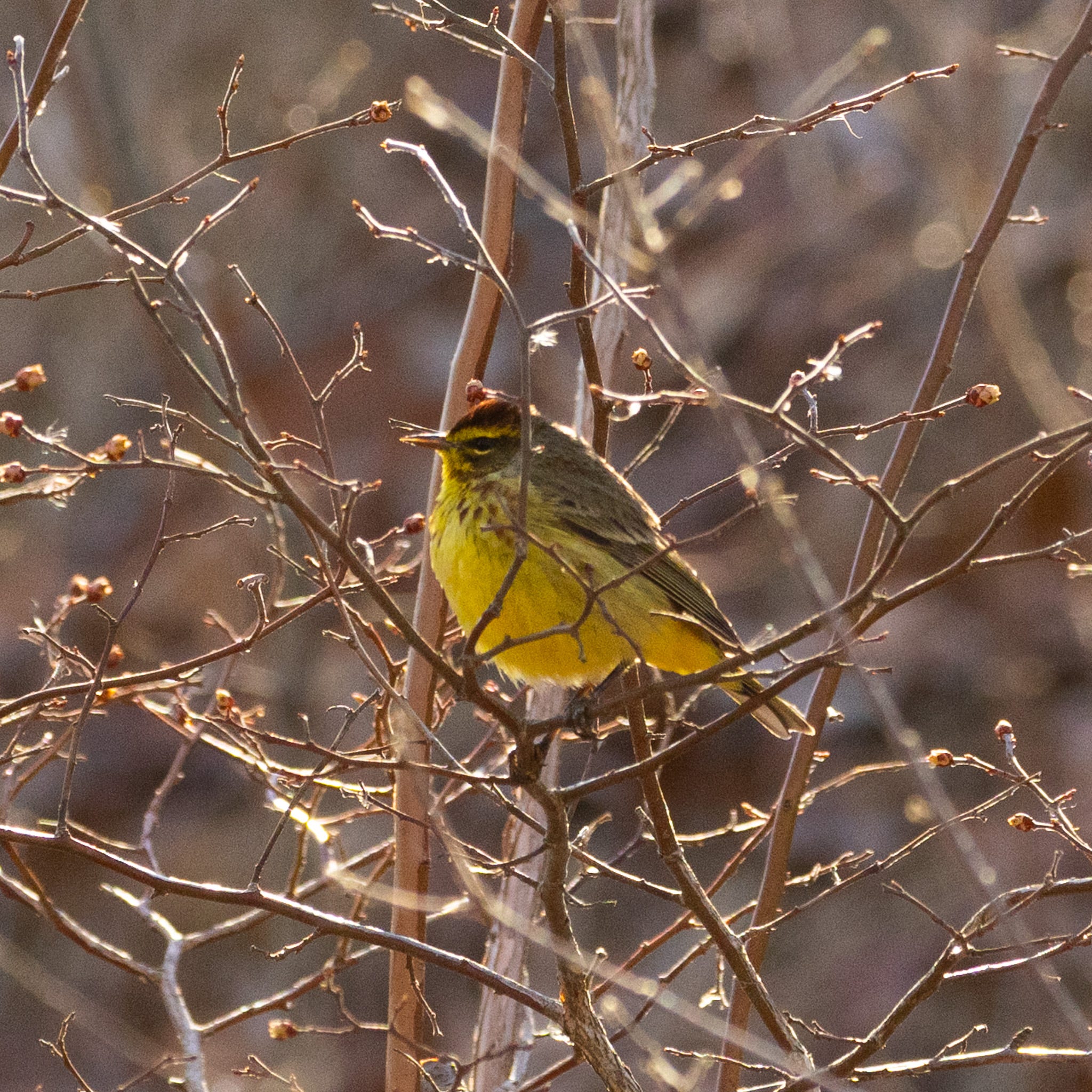
By Hap Ellis, Early Spring warbler (Palm Warbler) - Millennium Park, Boston, MA.
13. Avian flu update - from the Hamptons!: Georgica Pond is the brackish coastal pond in East Hampton, Long Island, around which sit the summer homes of the filmmaker Steven Spielberg and the hip-hop mogul Jay-Z. This winter, however, the pond went from a picturesque location to a horror scene when more than 700 dead geese lined its sandy shore and the surrounding area. Their deaths came at a time when much of the South and North Forks of Long Island were hit with a scourge of H5N1, also known as bird flu. Wildlife conservationists believe the outbreak was principally caused by an unusually long spell of freezing temperatures, which meant birds were dealing with scarce resources and weakened immune systems. (via The New York Times)
14. Backyard birders take note: Garden birds should not be fed seeds and nuts over the summer months, the RSPB has said, in an attempt to reduce the spread of avian diseases. Bird lovers are being urged to take down their bird feeders between May and October to help birds such as the greenfinch, whose numbers have plummeted after the spread of trichomonosis, a parasitic disease transmitted more easily when birds cluster around feeders in the warmer months. In new guidance, the RSPB is advising people to “feed safely and feed seasonally” by removing all bird feeders filled with seeds and peanuts and instead offering small amounts of protein such as mealworms, fat balls or suet from 1 May to 31 October, since they tend not to attract clusters of finches and protein is useful for the birds to feed their chicks. (via The Guardian)
15. Book review: The cormorant species as the subject of a "remarkable story"?: How does prejudice grow and mutate? What does intolerance, when transferred from human beings onto animals, do to those creatures? And what, in return, does it do to us? Cormorant is the gripping story of a ‘greedy’ bird hated across the world, the object of global conflict between the fishing industry on the one hand and environmental science on the other. Gordon McMullan’s book reveals that cormorants have been loathed for centuries, a detestation that has metamorphosed over time. Drawing on fields which include literature, art history and zoology, and ranging from America to China and from Britain to Peru, Cormorant explores racism, xenophobia and capitalism through the remarkable story of a bird. McMullan argues that if in the present we are to recognize prejudicial attitudes towards animals and our fellow human beings, then we need to look to the past to understand how those viewpoints have taken hold. (via Amazon)
16. Finally, we've experienced this "Biggest Week" and it definitely lives up to hype. As does this article (plus perfect pics of Cerulean and Blackburnian Warblers). Check it out: The suburbs of Toledo, Ohio, in early May may seem an unlikely spring break destination, but birders in the know, like Kimberly Kaufman, executive director of the Black Swamp Bird Observatory and one of the Biggest Week’s founders, would disagree. “All the birding stars align for us here in northwest Ohio,” Kimberly explains. “When migratory birds move north in spring, a large expanse of water poses a daunting barrier. Before crossing Lake Erie, small songbirds need to rest and feed to build their energy reserves. As a result, large concentrations of these birds converge on the patches of wooded habitat along our lakeshore in spring.” The festival is not only a gathering of birds; nearly 90,000 people visit the warbler capital of the world to catch a glimpse of the fliers passing through. I was lucky enough to join in. (via Birds and Blooms)
Bird Videos of the Week
Video by PBS, “How Great Grey Owls Hunt Hidden Prey”.

Cornell Live Bird Cam - The Great Horned Owl Nest.

Cornell Live Bird Cam - Hungry Owlet.