
Flyover.
Bird News Items
1. Let's begin with CBS' "60 Minutes" in Columbia: Colombia, with its varied geography, has about 2,000 species of birds — more than any other country in the world. All those species of birds have become an important part of a growing ecotourism industry. It brings in millions of dollars to Colombia’s economy, and bird watchers — birders, as they’re known — are flocking to the South American country, hoping to catch even a fleeting glimpse of species you can’t find anywhere else on Earth. The sound of birds fills the humid air in Tatamá National Park, located on the western slopes of the Andes mountains. This is one of the wettest places on Earth, and it is packed with birds, including the Blue-gray tanager, the Cinnamon flycatcher, the Violet-tailed sylph, the Velvet-purple coronet and the Purple-throated woodstar, according to Diego Calderón Franco, one of Colombia’s most famous birding guides. Here are some of the birds 60 Minutes learned about during a trip to Colombia. (via CBS News)
2. Also from 60 Minutes in Columbia - a birding guide's effort to turn Marxist rebel fighters into forest (and birding) guides: Diego Calderón Franco, a researcher and birding guide, was once kidnapped and held hostage by Marxist rebels in Colombia. Years later, he decided to introduce his former captors to bird-watching, thinking it might provide some of them with new careers as guides. The Revolutionary Armed Forces of Colombia, a far-left group known by its Spanish acronym FARC, captured Calderón Franco in 2004 and held him hostage for 88 days. The group was embroiled in a decades-long conflict with the Colombian government. After reaching a peace agreement in 2016, nearly 10,000 fighters gave up their guns and started a search for work. Calderón Franco thought the former fighters might make good forest guides. So he introduced some of them to birding. (via CBS News)
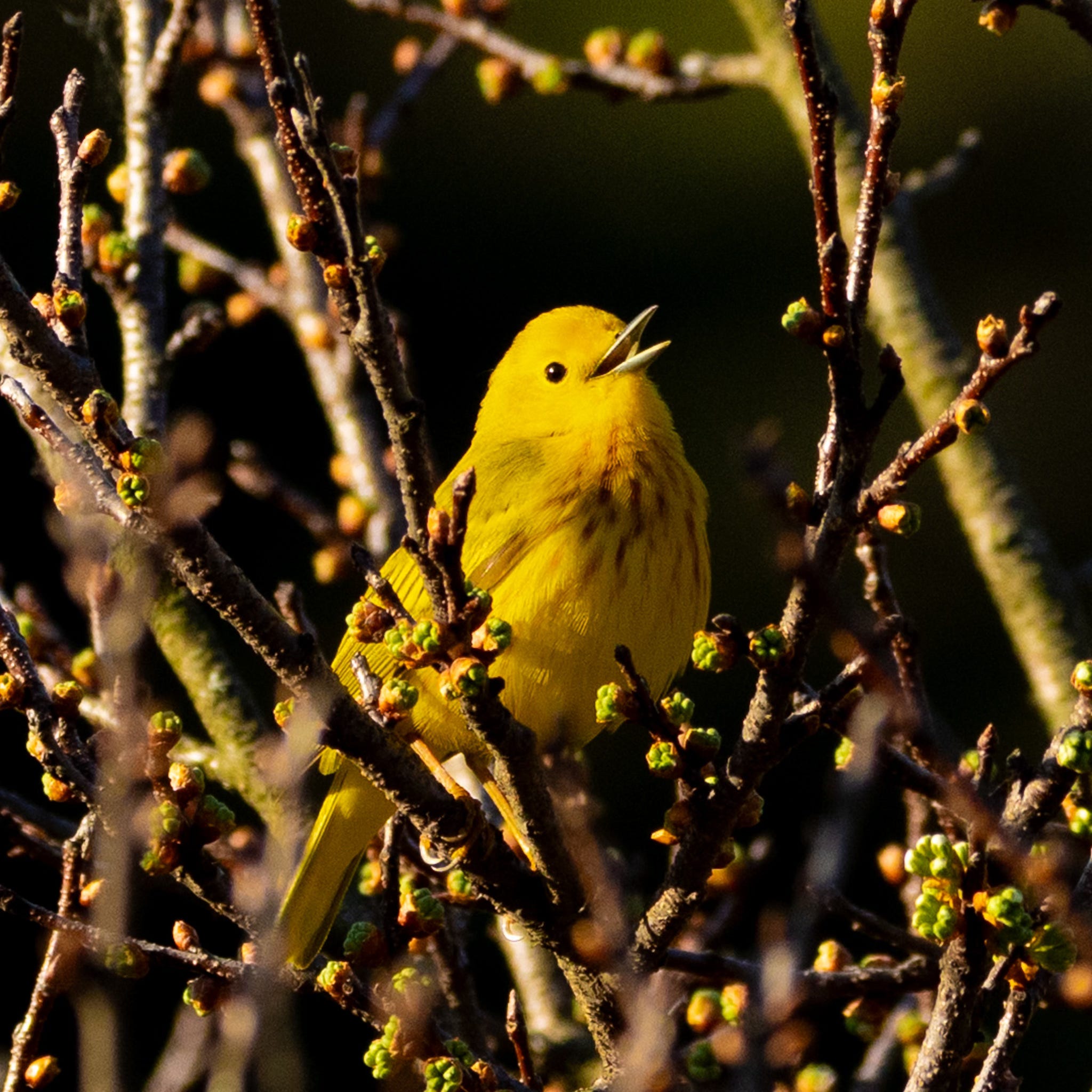
By Hap Ellis, Yellow Warbler - Arnold Arboretum, Boston, MA
3. Avid birder becomes critical doctor on the MV Hondius: When Stephen Kornfeld set sail aboard the MV Hondius in early April, his grand plan for the cruise was to add as many new species as possible to his birding list. A medical oncologist based in Bend, Oregon, Kornfeld is also an avid birder—second on eBird’s renowned rankings of birders worldwide—and the ship would visit several remote islands, where he might spot some of the globe’s most obscure avians. But last week, Kornfeld’s trip took an unexpected twist: He stepped in to care for three people thought to be sick with hantavirus, a severe respiratory pathogen that can kill roughly half of the people it infects. Kornfeld was, and still is, “a passenger on this boat,” he told me. “But I became the doctor on this boat.” (via The Atlantic)
4. "Social learning" in Australia: By watching their peers, dolphins learn to capture fish in empty conch shells, then ferry the shells up to the water’s surface in order to eat. Octopuses can master experimental tasks by watching their tankmates in the laboratory. Crows follow the cues of others in their flock to attack specific humans who have harassed fellow crows in the past. Scientists call it “social learning,” and it essentially means monkey see, monkey do, an adage that turns out to apply to many animals beyond just primates. Now, a study of Australia’s sulfur-crested cockatoos shows that the birds employ social learning to understand whether unfamiliar foods are safe to eat. (via The New York Times)
5. From Mongabay, a look at the challenges in the African-Eurasian flyway: Each year in May, World Migratory Bird Day draws attention to the billions of birds that migrate long distances with the changing of the seasons, a living braid of ecosystems separated by thousands — even tens of thousands — of kilometers. According to Kariuki Ndang’ang’a, BirdLife International Africa’s regional director, about 2 billion birds fly along the African-Eurasian flyway every year: the populations of between 40 and 50 percent of these migratory bird species are in decline. Ndang’ang’a told Mongabay added that the birds that travel furthest are at greatest risk. Some species, like Abdim’s stork (Ciconia abdimii), migrate relatively short distances within the continent, but palearctic migrants — those coming from distant landscapes in Europe or Asia — are particularly vulnerable, experiencing over a 30% decline in the past 30 years. (via Mongabay)
6. The enduring power of the Nightingale's song: Two weekends ago, I had the honor of attending a rare experience I will never forget. Folk musician Sam Lee guides people into the forest in Sussex, in the southeast of England after nightfall to listen to the song of the Nightingale. This is a tiny bird with an enormous heart. Part ecological music emergence, part enchantment, the evening is impossible to categorize. Which is why it’s wonderful. I’d heard of these sojourns to Sing with the Nightingales while I lived in England and always wanted to attend, but the timing didn’t work. However, in between events for my book “Heartwood” in Oxford and London, I had a free weekend. (via Aspen Times)
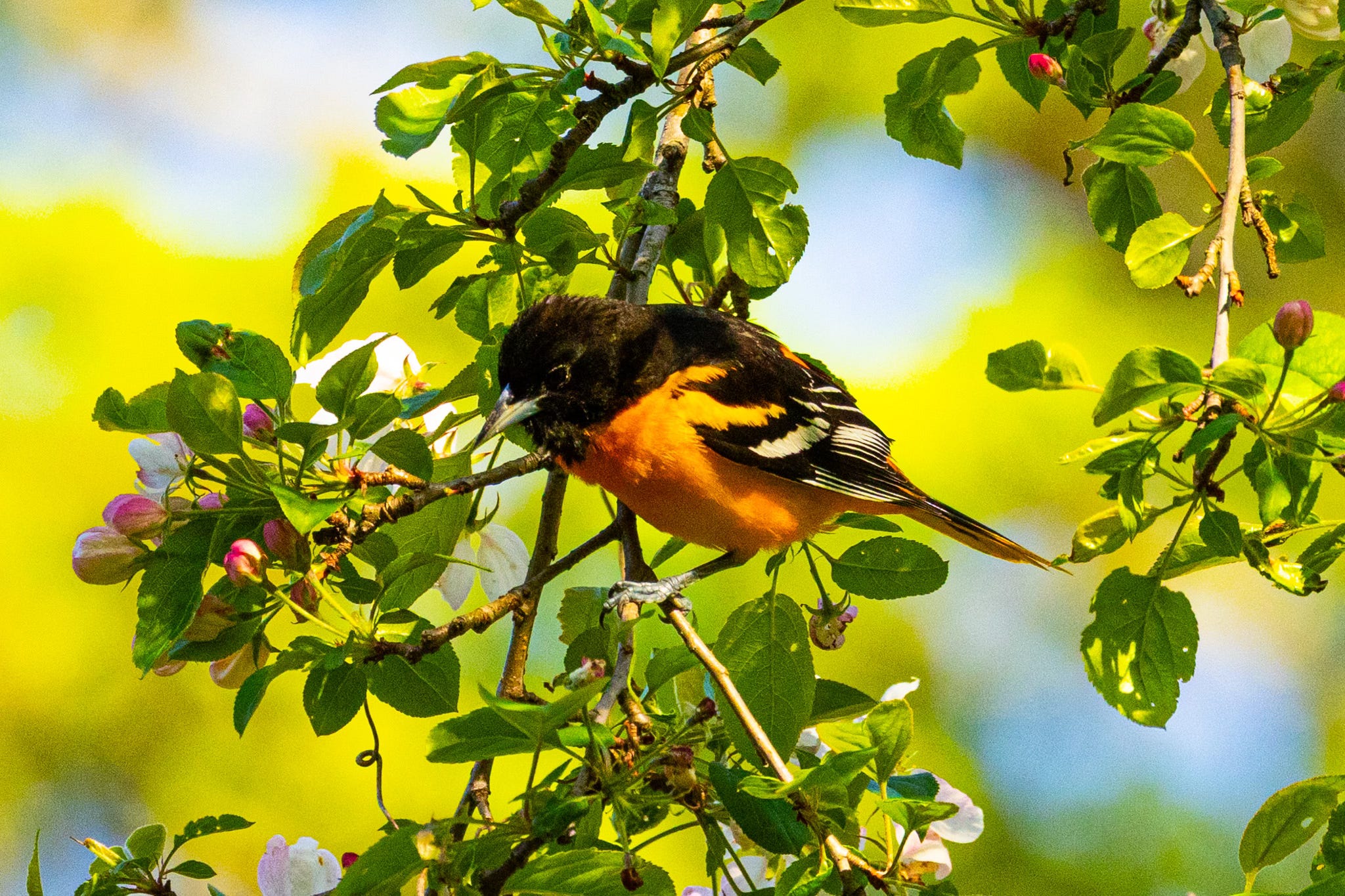
By Hap Ellis, Baltimore Oriole - Arnold Arboretum, Boston, MA.
7. Hawk watch in Iowa: It’s a cloudless and chilly February morning when Iowa Raptor Project director Dave Conrads pulls up to the Levitt Center for University Advancement, home of Iowa Magazine. Photographer Seth Diehl (07BA), art director Nick Beecher (03BA), and I are heading out with Conrads’ team for a leg of their winter raptor survey—an annual count of the area’s birds of prey. Before we pile into Conrads’ SUV, though, something catches our eye. Each winter, the Iowa Raptor Project—part of the University of Iowa College of Education’s UI WILD department—conducts surveys across Johnson County to study population trends and habitat needs for bald eagles, rough-legged hawks, northern harriers, and other birds of prey. (via For Iowa Magazine)
8. Nice piece on the Cornell Lab of Ornithology: Yesterday, May 9, was birding’s biggest day. It is called Global Big Day, an annual 24-hour event in which thousands of people around the world help crowdsource sightings of birds for the Cornell Lab of Ornithology, considered one of the leading avian research institutions in the world. Thousands more tune in to the lab’s FeederWatch camera and use the lab’s downloadable Merlin app, which can recognize bird sounds and images, both free to users. People young and old upload sightings, primarily using eBird, a massive database, with both a website and free downloadable app, with checklists birders can send in all day. (via WBUR News)
9. "Birds and seafarers" sailing together: Sailors and seabirds share the same weather. They ride the same winds, are hit by the same storms, feel the same calms. And, now, we all – birds and seafarers – are having to navigate the changing conditions brought on by climate change. I came to the sea early and to sailing late. Swimming, kayaking and fishing on the coast. Charts and compass, VHF and pilots gave me information. But birds gave me inspiration. I’ve always been a birder. I’m not an ornithologist, nor a twitcher; I’d rather see a common bird doing something interesting than gawp at some poor American catbird or African collared dove blown off course and expiring in a bush on the British coast. What brings joy is sharing this planet and especially the seas with birds. On my kayak trip around Ireland birds had become friends, subtly telling me things if I cared to listen. (via Yachting Monthly)
10. Open mic at night in Chicago: Back in 2019, a research study from the Cornell Bird Lab of Ornithology famously, or infamously, ranked Chicago as the “most dangerous city for migrating birds.” Benjamin Van Doren contributed to that scientific paper and, in a full-circle moment, is now collaborating on a project to make the Windy City safer for the estimated 150 million to 200 million birds that wing their way over the city on their journeys north and south in the spring and fall. The first step in protecting migrating birds, Van Doren said, is understanding how they use Chicago’s airspace. And that’s what brought him to the rooftop of Illinois Center on a blustery day in late April. Now an assistant professor at the University of Illinois Urbana-Champaign, Van Doren was joined by his grad assistant Shu-Yueh “Winnie” Liao and J’orge Garcia, executive director of Windy City Bird Lab, as the three installed an acoustic monitor more than 350 feet above East Wacker Drive. The device is the latest in a network that’s grown to 45 or 50 such monitors spread across the city (and a few suburbs). Garcia’s even installed one 111 stories up on the roof of the Willis Tower. (via WTTW News)
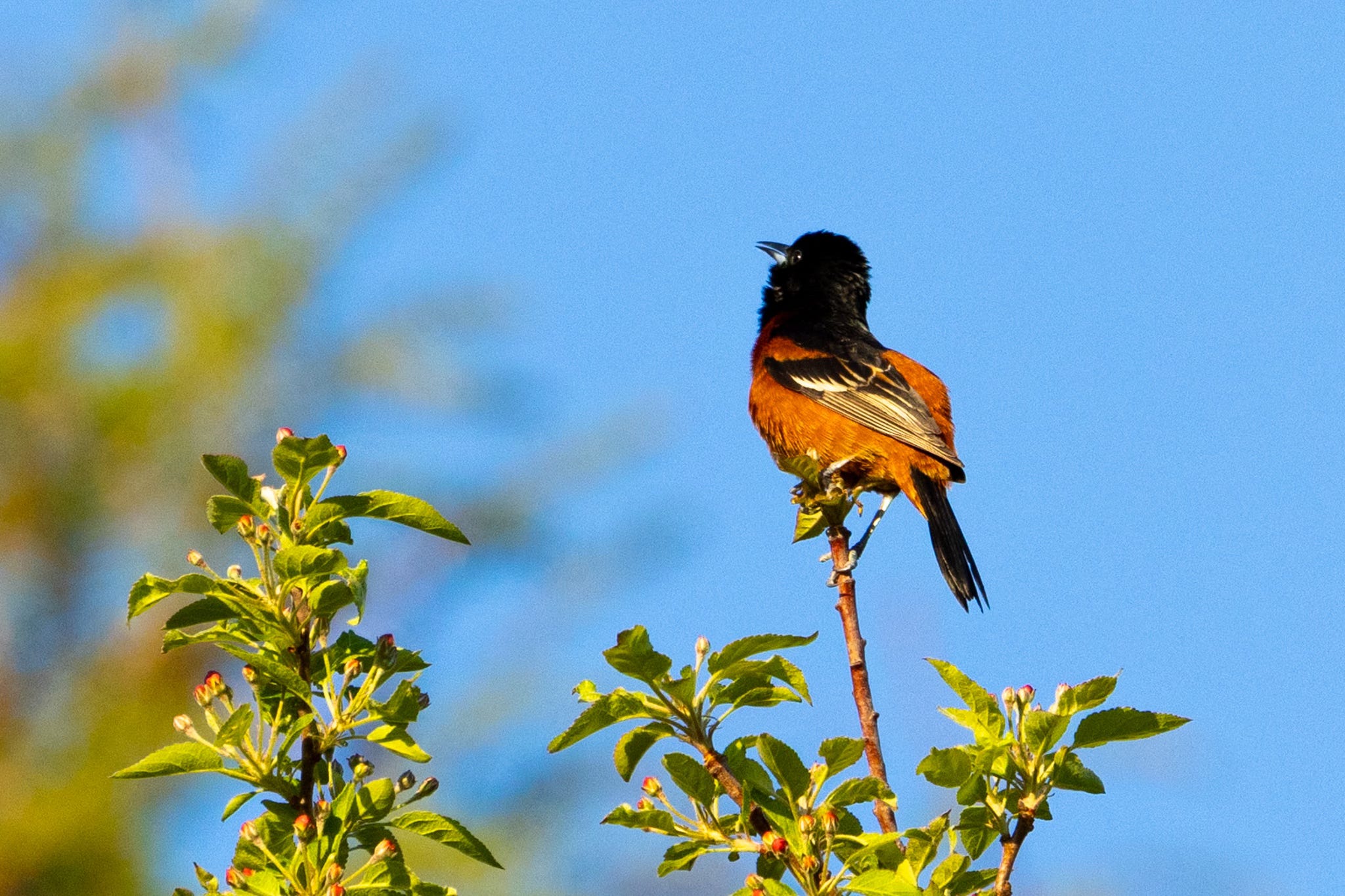
By Hap Ellis, Orchard Oriole - Arnold Arboretum, Boston, MA.
11. More on the tension between wind turbines and birds: It’s a delicate balance. Renewables need to be deployed fast to prevent ecological collapse, but they should also avoid wildlife-sensitive areas. The best and cheapest way to ensure that wind turbines don’t harm birds is to place them in the right location, away from vulnerable species and major migration routes, where impacts will be minor or easier to mitigate. Sensitivity maps, a tool that helps identify areas to be avoided, are gaining popularity across the industry and governments. And BirdLife is leading the way in developing these spatial tools. (via BirdLife)
12. Bird-friendly architecture: Every spring and fall, millions of migratory birds cross the American continent along major natural corridors known as flyways. These flyways connect ecosystems, economies, and cultures from the Arctic to Patagonia, stretching like invisible highways over mountains, rivers, and coastlines and guiding the movement of entire flocks across the continent. Although some species undertake extraordinary nonstop flights, for many others migration occurs in stages, with successive stops to rest and refuel; in fact, the cumulative time spent at these stopover sites can exceed the total time in flight. But when these stops occur in urbanized landscapes, birds must face additional obstacles and threats. In cities located within these corridors, the risk of mortality increases dramatically. (via Audubon)
13. The "feathered serpent": There’s an Aztec king’s headdress — the last of its kind — in the collection of Vienna’s Weltmuseum Wien, made with nearly 400 iridescent emerald tail feathers from the quetzal bird, which have been stitched into a half-moon fan. So rare are the feathers and so vivid — despite being more than 500 years old — that the artefact, reputedly from Mexico, is reportedly worth $50m (£38m). Yet nothing could possibly trump the real bird in front of me. “They used to call it the feathered serpent,” says my guide, Carlos Serrano Navarro, as we watch the bird flit between moss-cloaked branches heavy with bromeliads in the high-altitude cloud forest of San Gerardo de Dota. Its nickname makes sense: the quetzal is such a prized species for birdwatchers because of its long tail, which can reach up to a metre and give the impression of a writhing snake in flight. It’s little wonder the Aztecs and Mayans thought the quetzal so precious. (via National Geographic)
* More on the Resplendent Quetzal from Birds of the World: Species - Trogonidae - Trogons (via Birds of the World)
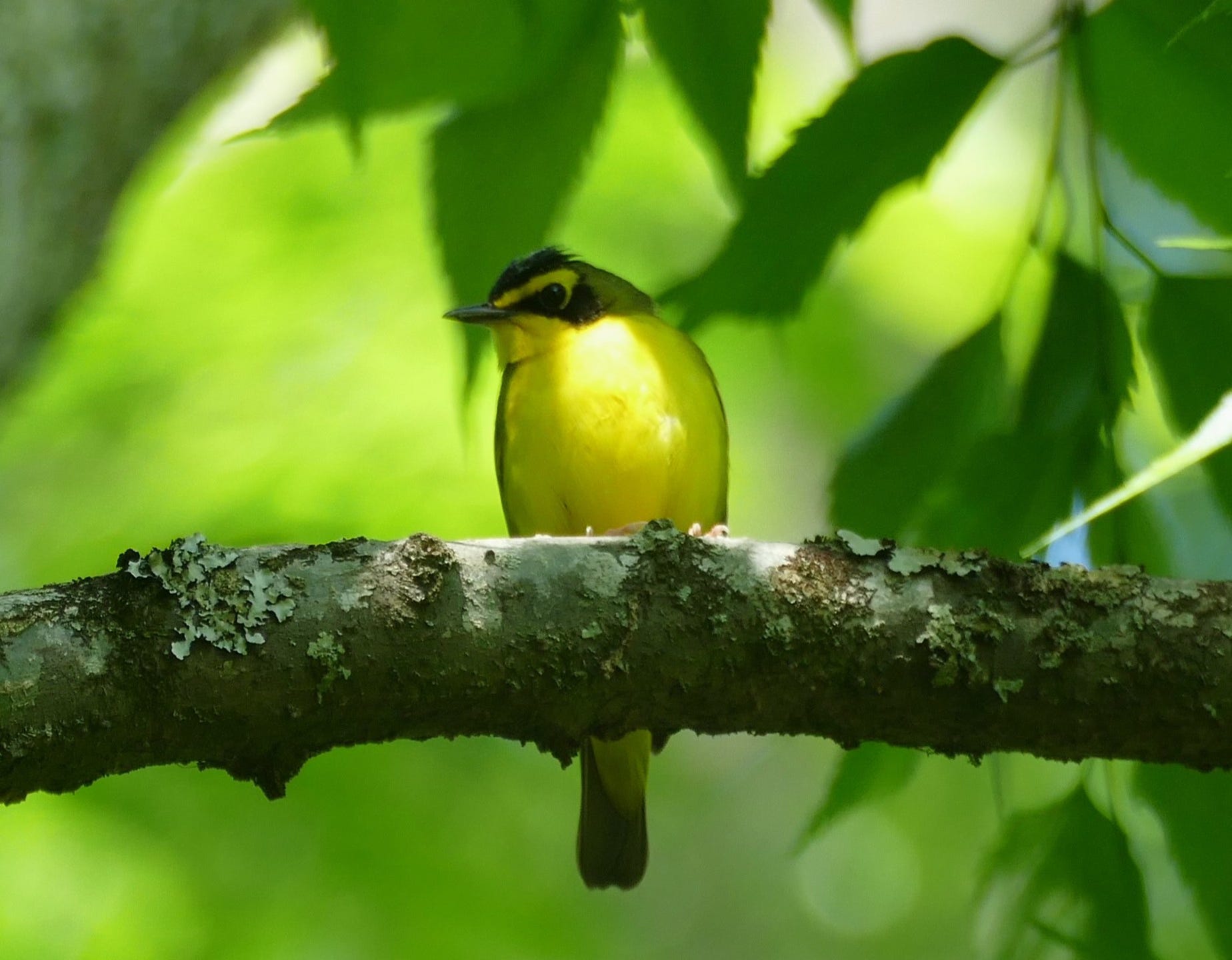
Photos From Friends: By Christopher Ellis, Kentucky Warbler - Powhatan State Park, Powhatan, VA.
14. From Minnesota, cultural teachings along the Mississippi River: Bird chirps resonate throughout the area of Wakaŋ Tipi, a site sacred to Dakota people. It’s located along the Mississippi River in east St. Paul. Lower Brule Sioux Tribe citizen Michael Tasunka Opi Kurtz is with Twin Cities-based Urban Bird Collective, an organization that supports birdwatchers of all different skill levels in their own neighborhoods. He stops to point out a brown-headed cowbird — a small bird with glossy black feathers on its body and brown feathers covering its head. The bird makes a high-pitched chirping noise. (via MPR News)
15. Finally, a look at Birdcast.org tools from Popular Science: Tonight, there will be more birds in the sky than there are people in the United States. According to Cornell Lab’s BirdCast, an estimated 373 million winged migrators will continue their journey north during the early evening hours of May 4th. Most of the activity will be visible in the South and along the East Coast, but wildlife experts are politely reminding everyone hoping to catch a glimpse of the traveling birds to make sure you’re not blinding them from below. Birds migrate for two primary reasons: food and nests. In the Northern Hemisphere, this typically means traveling north during warmer months when insects and budding plant life are more abundant. Colder seasons prompt a return south to avoid freezing temperatures, although many birds do just fine in snowy conditions. (via Popular Science)
* FYI...Birdcast estimated 352 million birds were in the air over the U.S. last night.
Go Birding!
Bird Videos of the Week

Cornell Live Bird Cam - An emerald White-vented Plumeleteer made a quick stop at the Panama Hummingbird Feeder Cam.
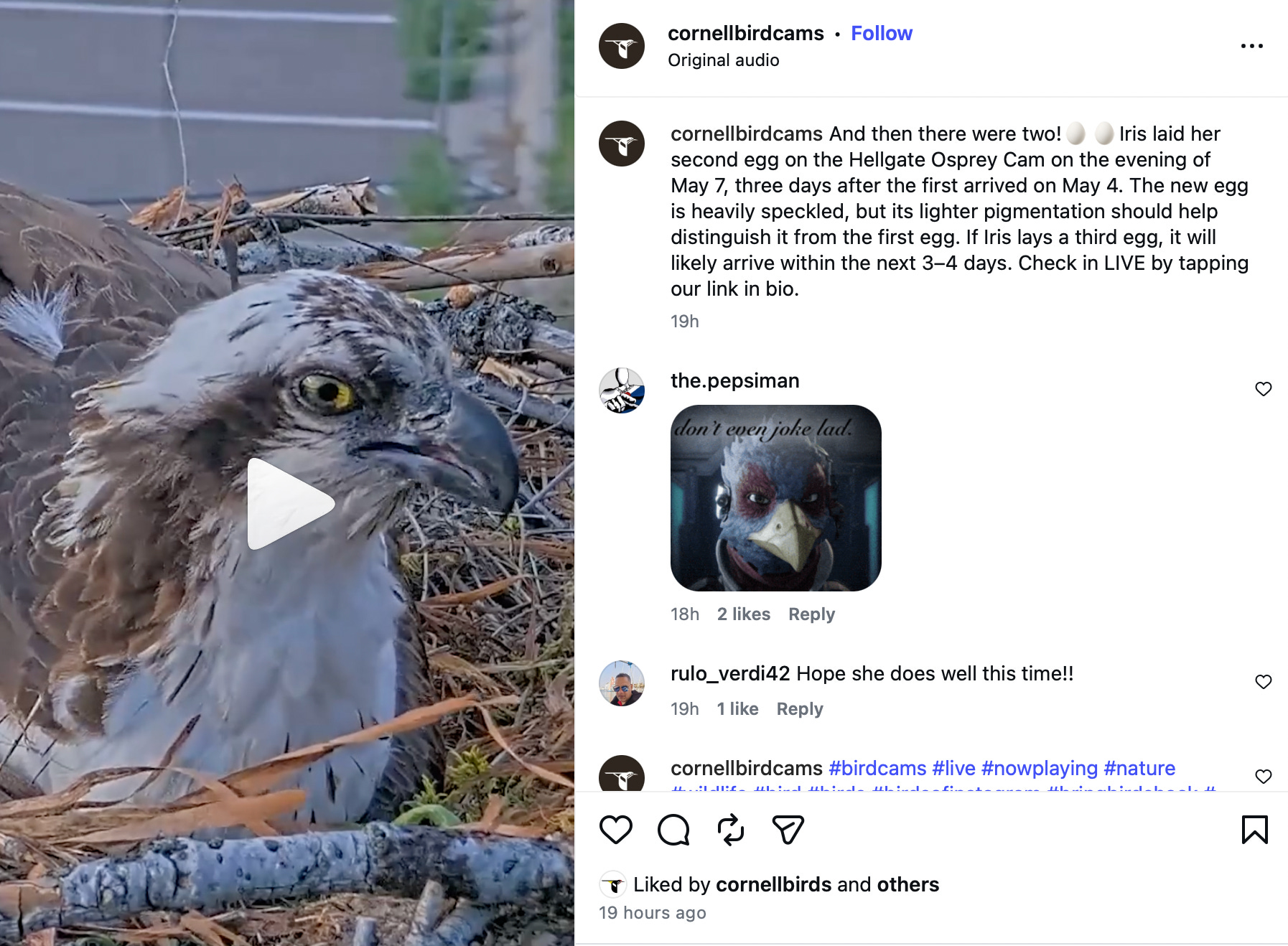
Cornell Live Bird Cam - Iris laid her second egg on the Hellgate Osprey Cam.