
Frozen Flight.
Bird News Items
Correction: “OOPS!” We inexplicably misnamed the King Penguins in the first two pictures. They are obviously Kings. The search for the guilty continues!!
Happy February!
1. A major new online tool from Cornell's Lab of Ornithology: The Cornell Lab of Ornithology today announced the release of a new online tool for studying biodiversity and the evolutionary relationships among birds: the illustrated Birds of the World Phylogeny Explorer. Available on Birds of the World, the Phylogeny Explorer offers a captivating experience for exploring avian evolution, discovering closely related species, and grasping the timescales at which they evolved. Understanding avian ancestry, what scientists call phylogeny, is a fundamental aspect that underpins most ornithology research. But with more than 11,000 bird species in the world, organizing the available phylogenetic trees into a single synthetic depiction, and keeping it current, has long challenged ornithologists. The Birds of the World Phylogeny Explorer uniquely addresses these challenges by staying current with the latest research. (via Phys Org)
2. American Bird Conservancy's look at bird conservation policy: If you care about birds, you probably already know that they’re in trouble. The threats they face, just at the federal level, are staggering: Current bills and rule-makings propose weakening the Endangered Species Act, National Environmental Policy Act, Roadless Area Conservation Rule, Northwest Forest Plan, and the Greater Sage-Grouse national conservation strategy, all at the same time. This is happening against the backdrop of federal agency staff reductions and proposed program cuts. The loss of knowledgeable and experienced experts and the slashes to program budgets have greatly diminished the capacity of federal agencies to carry out conservation projects. Maintaining current funding and staffing levels is crucial for bird conservation work to continue. (via ABC Birds)
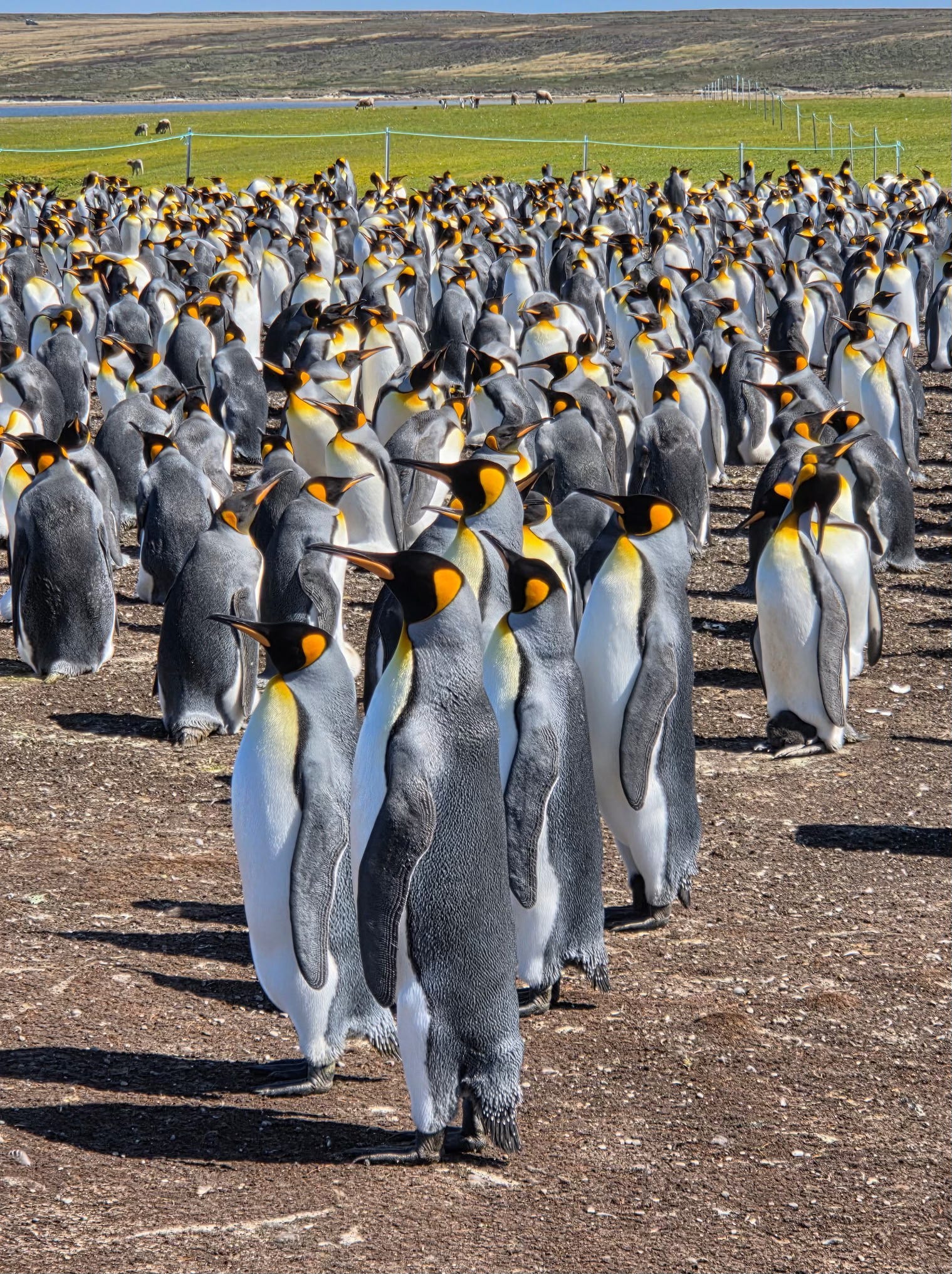
Pictures from Friends by Doug Doolittle, King Penguins - Falkland Islands.
3. Bald Eagles are flourishing in Alberta: At southeast Calgary’s Carburn Park, it took local naturalist Brian Keating practically no time to point out two bald eagles by the river. “They’ve been here nesting in this part of Calgary for years and years,” Keating said of this particular pair. “And it’s pretty well assured that you’re going to see an eagle when you come down to this park.” Seeing bald eagles in Calgary comes as no surprise to Keating, who says the Bow River offers an ideal habitat for them to stay in the city year-round. And spotting the iconic birds of prey, with their unmistakable plumage, is becoming more commonplace across the province as eagles expand their habitat and populations soar thanks to conservation efforts. (via CBC)
4. Who needs an intelligent bird-deterrence system? Oysters!: Virginia ranks first in the nation in eastern oyster production, but growers face an emerging challenge to meet federal sanitation requirements related to bird interactions. Addressing this issue has become a shared priority across aquaculture research, regulation and industry. Now, a new collaboration between Old Dominion University and William & Mary aims to deliver a solution that works for farmers, regulators and wildlife alike. By integrating autonomous systems, artificial intelligence and environmental science, the team will design and test an intelligent bird-deterrence system that protects shellfish farms while minimizing disruption to surrounding wildlife and coastal communities — a potential solution that helps sustain both Virginia’s oyster industry and the many ecosystem services oysters provide. (via William & Mary News)
5. From down under - spinifex "igloos" and a ghost bird is heard: For most of the 1900s, the night parrot felt like a rumor with feathers. It lives in Australia’s arid interior, hides in thick grass by day, and mostly speaks after dark. So how do you protect something you almost never see? New fieldwork on Ngururrpa Country in Western Australia suggests the bird is not just hanging on. Researchers and Indigenous rangers detected night parrots at 17 of 31 survey sites and estimate there could be at least 50 individuals in the area, making it the largest known population so far. Between 2020 and 2023, teams used weatherproof acoustic recorders to capture nighttime sound across dozens of sites. The idea was simple: if you can’t spot the bird, let the bird reveal itself by voice. (via Eco News)
6. For you listers among us, this is impressive: Julian Johnson didn’t even consider himself a birder until a couple of years ago, but the UC Davis undergraduate student broke the Yolo County Big Year record for birding in 2025. He recorded 275 species while spending more than 1,000 hours birdwatching in the country last year. His achievement came just months after a UC Davis team broke the” Big Day” record for Yolo County. I caught up with Johnson, who is majoring in environmental science and wildlife biology, at the Woodland Wastewater Treatment Plant, which he visited 134 times while birding in 2025. (via U.C. Davis)
7. Hard to believe there is any research on bird survival in Ukraine, but there is: During times of war, our primary concern is humans. A prolonged conflict, such as the war in Ukraine, takes a tremendous toll on lives, well-being, and finances. But other species suffer the blows of battle too, with potentially lasting consequences. A study published in The European Zoological Journal reports on the Ukraine war’s impacts on birds. With 21 percent of bird species already vulnerable to extinction, the study authors argue that exposure to military conflict is “a significant, yet under-recognized, contributor to avifaunal decline.” Like humans, birds are loyal to their homelands, establishing territories that offer the resources they need and define their spheres of movement. Even migratory birds typically return to the same places year after year to breed and raise families. Although birds can theoretically fly away from the dangerous conditions of war, their “site fidelity” may limit escape responses, akin to how people stay in their homes even as their neighborhoods become conflict zones. (via Nautilus)
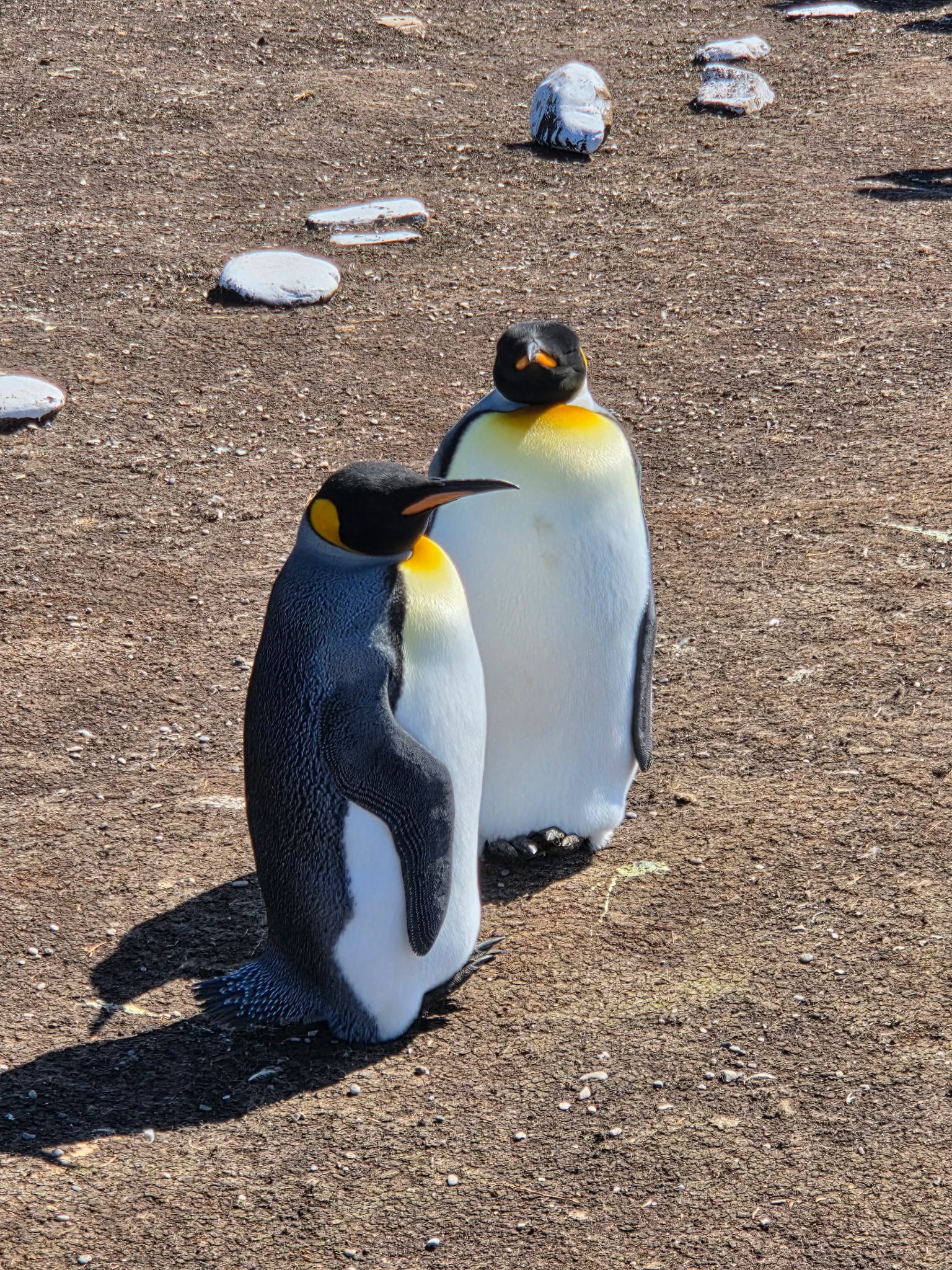
Pictures from Friends by Doug Doolittle, King Penguins - Falkland Islands.
8. Check your feeders during these cold snaps, says this favorite columnist: I know I always yell at you to get outside to look for birds, but apparently, we now live in Buffalo, New York, and will be waist deep in snow until May. Throw in the frigid temps, and even I have to admit that this may be a week to hunker down and watch the feeders. The feeders may be where all the birds are, anyway. Some of the bay beaches are iced out a half mile like it’s Point Barrow, Alaska, and the songbirds that prefer feeding on the ground are swallowing their pride and hitting the feeders due to the snow. The suet is my most productive offering when it comes to some of the more interesting birds, like warblers and bluebirds. (via Cape and Islands NPR)
9. This cold snap takes its toll on birds too: Recent extreme cold and heavy snowfall in Connecticut have left many juvenile birds of prey—such as owls and hawks—struggling to survive. Young raptors in their first winter often lack the skills needed to hunt efficiently or find adequate shelter, making them especially vulnerable to hypothermia and starvation. As snow blankets the landscape, prey becomes harder to find, forcing weakened birds to expend more energy and, in some cases, lose their grip and fall from trees. Wildlife rescue organizations have responded to multiple reports of grounded raptors suffering from cold exposure. If a bird is found on the ground, experts advise placing it in a ventilated box, keeping it warm, and contacting a licensed wildlife rehabilitator as soon as possible. (via i95 Rock)
10. For those in more temperate climates, birds can still use your help in winter: The sun may shine here in the Central Valley most of the winter, but the temperatures are still cold. While we can live comfortably in our cozy, warm homes, our feathered friends need some help keeping warm and fed during the winter. Birds need three things to help them survive during the colder month: shelter, food, and water. By providing them with these essentials in our yards, you can help them to thrive during these chilly days. (via U.C. ARN)
11. Another look at an evolutionary riddle: Lipstick vines get their name from their bright red, tube-shaped flowers. But one member of this group of plants has lost its lipstick-like appearance— its flowers are shorter, wider, and yellowish green in color. It also attracts shorter-beaked birds than its crimson cousins do, and it’s found in different places. Scientists wanted to know how this plant evolved from its lipstick-like relatives. After observing birds visiting hundreds of plants and examining the plants’ DNA, the researchers found that the story of the green flower’s evolution contradicts a long-standing scientific “rule” about how plants evolve into new species. (via Eureka Alert)
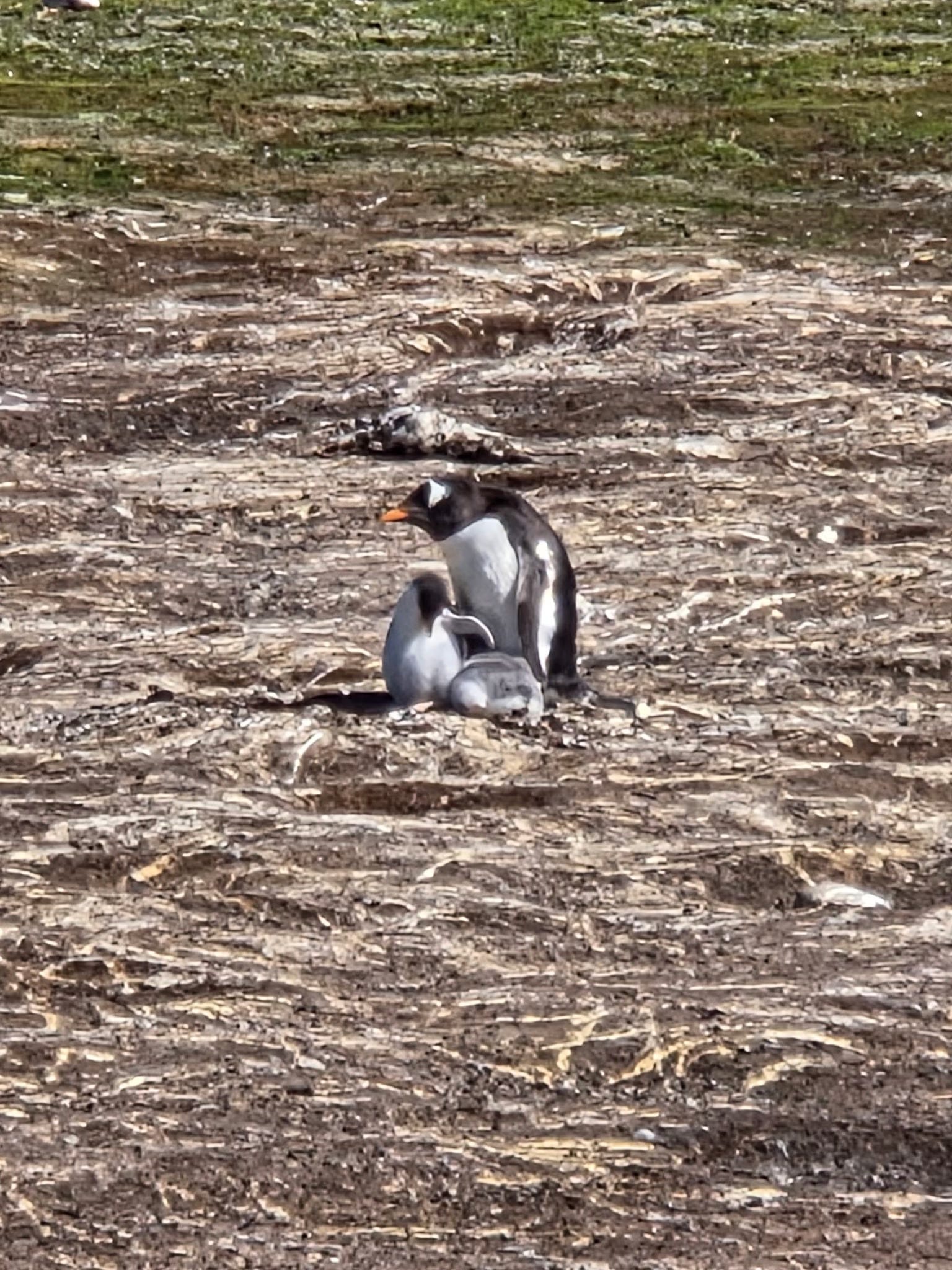
Pictures from Friends by Doug Doolittle, Gentoo Penguin - Falkland Islands.
12. A lot of New England birders ask this question: I’ve seen a lot of evening grosbeaks in my life, but my latest sighting was a doozy. On a coastal road near Passamaquoddy Bay, there was a tree with so many birds in the branches, no more could fit. It was standing room only. The adjacent tree was equally full. Just down the road, a third tree had barely enough room to squeeze in a few more. It’s been 60 years since I’ve seen so many evening grosbeaks gathered in one place. It was a commonplace sight in my boyhood. Another big wave swept through Maine in the late 1980s. Then they mostly disappeared from our state. What happened? The usual answer is loss of suitable habitat and dwindling food supplies. But these are unusual birds. The evening grosbeak is enigmatic — with a mysterious past. (via Bangor Daily News)
13. Another good article on that study of dark-eyed juncos on the UCLA campus that we covered last week: Dark-eyed juncos are the subject of a new PNAS study, which shows that juncos at the University of California, Los Angeles, campus have developed beaks that are shorter and thicker than their wilder, nonurban cousins, whose beaks are longer and thinner. The culprit for these changes might be human activity. In 2018, study authors Pamela Yeh, an evolutionary biologist at UCLA, and Eleanor Diamant, assistant professor of biology at Bard College, began banding and measuring dark-eyed juncos on the UCLA campus and in the wildlands farther out to study their breeding behaviors. Then the pandemic hit. The Covid shutdown that upturned lives everywhere left the campus empty and disrupted their research. It also presented an opportunity: How would the urban dark-eyed juncos change without human influence? (via Sierra Club)
14. Speaking of juncos, "Junco Junkies" turned this columnist around: In my column two weeks ago, I mentioned that I wasn’t fond of dark-eyed juncos. Much to my regret, I called them “drab” and “soot black.” Readers quickly gave me an email earful. One reader said he was disappointed that I didn’t appreciate these winter birds. Yikes! I know folks love juncos, but I never realized how many junco junkies are out there, and how observant they are. To make amends (and to eat crow, so to speak), I asked North Jersey birders on Facebook what made them junco mavens, and the response was well-nigh Shakespearean. How do they love juncos? Let them count the ways. (via New Jersey Herald)
15. From the Adirondacks, birds and loss: Do birds grieve? For humans, grief, caused by the death of a loved one, can involve many emotions including deep sorrow, great sadness, despair, guilt and even anger. Witnessing a bird lose a mate, flock member or offspring can cause sadness and heartbreak in us, but how does the bird feel? Scientists caution people from anthropomorphizing our feelings onto other animals. Without studying a bird’s hippocampus, the area of its brain involved with emotion and stress responses, while it suffers a loss, it is difficult to determine how it’s feeling. What we can do, however, is describe the behavior of birds that experience loss without making assumptions. Over the years, I’ve had the opportunity to observe birds react to loss. I’ll share some of these observations. (via Adirondack Explorer)
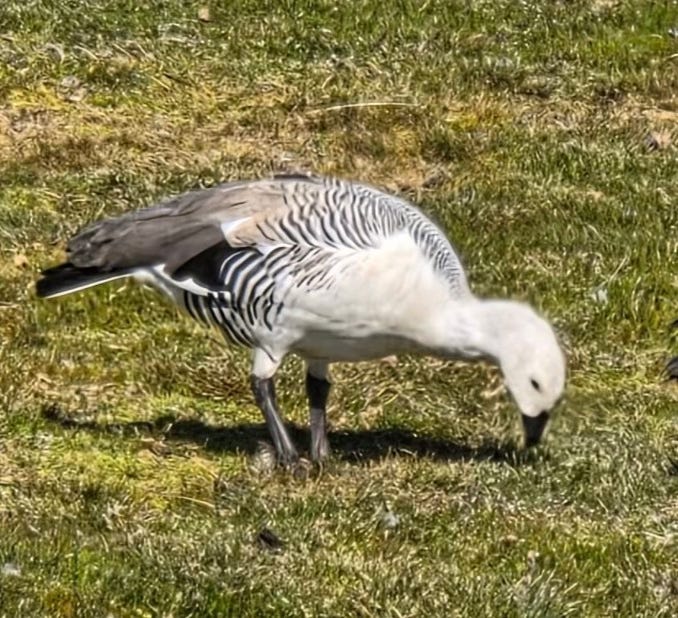
Pictures from Friends by Doug Doolittle, Upland Goose - Falkland Islands.
16. Books: Put this in your back pocket if you are birding in eastern Oregon and Washington: Many sing the praises of Oregon’s natural beauty found between the coastline and Central Oregon. Meanwhile, the allure of eastern portion of the state, home to the deep canyons of the Owyhee River, the alpine scenery of the Wallowa Mountains, the massive Steens Mountain and neighboring Alvord Desert, is sometimes forgotten. Biologist Tamara Enz considers the eastern portion of Oregon and Washington among her favorite places. “It is such a spectacular area and there’s so much to see. So many people dismiss it as just desert or agriculture or fairly uninteresting landscape, but it’s so fascinating and there are so many nooks and crannies and pockets of habitat,” she said. (via Bend Bulletin)
17. Movie review: 'H is for Hawk' review: A woman struggling after the death of her father turns to a pet hawk for companionship in “H is for Hawk,” an emotionally raw story about grieving and learning to move on that refuses to tidy itself up like so many stories told in a similar vein. Claire Foy plays Helen, who spirals emotionally after the death of her photographer father, Alisdair (Brendan Gleeson). Lost, Helen adopts a goshawk and throws herself into the world of big bird ownership, gloves and all. (via The Detroit News)
Bird Videos of the Week
Video by BBC, “How Baby Flamingos Get Their Pink Color”.

Cornell Live Bird Cam - Collared Aracari.

Cornell Live Bird Cam - Lunchtime.