
Ocean Wanderers.
Bird News Items
1. Let’s start with the BirdLife International’s report on the World Coastal Forum in Yancheng, China: As you read this, millions of shorebirds are taking to the sky. These migratory birds will skirt thousands of kilometres of coastlines before reaching a warmer climate to spend the winter. But coastlines across the planet are changing quickly, whether it’s from development, pollution or climate change. That is why from September 25-27, world leaders gathered to discuss protections for these coastlines at the World Coastal Forum in Yancheng, China. The World Coastal Forum has been an opportunity to turn ideas into action. In the past several years, attendees at the World Coastal Forum have discussed and implemented solutions to resolutions proposed at both the Ramsar Convention and the Convention on Biological Diversity. One such solution has been the designation of UNESCO World Heritage Sites along the Yellow Sea. (via BirdLife)
2. A billion bird night - check this out: Weather radar can tell us how to dress for the day or if rain will ruin your weekend cookout, but for bird experts, it also reveals a treasure trove of data about bird migration. Autumn bird migration typically peaks in the northern United States in late September and early October. On Wednesday night, around 9:40 p.m. EDT, scientists estimated that 1.25 billion birds were in flight, mostly in the Southeast, where a northerly breeze behind a cold front helped birds move south for the winter. (via AccuWeather)
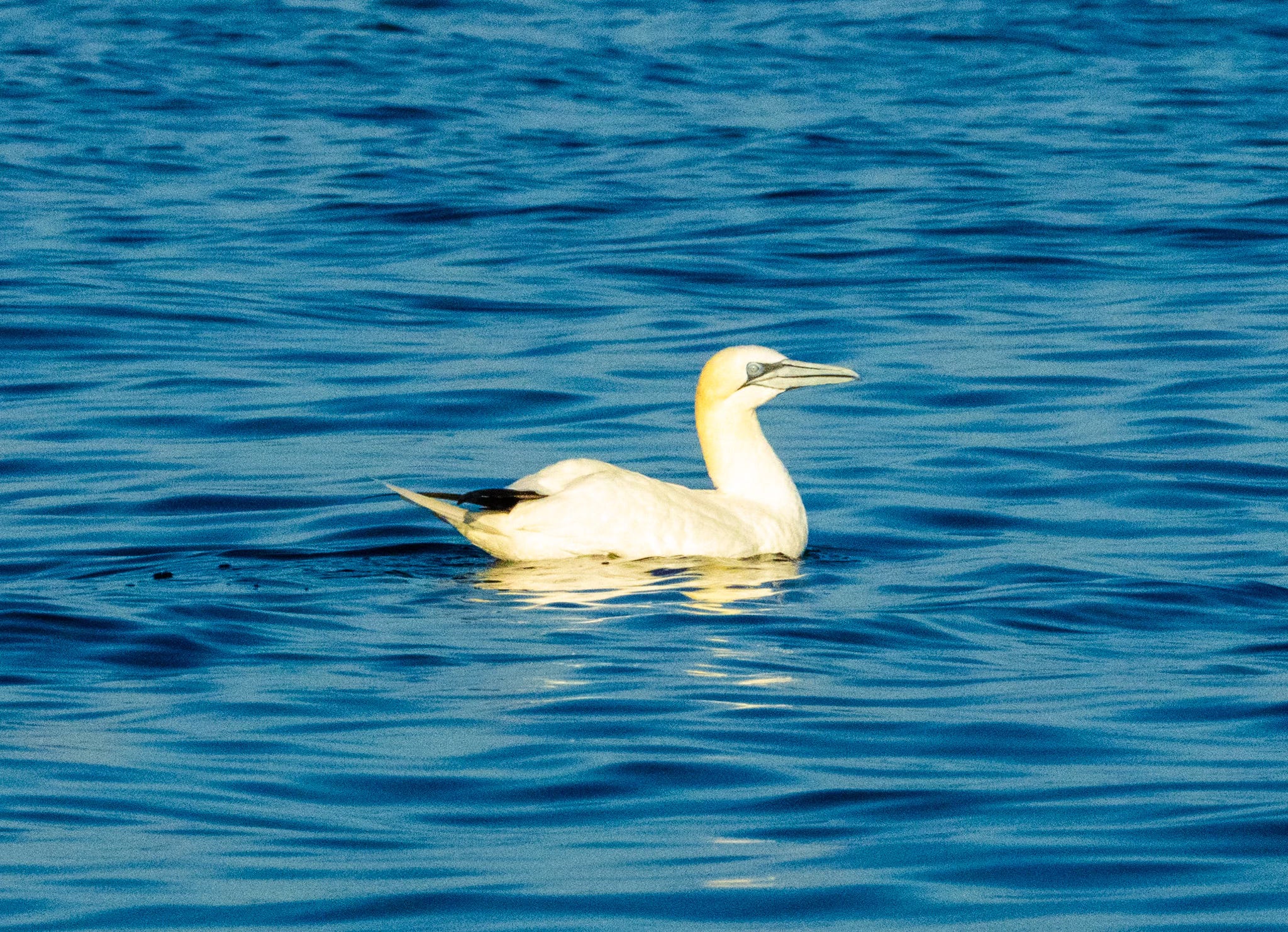
By Hap Ellis, Northern Gannet - Gulf of Maine.
3. Ominous warning: Birds throughout the US have adopted a disturbing habit that could have devastating implications for human society if it continues. Researchers have found that birds are abandoning their usual migration patterns, with warmer temperatures in their winter habitats disrupting their annual flights. While delaying their yearly flight south may not sound like a major problem, a visiting scientist at Cornell University, Andrew Farnsworth, warned that it could lead to many bird species dying out and drastically altering nature. Birds play an important role for people because they help control pests, spread seeds, and pollinate plants. (via DailyMail)
4. The vocal warnings heard ‘round the world: Charles Darwin suggestedin 1871 that spoken language originated with instinctive sounds, like squeals or yells, which humans then learned to imitate and modify for specific purposes. Now, scientists say groups of birds around the world may be proving him right. A new study published last week in Nature Ecology & Evolutionfound that 21 different species of birds, spanning several continents and millions of years of evolution, make nearly identical sounds as a warning against brood parasites—species that force others to raise their young. “This indicates that the function of this vocalization is to facilitate a communication across species rather than just within,” saysWilliam Feeney, co-lead author of the study and an evolutionary ecologist at Doñana Biological Station in Spain, toNew Scientist’s Chris Simms. (via Smithsonian Mag)
* Another take from Cornell: Birds separated by vast geographic distances and millions of years of evolution share a remarkably similar learned vocal warning to identify parasitic enemies near their nests, an international team of researchers has found. The results represent the first known example of an animal vocalization that is learned from an innate response shared across multiple species. The findings, published on October 3 in Nature Ecology and Evolution, provide a glimpse into the role natural selection can play in the evolution of vocal communication systems. The study, led by researchers at Cornell University and Donana Biological Station in Seville, Spain, is one of the largest and most comprehensive studies concerning brood parasites to date. (via Cornell University)
5. Surprising!: Tree swallows in polluted U.S. regions are accumulating high levels of “forever chemicals.” These durable pollutants, used in firefighting foams and consumer products, are found everywhere from soil to human blood. Surprisingly, researchers observed no significant impact on the birds’ reproduction, suggesting possible resilience in wild populations. (via Science Daily)
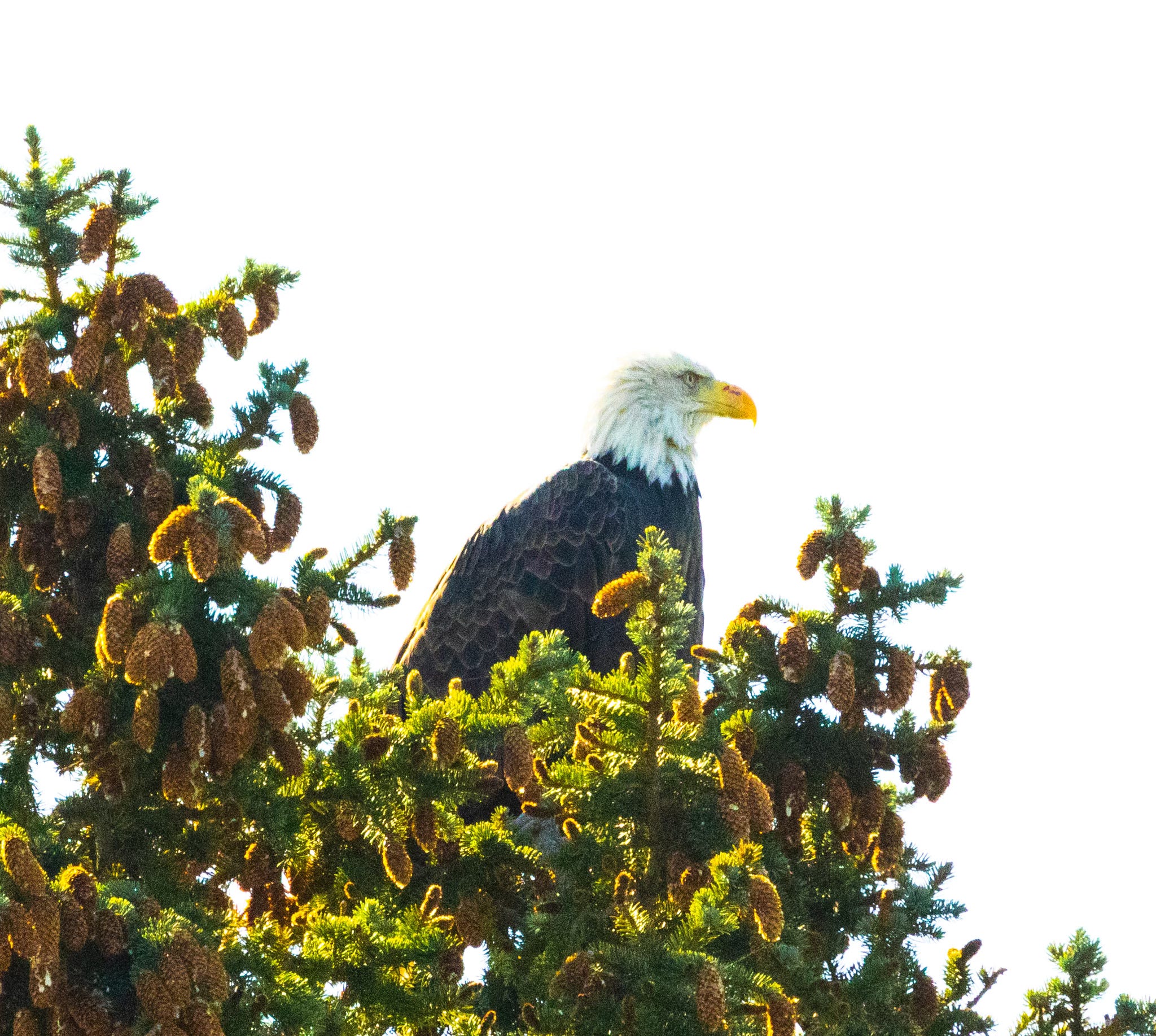
By Hap Ellis, Bald Eagle - Kennebunkport, ME.
6. What it takes - in this case, to protect nesting Least Terns: Prior to this summer, I never gave much thought to how birds find shade on scorching beaches. On bare beaches, even a few degrees can make the difference for chicks between survival and death. This past summer, working as a Coastal Outreach Intern on the North Shore of Long Island, I had the opportunity to contribute to a study on Least Tern chick’s shelter use. Audubon’s coastal staff in New York has been monitoring nesting shorebirds on Long Island for over a decade, including Least Tern colonies along the North Shore at Stehli Beach. The study would assess the use of shelters by Least Tern chicks, and the frequency of use, to aid in protecting them from increased temperatures and predators. (via Audubon)
7. Yikes! New paper in Science reveals large bats preying on migrating birds: During spring and fall migrations, billions of birds take to the night skies. The high-altitude darkness protects them from predators. Well, most predators. New research shows an unlikely creature can successfully hunt these migrating animals. It’s a bat. Ina paper published Thursday in the journal Science, researchers detailed how the largest bat in Europe, the greater noctule bat, nabbed a European robin, before chewing and eating the prey in flight. This stands in stark contrast to the bats’ typical diet of insects. (via The New York Times)
8. Audubon at Climate Week: What’s good for birds is good for people and the planet. That was Audubon’s guiding message during this year’s Climate Week in New York. The annual global platform for climate action sees thousands of leaders gather for conferences, meetings, and events throughout the city, concurrent with the annual meeting at the United Nations. As a leader in conservation for 120 years, Audubon highlighted how we can collaboratively make progress on climate change and biodiversity loss while halting and ultimately reversing bird population declines, or “bending the bird curve.” (via Audubon)
9. Bird flu update: It was a quiet summer for bird flu: Egg prices fell a bit, fewer sick poultry flocks were culled on farms, and officials took a breath. “It was lovely,” said Shauna Voss, the assistant director of the Minnesota Board of Animal Health. But it didn’t last. Bird flu is spreading again, now that wild water fowl — geese, ducks and cranes — have begun their seasonal migrations. As the birds travel, they mingle at lakes and ponds and share viruses. In poultry, bird flu cases are spiking earlier than expected. More than 4 million poultry birds have been culled in the last month, in states including Minnesota and Iowa, after members of their flock tested positive for the virus, called H5N1. The trend corresponds to a spike in infections detected among wild birds in northern states. (via NBC News)
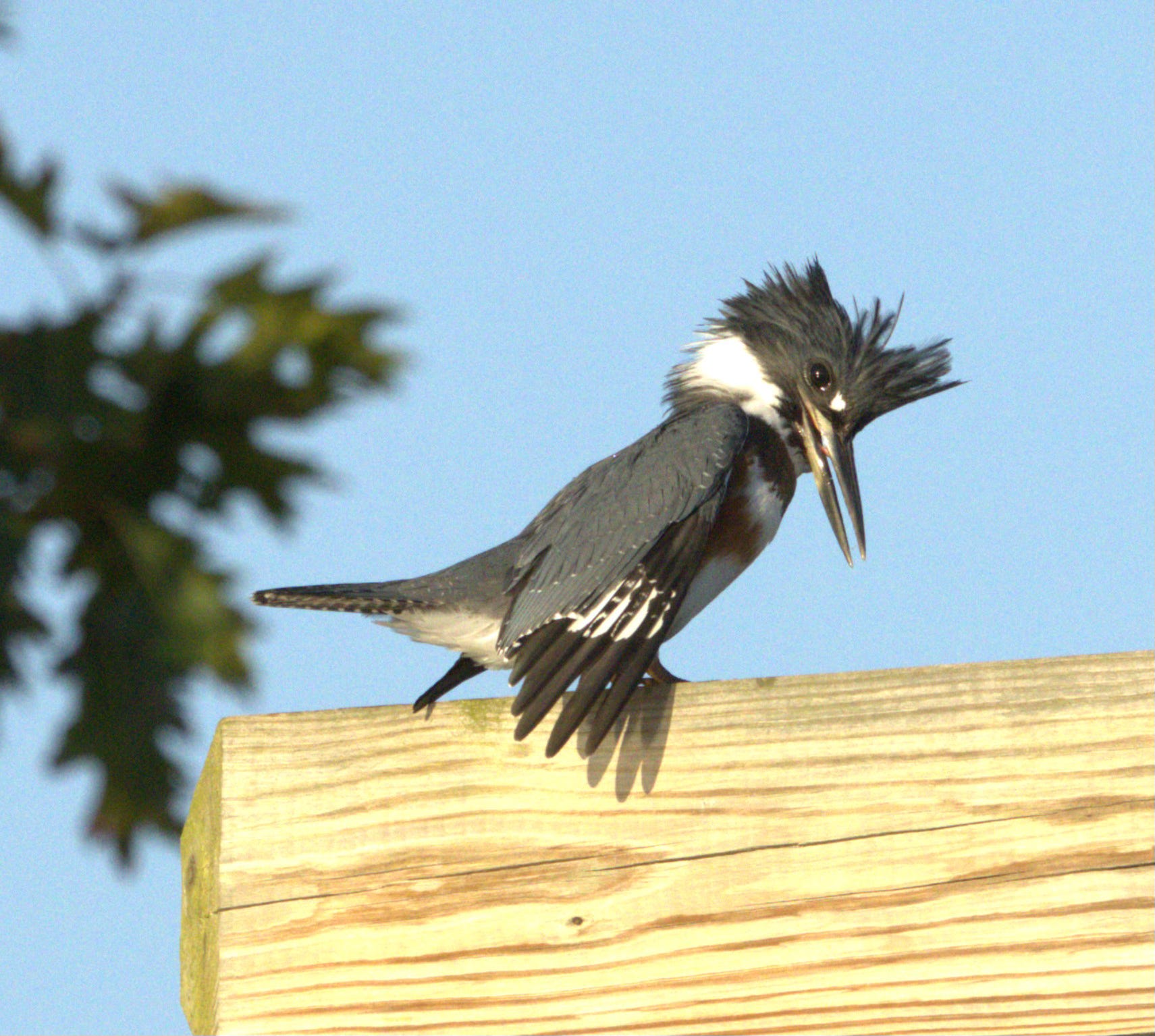
By Hap Ellis, Belted Kingfisher - Kennebunkport, ME.
10. Protecting migrating birds one university at a time: This fall, American University students, faculty, and staff are turning theHall of Science into a safe haven for migrating birds. What started as student-led concern over bird strikes—when birds mistake reflective windows for open sky and crash into them—has grown into a collaborative project that reflects AU’s values of sustainability, innovation, and civic responsibility. The effort is led by Biology Professor Chris Tudge, the Birders of AU, theOffice of Sustainability, and dozens of student volunteers. Together, they’re applying small patterned decals to one of the Hall of Science’s expansive glass walls. These simple markings break up reflections so birds recognize the glass as solid, which prevents deadly collisions and keeps AU’s campus a safe stopover on their long migration journeys. (via American University)
11. More universities making news - this from Indiana University: Total solar eclipses only happen in the same spot once every 300 or 400 years, so it’s no surprise that a team of researchers based at Indiana University jumped on the opportunity to use this natural experiment to better understand how light affects wild birds. Their study, led byLiz Aguilar, was published in the latest edition of Science. Aguilar is a Ph.D. student inKimberly Rosvall’s lab in the Evolution, Ecology and Behavior program in the College of Arts and Sciences at IU Bloomington. In a large collaboration spanning the continent, including the Luddy School of Informatics, Computing, and Engineering, researchers discovered that even when night comes at the wrong time of day and only lasts for about four minutes, many bird species sing as if it were dawn. (via Ruddy School, Indiana University)
12. Even more - This from Viginia Tech: In September through mid-October, we see peak nocturnal bird migration numbers in our area. Last night alone, 87, 400 birds crossed Montgomery County. More than 36 million have flown over our mountains this season so far. But their journey is treacherous. Virginia Tech experts Dana Hawley and Ashley Dayer explain the threats birds face during migration, and what we can do to help them get where they are going. (via Virginia Tech)
13. We like local field reports like this one: The trees at the edge of my meadow were dripping with birds, but many of them were not migrants. Instead, I found myself in a situation where the majority of the little olive-green birds were actually baby American goldfinches. They zipped around in groups that were the epitome of disorganized, youthful exuberance; a riot of frenzied energy as they pestered their parents for food. But I have learned, by painful personal experience, that there is value in the constant scrutiny of the ordinary and mundane. Every once in the greatest of whiles, a baby goldfinch turns out to be something else altogether. (via Daily Hampshire Gazette)
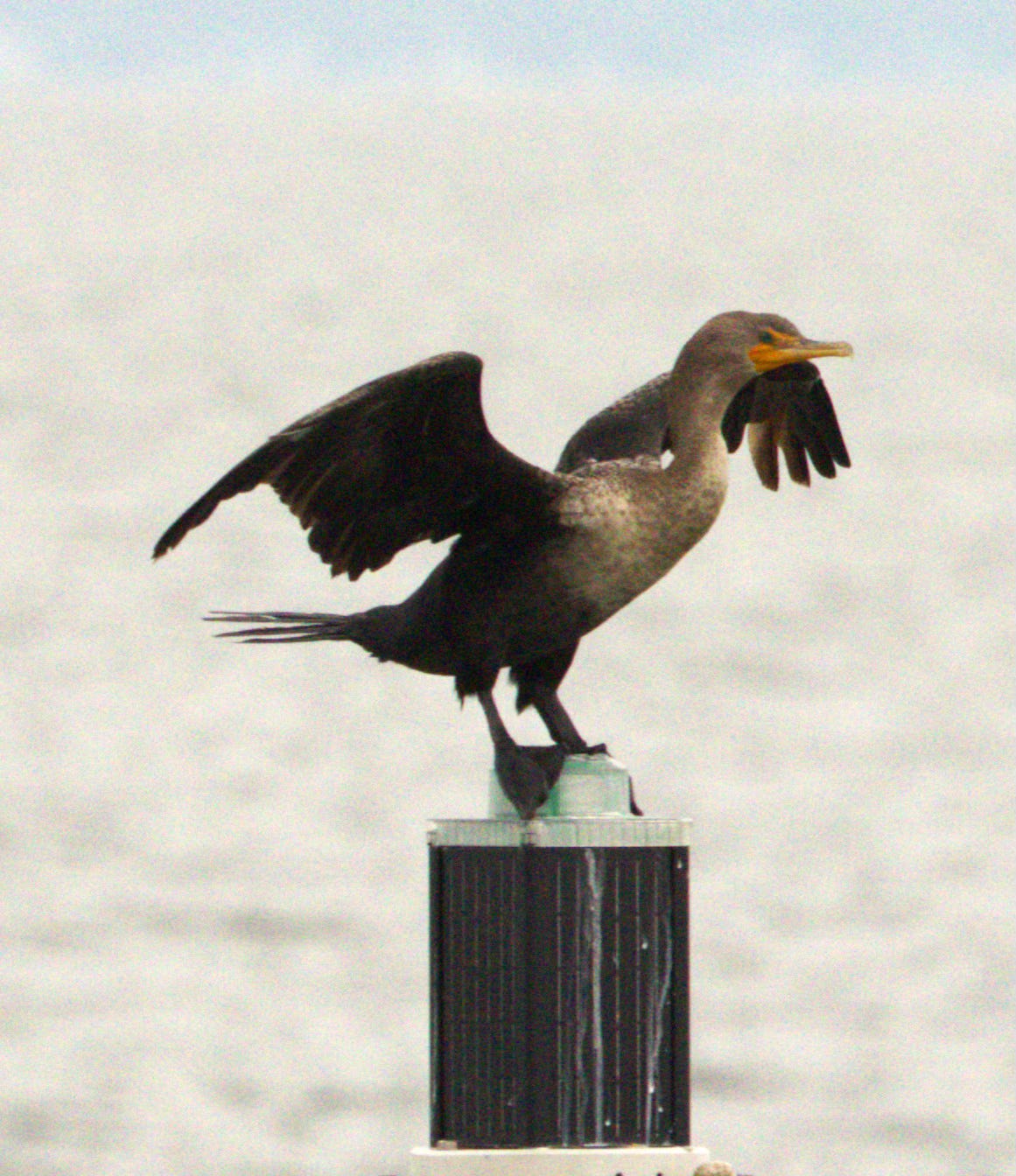
By Hap Ellis, Double-crested Cormorant - Chesapeake & Delaware Canal.
14. And this one, too, by a favorite writer on a very cool pelagic trip out of Hyannis (MA): Back on September 29, a boatload of birders clutching backpacks and sleeping bags headed out of Hyannis at dawn, bound for the continental shelf and its deep, warm water canyons some 130 miles to the south. This was an overnight pelagic trip run by the Brookline Bird Club, so they wouldn’t touch land again until the next evening. I’m sure they slept fitfully the night before, dreaming of obscure petrels and shearwaters, skuas, and maybe a tropicbird or some other exotic ocean wanderer – after all, they were paying for the chance to see mysterious and rare seabirds in these rarely birded offshore waters. And what they got, some 90 miles south of the nearest land, was hundreds of tiny migrating songbirds. (via Cape and Islands, NPR)
15. Rare Bird Alert #1 from Michigan’s UP: A bird not seen before in Michigan’s Upper Peninsula was among the songbird species seen during fall migration in recent days. The Whitefish Point Bird Observatory, which is off Whitefish Point in Lake Superior, shared the sighting of a young purple gallinule at the Whitefish Point harbor in a social media post Tuesday, calling the news a “showstopper.” “This is the first-ever record for Michigan’s Upper Peninsula — an extraordinary occurrence for a species typically found in the southeastern U.S.,” the observatory said. The arrival was part of a “substantial songbird migration event” noticed on Friday, when migrating birds flocked to and settled in around the lake. (via CBS News)
16. (Really) Rare Bird Alert #2: The sighting of a rare Cocos Booby (a species of seabird split from the Brown Booby in late 2024) in South Lake Tahoe in August stoked tremendous excitement among nature and birding enthusiasts from across the U.S.. Despite the unfortunate demise of the bird, its widespread documentation and discussion highlight the importance of citizen science, the Tahoe Institute of Natural Science (TINS) said. The Cocos Booby was first spotted fishing in the Tahoe Keys area on August 1st, and stirred up a lot of excitement in the birding community, even drawing a couple from Minnesota to see the bird. (via South Tahoe Now)
17. Finally, let’s wrap up with Audubon’s annual photo contest: The 2025 Audubon Photography Awards: Marvel at the beauty of birds and learn the stories behind our favorite images from this year’s contests—featuring, for the first time, photographers from Chile and Colombia. (via Audubon)
Bird Videos of the Week
Video by BBC, “Peacock Tries “Faking It” to Find a Mate”.
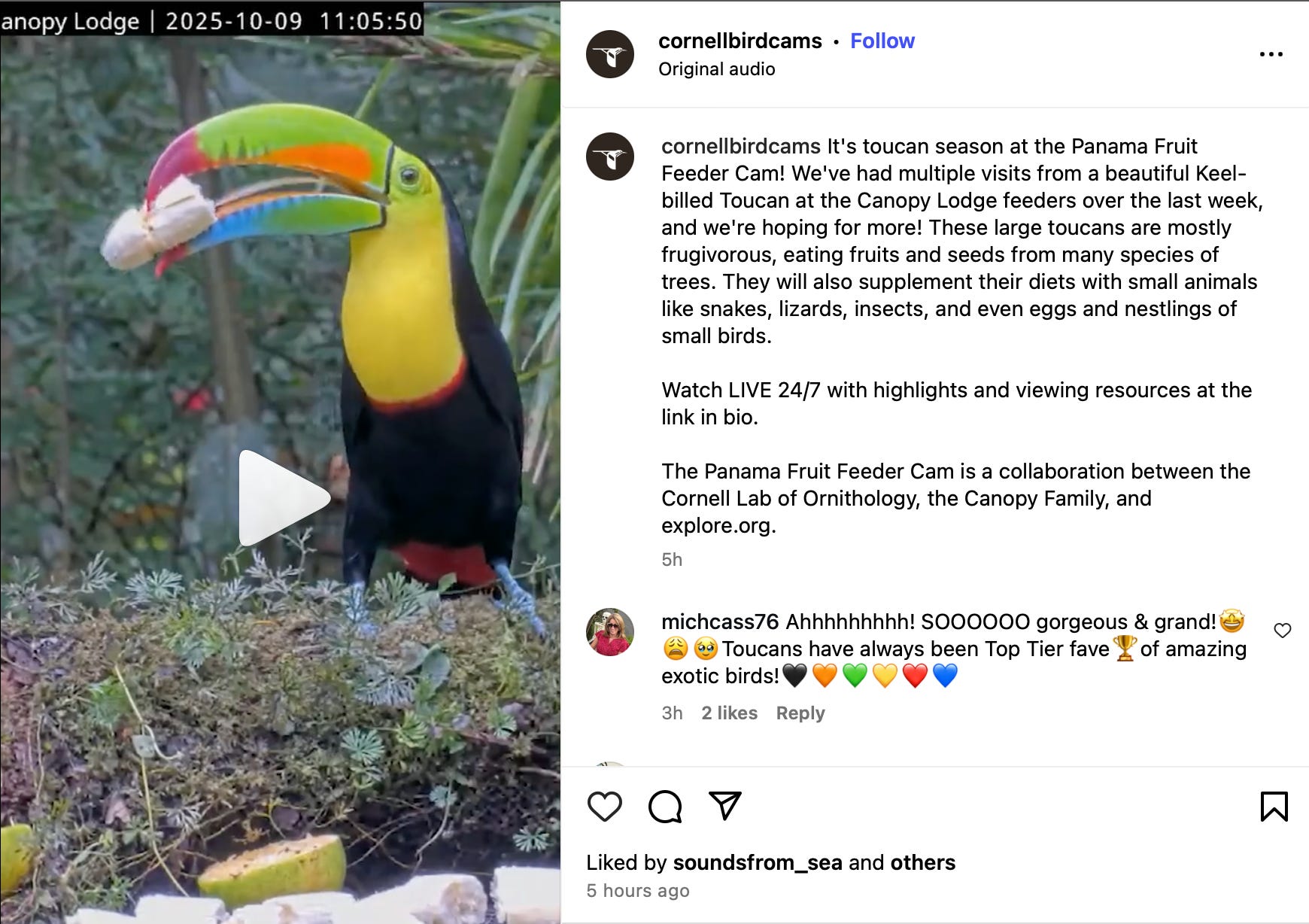
Cornell Live Bird Cam - Keel-billed Toucan.

Cornell Live Bird Cam - California Condor nestling.