
Painted Turbines.
Bird News Items
1. Let's begin with " ...a remarkable day in birding history": 9 May 2026 will go down as a remarkable day in birding history. For the first time ever, Global Big Day birders documented more than 8,000 bird species in one day, a new world record, set by the largest community of bird enthusiasts ever united for a single event. And birders didn’t just find those species—they experienced them. Participants submitted a record 100,000+ photos and doubled the number of audio recordings from the last Global Big Day. Half of all species found on Global Big Day (4,035) were documented by photo, 2,089 species were recorded by sound, and 695 by video, preserving a rich and lasting archive of the natural world to commemorate the occasion. (via eBird)
2. The bird retina - "...a complete paradox": The retina is one of the body’s most energetically expensive tissues. Built from complex networks of sometimes more than 100 different types of neurons, retinal tissue consumes two to three times more energy than the same mass of typical brain tissue. That’s why most vertebrate retinas, including our own, are furrowed with dense, branching networks of blood vessels: to deliver oxygen and other ingredients for producing energy. But there’s a significant exception to this rule. Birds have retinas that mostly lack blood vessels. This may seem especially strange given birds’ exceptional vision. The bird retina is “one of the most metabolically active tissues in the animal kingdom, yet it worked with no apparent blood perfusion,” said , an evolutionary physiologist at Aarhus University. “It was a complete paradox.” For centuries this has puzzled scientists, who figured that the bird retina must obtain oxygen through a unique, undiscovered process. (via Quanta Magazine)
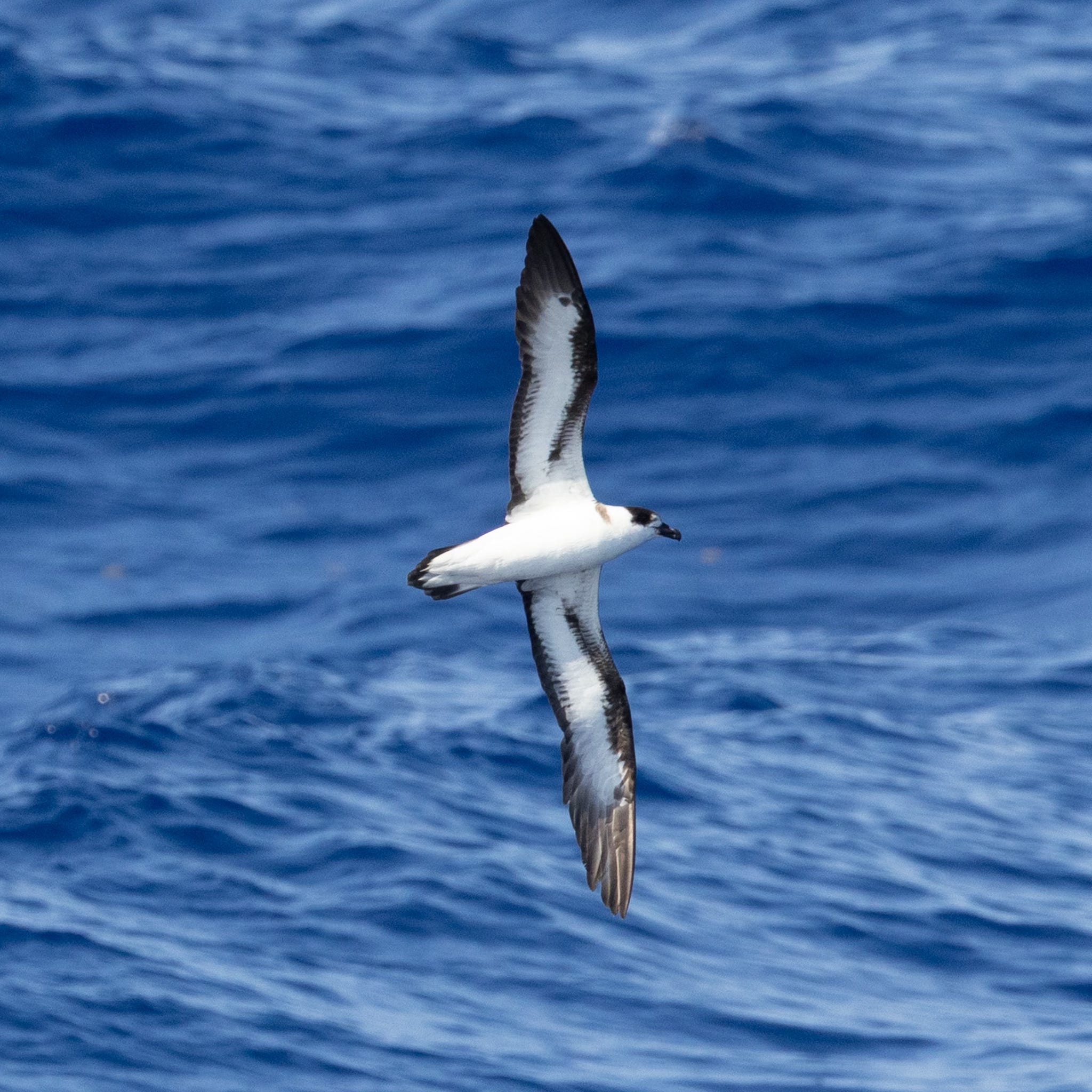
By Hap Ellis, Black-capped Petrel - North Atlantic off Charleston SC.
3. A look at fires in the Arctic: Right now hundreds of millions of birds are making their annual trek to settle down in their northern breeding grounds. As they fly hundreds to even thousands of miles, they stop occasionally to refuel—delighting birders as they go. Horton’s lab and the BirdCast collaboration use radar data to study bird migration patterns and generate a number of bird tracking maps that give birders a glimpse into how many birds are on the move—and offer Radar systems send out radio waves and then record any energy that is reflected back to their receivers. Information about how long it takes for the signal to return to the receiver is used to calculate how far away something is from the radar tower. Just like radar beams reflect off of the water droplets in brewing storms, they reflect off migrating birds. (via New Scientist)
4. Hantavirus latest - Don't blame Ushuaia say these birders: The hantavirus outbreak on a cruise that departed from Argentina last month has cast an unwelcome spotlight on Tierra del Fuego, a region well known for its biodiversity and bird-watching, authorities and guides say. Now, bird-watching may be at the epicenter of the outbreak on board the MV Hondius, in which three people have died and five others were sickened. The World Health Organization has said the first person with a confirmed case may have been exposed to rodents — which can carry hantavirus — while on a birding trip. The farthest stretches of the South American continent are a strong draw for bird-watchers. (via NBC News)
5. The honeycreepers who are quilty of "nest material kleptoparasitism?": When Mauna Loa erupted in 1885, it enveloped native forests on the island of Hawaii in a layer of basaltic lava flow. The magma eventually cooled, sparing a mosaic of scattered forests known as kīpukas that today are home to a unique set of forest songbirds. Hawaiian honeycreepers are adapted to the most unforgiving of ecosystems, surviving at high elevations where mosquitoes can’t go and equipped with curved bills perfectly suited to forage on the native flowers. Now, researchers have pinpointed yet another of their evolutionary tricks: opportunistic thievery. Researchers found that three species of scarlet and golden honeycreepers on Hawaii are adept at “nest material kleptoparasitism,” the practice of stealing material from the nests of others instead of finding their own. After using GPS tracking devices to monitor 216 honeycreeper nests, researchers found 39 instances of theft. (via The New York Times)
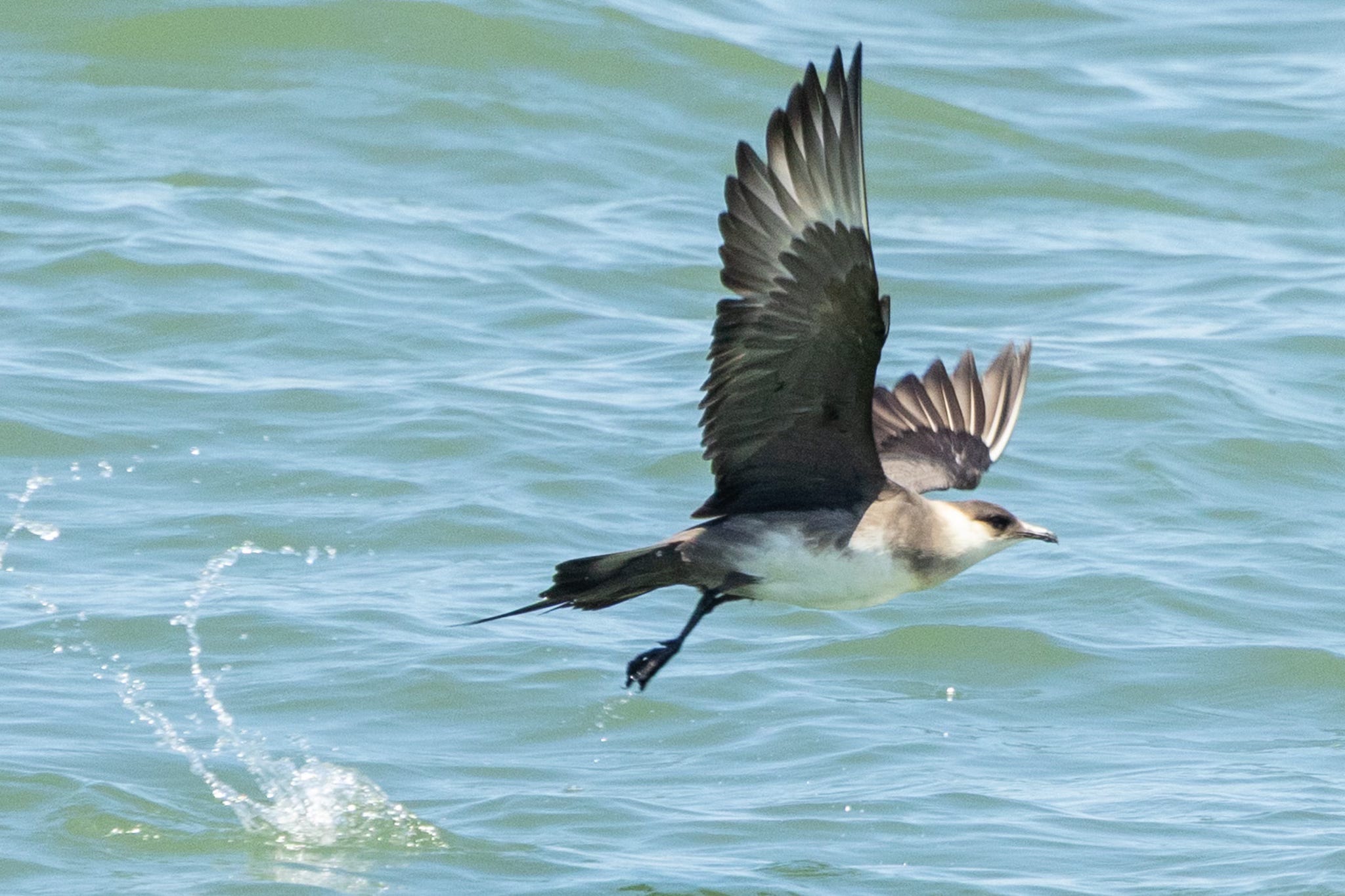
By Hap Ellis, Parasitic Jaeger - North Atlantic off North Carolina.
6. Everyone knows Merlin; not everyone knows BirdNet: Scientists have discovered that they can eavesdrop on the secret lives of birds using networks of inexpensive microphones, revealing complex behaviors across vast wilderness areas, according to research published in the journal Ecology. Previously, microphone technology that records sounds from wildlife had mostly been used to determine if a species was present in an area. Recordings could tell researchers what birds were present, but not what the birds were doing. Now, scientists from the Cornell Lab of Ornithology show that recordings of bird songs and calls can also reveal details about bird behavior that are otherwise time-consuming and difficult for scientists to observe directly in the wild. (via Phys Org)
7. Twitchers in the Cotswolds: It’s early. 6:00 a.m. Wellies are pulled on and I’m out the door to meet ornithologist, naturalist, and wildlife guide, Dr. Ed Drewitt. I’m geared up for the dawn chorus for a birding tour, organized by Active England, where we walk from Upper Slaugther to Lower Slaugther, following the River Eye in England’s Cotswolds, an Area of Outstanding Natural Beauty. Drewitt’s hobby has always been birds. “My grandma would feed the starlings and sparrows, and we would go to the duck pond to feed the ducks,” Drewitt says. “I also had teachers that really encouraged my interests and gave me the confidence to think about it. A lot of bird songs I learned through my teenage years.” (via Forbes)
8. A look at the effects of climate change on chicks: Experiences in the first days and weeks of life can have a profound impact on humans — and birds. A new study led by Sage Madden, a graduate student in evolution and ecology at the University of California, Davis, shows how weather conditions and family dynamics affect the growth of barn swallow (Hirundo rustica erythrogaster) chicks. By tracking over 100 barn swallow chicks during their first two weeks of life, Madden and Professor Gail Patricelli showed that the chicks’ growth was stunted by cold spells if experienced within five days of hatching, if they were the smallest sibling, and if their parents brought less food back to the nest. Hot weather also stunted the chicks’ growth, during both early and late development, and parents were unable to buffer their chicks against the heat by feeding them more. (via U.C. Davis)
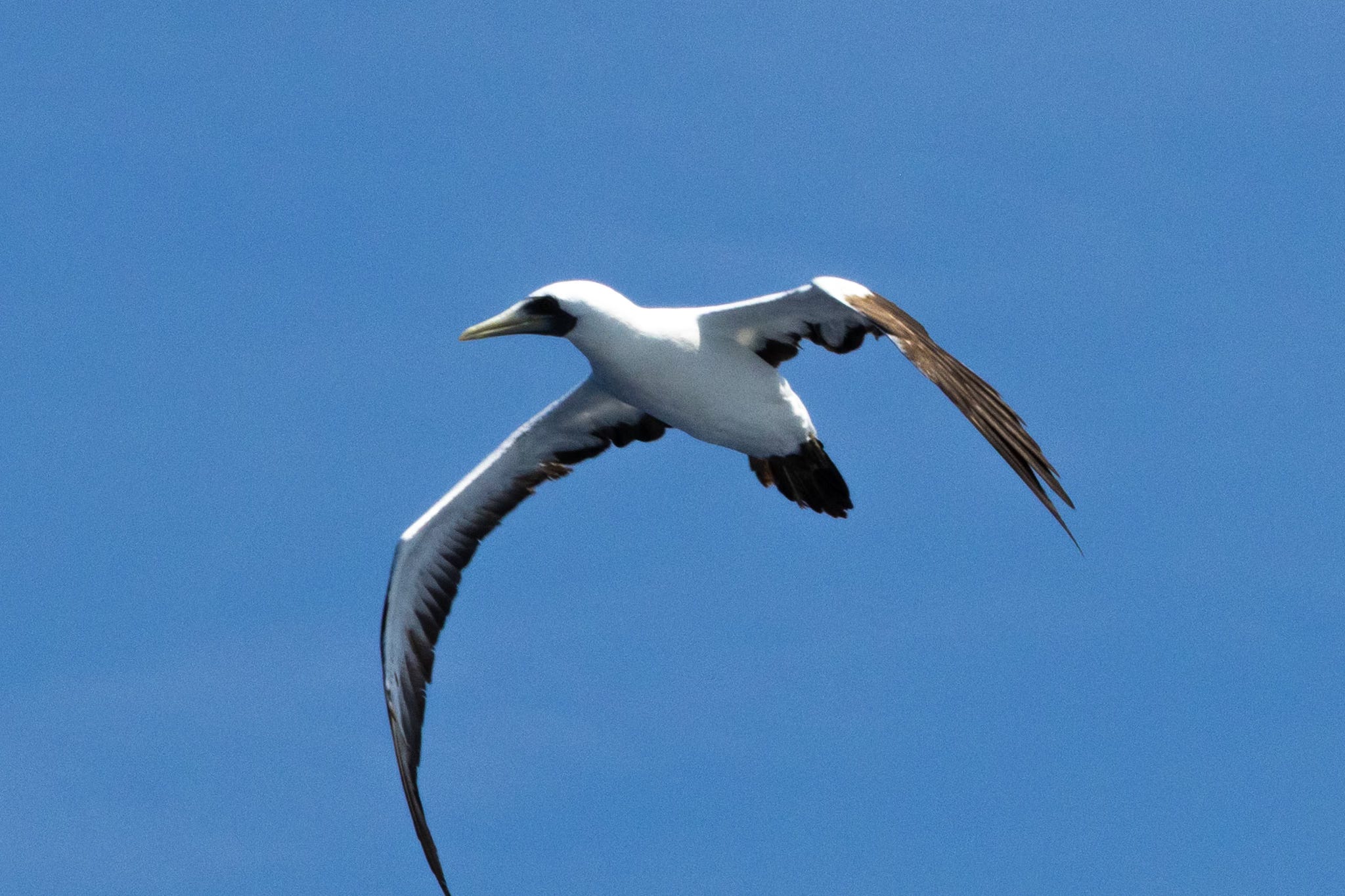
By Hap Ellis, Masked Booby - North Atlantic off Florida.
9. And the fish fight back: Beneath the tropical trees of southern Mexico, enormous shoals of sulphur mollies blanket the water surface of toxic sulphur springs, where survival depends on collective defence against relentless attacks from predatory birds. The tiny fish survive attacks of birds through creating spectacular collective waves. But new research now shows that their avian predators are adapting too, changing where they attack to avoid triggering the fish’s powerful group defence. The fish, in turn, appear to fight back with a surprising form of collective “memory.” (via Eureka Alert)
10. When it comes to bird collisions with wind turbine blades, hopefully this helps: Wind turbines are a net positive for a sustainable society, but that doesn’t mean they don’t have an environmental impact. Apart from their material requirements, those giant, spinning blades can be lethal to unsuspecting winged animals like birds and bats. Although some reports dramatically overplay wind farms’ danger to flying species, there is no denying they can unintentionally kill anywhere from two-to-six birds and four-to-seven bats per megawatt every year. That may not seem like many fatalities, but every animal counts for an endangered species. To lower these risks, engineers are devising new ways to make wind turbines more visible and avoidable. One potential solution may involve taking a cue from some of nature’s most dangerous creatures. More bats and birds will steer clear of wind turbines when their blades are painted with colors similar to animals like venomous coral snakes and poison dart frogs. (via Popular Science)
11. Bird banding news from the Adirondacks: Writing from the Crown Point Bird Banding Station where we are in operation for the 51st year. At home, the night before I left, a black bear hit all my feeders and because I didn’t fill them that night and the birds had pretty much cleaned them out during the day before, it didn’t get much other than the fun of taking them all down. I had left my garage door down as I had the truck backed part way in the garage in the rain to load up but I went out just before going to bed, moved the truck and put down the door or it would have had a ball in the garage and that would not have been pretty. So, before I left to come here, I cleaned up the mess and am no longer feeding birds until I get my electric fence back in operation. (via Adirondack Almanac)
12. What it takes -to compete with 87 teams in NJ for the Big Day title: It’s just after midnight in north New Jersey when a white SUV pulls up next to a deserted park, and three teenage boys leap out into the dark. They sprint across a field, vault a fence and peer through binoculars — up toward giant nests atop a pole — all in the hopes of catching a momentary flash of a sleeping parrot’s tail. By the light of street lamps, they strain to get a look through the nests’ dark holes. Then, after 10 minutes of waiting, 16-year-old Otys Train calls out: “I’ve I got it, I got it, I got it, I got it, I got it, I got the monk parakeet!” He and his friends, 17-year-old Jack Trojan and 16-year-old Zade Pacetti, have repeatedly come to this park late at night to try to find this bird. And tonight, the work has paid off. They’ve found their first bird of the 43rd annual World Series of Birding. (via National Public Radio)
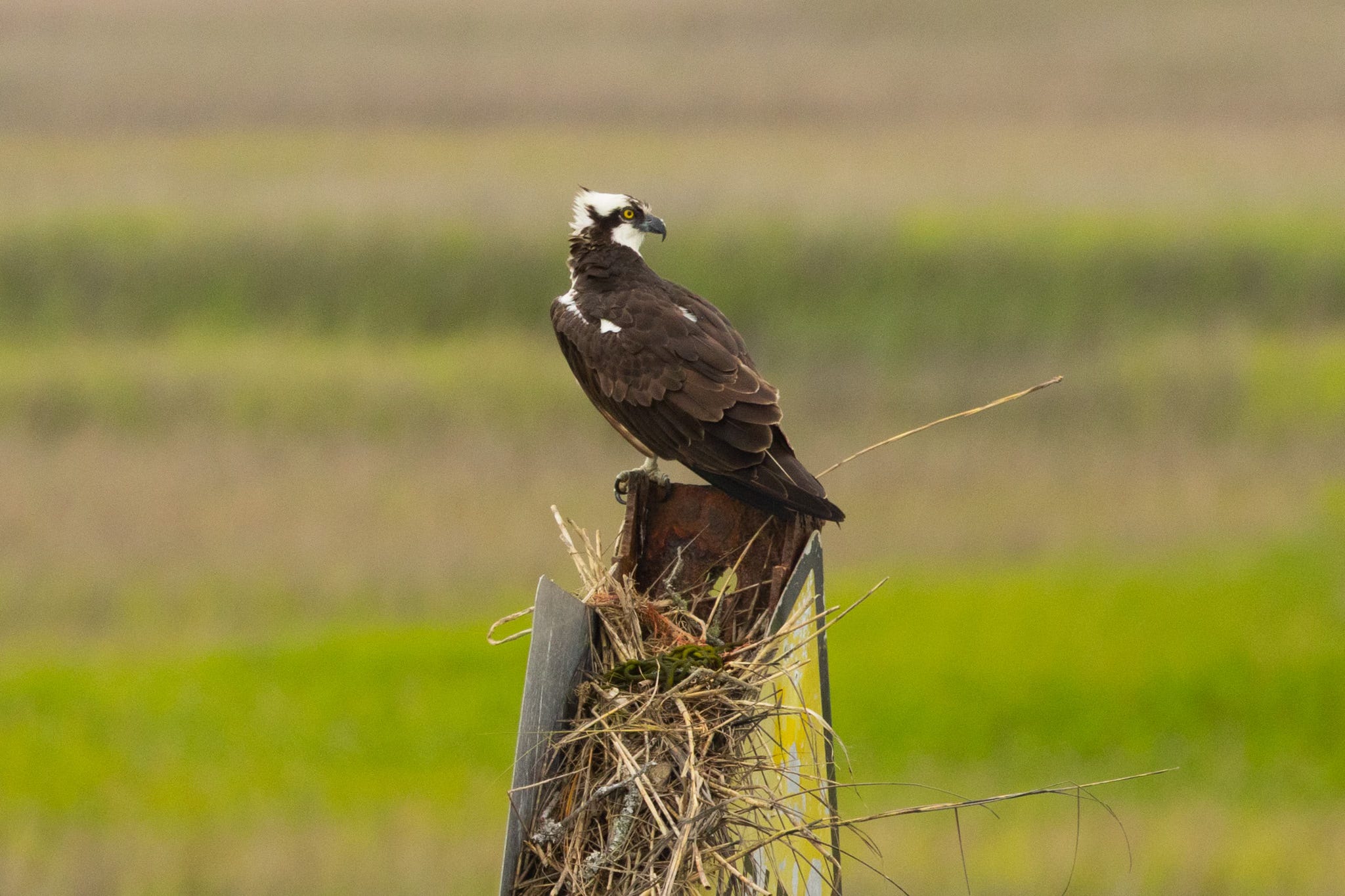
By Hap Ellis, Osprey - Inland Waterway, North Carolina
13. Birder I.D. tips from a favorite local New England columnist: About this time every year, I offer counsel on how to make bird identification easier. Usually, the first step is to simplify the range of choices in front of you. The standard police lineup features six people from which the eyewitness is supposed to pick out the suspect. Imagine if that lineup consisted of 100 people. To reduce the overwhelming range of identification possibilities, birds can be divided mentally into smaller, more manageable groups. You can first divide them into two piles: birds you know and birds you don’t know. Then they can be divided by size, shape, color and field marks. Birds can be divided by habitat and behavior. It doesn’t take long before the bird lineup is suitably reduced to six or fewer. Simplification is the key. That’s my usual advice. But not today. Today, I recommend getting overwhelmed. (via Bangor Daily News)
14. BirdCast explained (again): Flock shape, speed and structure are key in deciphering whether radar readouts are birds, bats, insects or weather Right now hundreds of millions of birds are making their annual trek to settle down in their northern breeding grounds. As they fly hundreds to even thousands of miles, they stop occasionally to refuel—delighting birders as they go. The majority of their travelling happens at night, however; that’s one reason experts say to turn off unneeded lights during migration season. So how are bird enthusiasts able to track these migrations? It turns out the same radar that helps track storms has a big part to play. Horton’s lab and the BirdCast collaboration use radar data to study bird migration patterns and generate a number of bird tracking maps that give birders a glimpse into how many birds are on the move—and offer birding forecasts for the next few days. (via Scientific American)
15. Finlly, let's conclude with a short paean to one our most beautiful warblers: Warbler excitement peaks in Northern Ohio during the first couple weeks of May. In fact, the Biggest Week in American Birding — the celebrated warbler migration event in Northwest Ohio that brings thousands of visitors from around the world and millions of dollars to the area — is still continuing for a couple more days. Although warblers come in a variety of brilliant colors, the color most commonly associated with them is yellow, and much of their attraction is that they are migrating through the area. But there are exceptions. The cerulean warbler is not yellow, and it is not migrating through. It is a striking soft blue warbler that breeds here in Ohio and across parts of the Midwest. Its migration, however, is still remarkable, extending to non-breeding areas in South America. Each year, it migrates through the southern United States and Mexico, making the dangerous journey across the Gulf of Mexico. (via The Chronicle)
Bird Videos of the Week
Video by 60 Minutes, “In Comobia, Anderson Cooper discovers the surprising thrills of birding”.

Cornell Live Bird Cam - Fresh fish is served at the Hellgate Osprey.

Cornell Live Bird Cam - A Pileated Woodpecker enjoys some suet alongside European Starlings.
Another gorgeous warbler from nature's jewelry box!
Going beyond the cerulean warbler? Lucy's warblers are definitely not yellow AND they never leave the desert. First encounter was on vacation in March at Desert NWR.