
Pigeon-Eyed Spies.
Bird News Items
1. Let’s begin with a beautiful piece in the NY Times on how “The Goldfinch” (the painting not the novel!) inspired this amazing exhibit: “The Goldfinch” by Carel Fabritius is one of the collection treasures at the Mauritshuis museum in The Hague.Ilvy Njiokiktjien for The New York Times. The British historian, art critic and TV presenter Simon Schama counts among his many fascinations the paintings of Rembrandt, the history of the Jews, and the human relationship with the natural world. During the Covid-19 pandemic, his thoughts turned frequently to the link between endangered animals and human illness, and how interspecies interactions can bring us perilously close to extinction. He explored these connections in his 2023 book, “Foreign Bodies: Pandemics, Vaccines and the Health of Nations.” Martine Gosselink, the director of the Mauritshuis museum in The Hague, read an excerpt from the book, and it nearly brought her to tears. So she invited Schama to curate an exhibition at the Mauritshuis, exploring some of the book’s complexities. (via The New York Times)
2. Ever wonder how sports teams got their bird names?: There’s an interesting schism between the birds of National Football League and Major League Baseball teams. Three of the birds that adorn NFL helmets are fierce: falcons, eagles, and Osprey (seahawks). Meanwhile the three avian MLB teams are named for colorful backyard birds: cardinals, Blue Jays, and Baltimore Orioles. It’s as if the birds of pro sports teams mirror comedian George Carlin’s famous comparison: Football is about marching into enemy territory. In baseball, the goal is to go home. All of the species that fly as pro sports team symbols are common birds. For the superstitious fan, maybe seeing a team’s namesake bird on game day could convey a little extra luck. And in most cases, the avian icon is somewhat easy to see within or near their respective cities. eBird might even help you get on your team’s bird in the morning with plenty of time to find your seats at the stadium before kickoff/first pitch/tip-off. (via Living Bird Magazine)
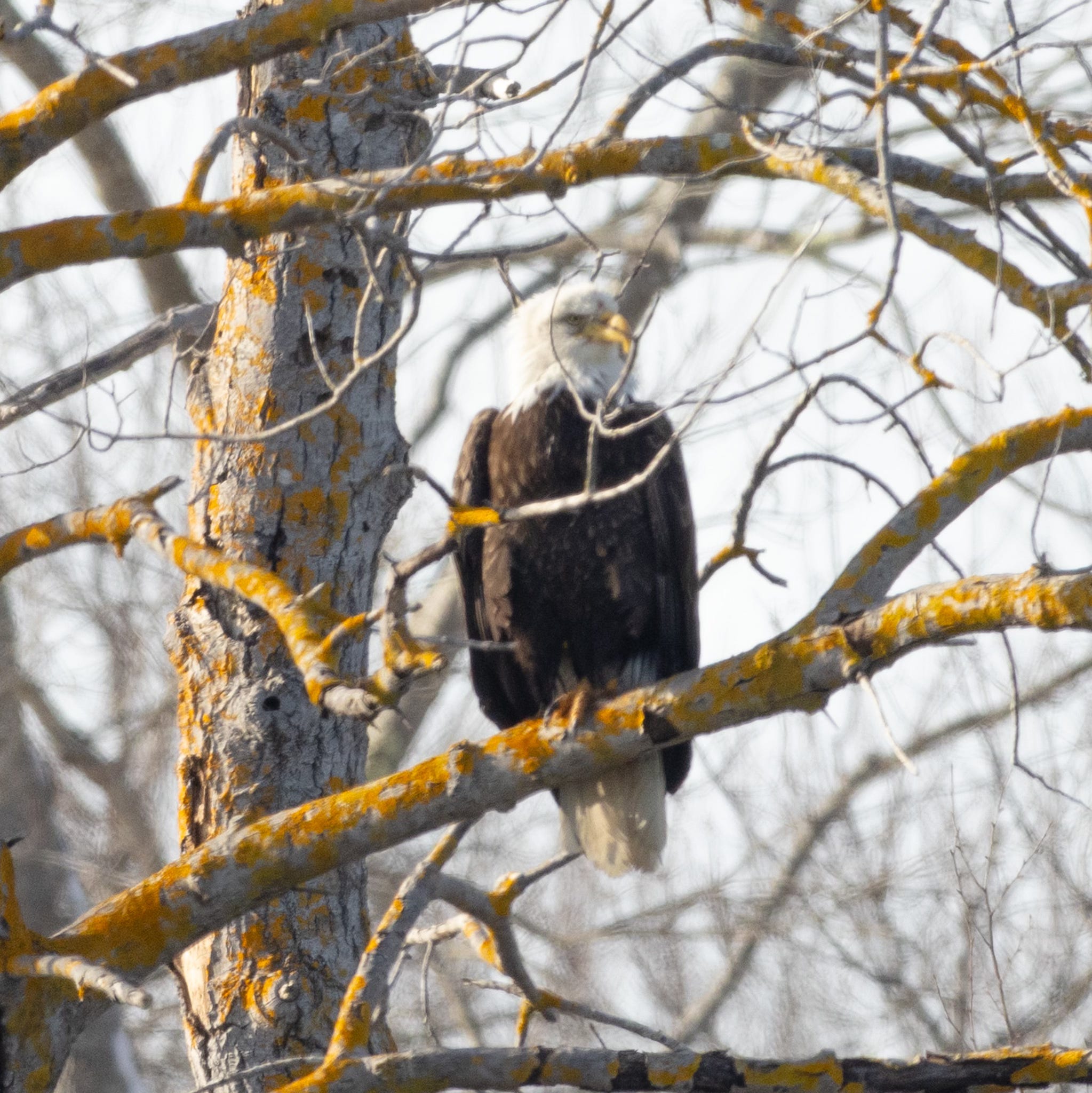
By Hap Ellis, A not uncommon sight in winter (Bald Eagle) - Kennebunkport, ME.
3. Yikes!: Avian malaria is spreading across Hawaiʻi in a way scientists didn’t fully grasp until now: nearly every forest bird species can help keep the disease alive. Researchers found the parasite at 63 of 64 sites statewide, revealing that both native honeycreepers and introduced birds can quietly pass the infection to mosquitoes—even when carrying only tiny amounts of it. Because infected birds can remain contagious for months or even years, transmission keeps simmering almost everywhere mosquitoes exist. (via Science Daily)
4. To Peru 800 years ago for the secret behind the Chincha Kingdom (1000-1400CE): In 1532, in the city of Cajamarca, Peru, Spanish conquistador Francisco Pizarro and a group of Europeans took the Inca ruler Atahualpa hostage, setting the stage for the fall of the Inca Empire. Before this fateful attack, Pizarro’s brother, Pedro Pizarro, made a curious observation: other than the Inca himself, the Lord of Chincha was the only person at Cajamarca carried on alitter, a carrying platform. Why did the Lord of Chincha occupy such a high position in Inca society? In a new study published in PLOS One, we find evidence for a surprising potential source of power and influence: bird poop. (via Science Alert)
5. From Russia with(out) love: For thousands of years, humans have trained pigeons to race, deliver messages and “spy behind enemy lines”, said Bloomberg. “What would happen if people could bypass the training and steer their bird brains instead?” A Russian neurotechnology company linked to Vladimir Putin’s daughter is claiming to do just that, said The Times. Scientists at Neiry have reportedly been implanting computer chips into the birds’ brains and strapping video cameras to their chests, trying to transform them into “living drones”. There has been “no independent scientific verification” of the company’s claims – but in theory, the birds could be “adapted for military surveillance”. (via The Week)
6. The making of a better chemist – you wouldn’t guess it: My fascination with bird photography started when I came across stunning bird pictures shared by expert photographers on Twitter (now X). Inspired by this, I started photographing birds to share them on social media. At first, I began noticing the eye detailing, species differences and their unique behaviour in the natural habitat. However, the pursuit of photographing birds deepened when I visualised birds as not just enigmatic creatures, but as living metaphors of organic chemistry. It all began with a typical day in my lab planning organic reactions and following industry protocols. I was troubleshooting a difficult step in a reaction that refused to work – numerous trials failed and I returned home in frustration. (via Chemistry World)
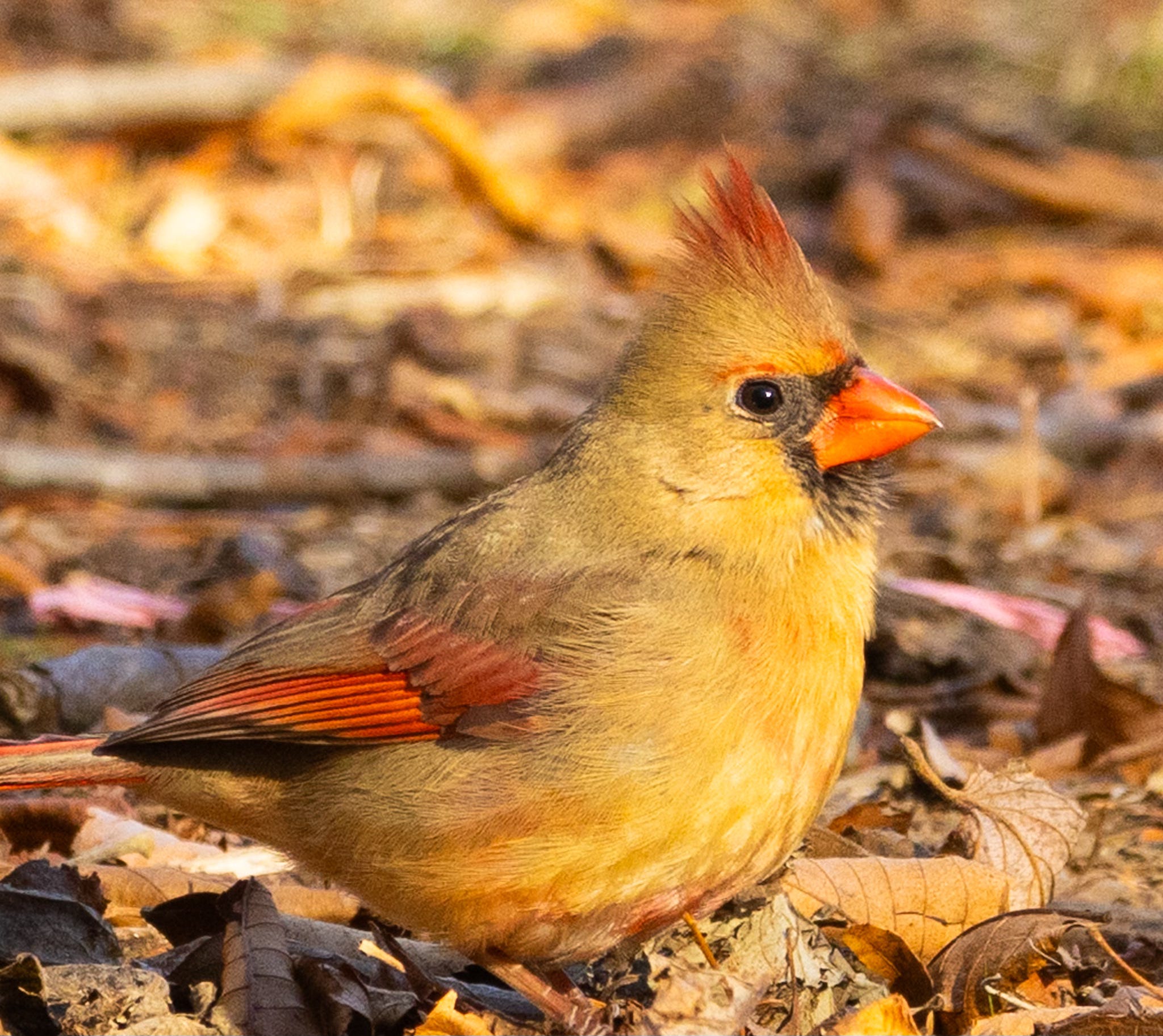
By Hap Ellis, Northern Cardinal - Millenium Park, Boston, MA.
7. The NY Times explores “interspecific allopreening”: On Feb. 4, 2023, in Phil Hardberger Park in San Antonio, a large bird glided into a tree. Another bird, already perched there, began to preen the newcomer’s head and neck. This caught the watchful camera and eye of Lora Reynolds, a volunteer with the Bexar Audubon Society. The bird receiving the attention was a crested caracara, a raptor in the falcon family. The one doing the preening was a black vulture. “It was just very weird to see that,” Ms. Reynolds said. She had been birding since 2009, but seeing a bird from one species preen one from another was new to her. Later that month, the park shared photographs of the curious interaction on its website and on social media. Lori Boies, a local cancer biologist with a passion for nature photography, noticed them. She said she had seen the same behavior just around a mile away the year before. (via The New York Times)
8. The importance of bioacoustics classification from Google Research: Google has a long history of collaborating with external scientists on using bioacoustics for monitoring and protecting whales, including our original research models to detect humpback whale classifications and the release of our multi-species whale model in 2024. To keep up with this pace, Google’s approach to AI for bioacoustics is evolving to enable more efficient connections from new discoveries to scientific insights at scale. In August 2025, Google DeepMind released the latest Perch foundational bioacoustics model, Perch 2.0, a bioacoustics foundation model trained primarily on birds and other terrestrial vocalizing animals. Surprisingly, despite including no underwater audio in training, Perch 2.0 performed well as an embedding model for transfer learning in marine validation tasks. (via Google Research)
9. Wondering how birds survive this winter’s cold snap?: In this unusually cold and snowy winter, you probably find yourself gazing out the window and wondering how the birds and other animals make it out there. I mean, just look at those tiny naked legs and feet standing in the snow, or on the ice! You just want to order them some little boots, don’t you? And those ducks floating blithely about in ice water like they signed up for some some masochistic, never-ending polar plunge. How do these little critters manage what we could never do? The answer is, they’re built different. From their feathers to fat to feet to food, our birds are designed for just such a winter. Let’s jump feet first into this topic. (via National Public Radio)
10. What it takes – conservation and ranchers: The showroom at the Washington Cattlemen’s Association Convention & Tradeshow was bustling on a November afternoon. The keynote speech had just let out, and people shuffled from booth to booth, decked out in cowboy hats of all colors, warm winter vests and turquoise jewelry. A few lingered at a small table near the glass windows of Wenatchee’s Convention Center. It was a booth you might not expect to find nestled among fencing, feed and animal health vendors: Audubon Washington. With a glance, rancher Samantha Buma strolled up to the booth. “The bird people,” she said. Bird species are on the decline across the U.S. for all different types of reasons – they’ve lost habitat. The climate is changing. Food sources are disappearing. But a new program in Washington hopes to create more habitat for birds, using ranches. (via Northwest Public Broadcasting)
11. On the technology front - this is cool: Bright lights lead to the deaths of countless migrating birds each fall and spring, when millions stream across the night sky. Lights disorient birds and draws them closer to buildings where they collide with windows. A new AI technology protects them by automatically dimming lights when it matters most. Photometrics AI, a street-lighting optimization company, now includes bird migration forecasts as part of its lighting management platform. Cities using the platform will have access to an automated feature that dims lights when data from the Cornell Lab of Ornithology’s BirdCast migration monitoring platform signals big migration nights with high risks for window collisions. (via CornellLab)
12. U of Michigan study looks at the impacts of noise pollution on birds: New research led by the University of Michigan is painting a more comprehensive picture of how noise pollution is impacting birds around the world. “The major takeaway from this study is that anthropogenic noise affects many aspects of bird behavior, with some responses more directly tied to fitness,” said Natalie Madden, lead author of the new study published in the journal Proceedings of the Royal Society B. (via University of Michigan)
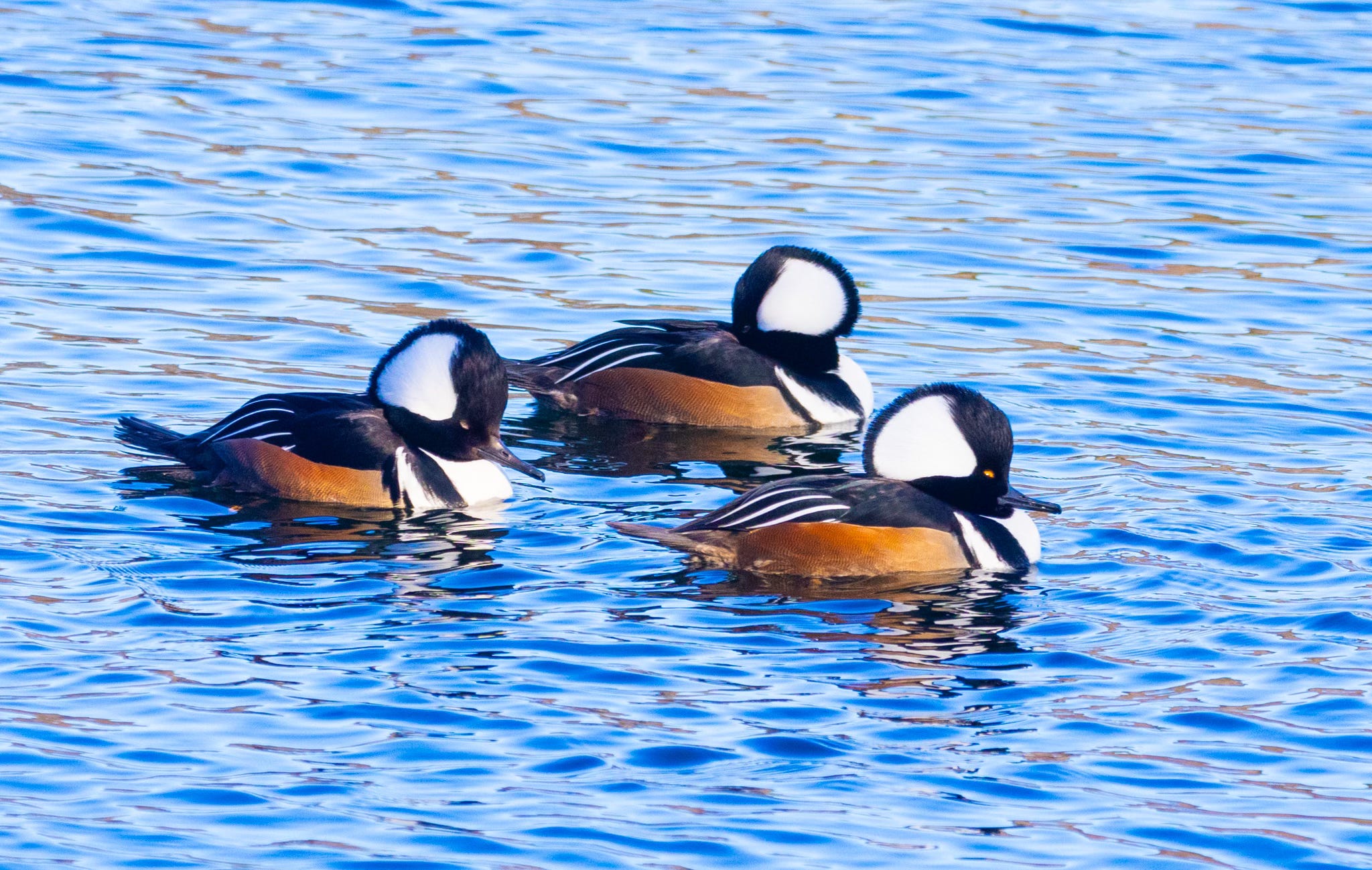
By Hap Ellis, Hooded Mergansers - Boston, MA.
13. Just getting into birding? Try “slow birding”: Counting birds is almost like a sport among the passionate bird-watching community. But for aspiring birders, the rapid-fire memory game can sometimes be a little much. Enter “slow birding,” a movement for novice birders who wish to spot and learn about these winged wonders without pressure. Bridget Butler, a Vermont birding business owner known as the “Bird Diva,” helped popularize the practice. She said “traditional birding” can be competitive because it often hinges on knowledge: correctly identifying what you’re hearing or seeing. “ Sometimes that can feel really intimidating for folks and kind of keep some people out of the practice of birding,” Butler said. With “slow birding” Butler said the pressure comes off, and it’s more about the experience of being out in nature rather than having “a right answer.” (via WBUR News)
14. A new study examines “Altitudinal migration” in mountain birds: Research led by the University of East Anglia (UEA) sheds new light on how mountain birds adapt to changes in climate. Scientists know that species diversity changes as you go up a mountain, but it is not clearly understood why this is the case. One theory is that it is mostly because of long-term evolution, and the climate niches species have adapted to over millions of years. Another—the “energy efficiency” hypothesis—suggests it is about how species today manage their energy budgets and compete for available resources that vary in space and time. (via University of East Anglia)
15. It being Valentine’s Day, this “Talon-Tines” Instagram post caught our eye: It’s almost Valentine’s Day and we’re looking at some unusual ways to say “I love you.” The World Center for Birds of Prey has put a twist on this romantic holiday with Talon-Tines day because “nothing says ‘love’ quite like razor-sharp talons and impressive wingspans.” On Saturday, you can meet raptors like Clara. She’s an American kestrel and she joined Idaho Matters, along with Tate Mason, the director of the World Center for Birds of Prey and their curator of education, Curtis Evans. (via Boise State Public Radio)
16. Finally, an update from the Sunshine State on the renaming of the state bird: Supporters have argued the flamingo better reflects Florida’s identity and pairs the state with a globally recognized tropical species long associated with Florida tourism. House Representatives voted to retire the northern mockingbird after nearly a century as the Florida state bird and elevate the American flamingo and the Florida scrub-jay in its place. HB 11, sponsored by Republican Reps.Jim Mooney of Islamorada andChip LaMarca of Lighthouse Point would designate the American flamingo as Florida’s official state bird and the Florida scrub-jay as the official state songbird,formally replacing the mockingbird – whose designation dates back to 1927.Recent polling shows most residents and visitors already think or support the Flamingo as Florida’s state bird. (via Florida Politics)
Bird Videos of the Week
Video by Nat Geo, Animals That Mate for Life.

Cornell Live Bird Cam - Northern Royal Albatrosses.
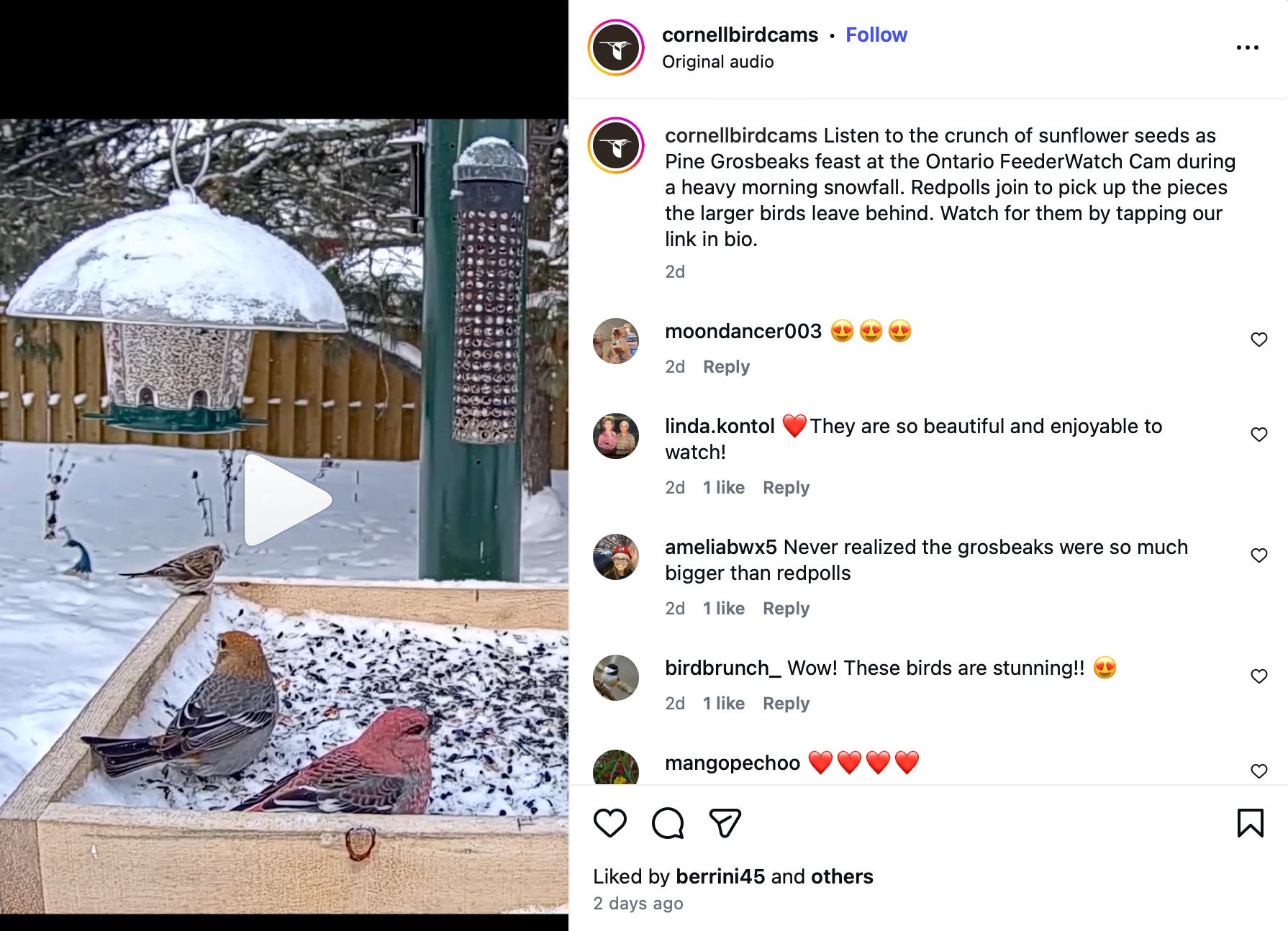
Cornell Live Bird Cam - Ontario Feeder.
Go Birding!