
Preventing Extinction.
Bird News Items
1. Let's begin with the "Falcon capital of the world": Bird-watching guide Janbemo Odyuo is piloting a small wooden canoe through a wetland off Aree Old village, in the northeastern Indian state of Nagaland, accompanied by two European bird-watchers who have come to see the migratory Amur falcon (Falco amurensis). To the naked eye, the trees in the distance appear laden with pale-colored flowers. Then, as if on cue, thousands of Amur falcons rise from the foliage, their simultaneous flapping creating a thunderous roar. The sky darkens as the flock takes to the air, leaving the bird-watchers spellbound. This stunning natural phenomenon was described by British raptor conservationist Nick Williams as “the largest and most spectacular roost of any species of falcon ever seen anywhere,” and has earned Nagaland the unofficial title of “falcon capital of the world.” (via Nikkei Asia)
2. Very interesting studies on birds and forest fires: In the forests of the Sierra Nevada, the black-backed woodpecker is without parallel. The bird appears almost born of fire, thriving on the flames that flicker through California’s coniferous forests every few years. Swooping in shortly after a blaze subsides, this woodpecker species, Picoides arcticus, nests in the hollowed-out trees the burn has left behind, gorging on an abundance of longhorn and bark beetles. Throughout the forest, a steady whack-whack can be heard from the birds’ bills drilling into charred wood. The relationship between wildlife and wildfire is a complicated one. Many bird species, like the black-backed woodpecker, need the occasional inferno to create new habitat by opening up the forest canopy and increasing available food by kicking off a boom in insect populations. (via Mavens Notebook)
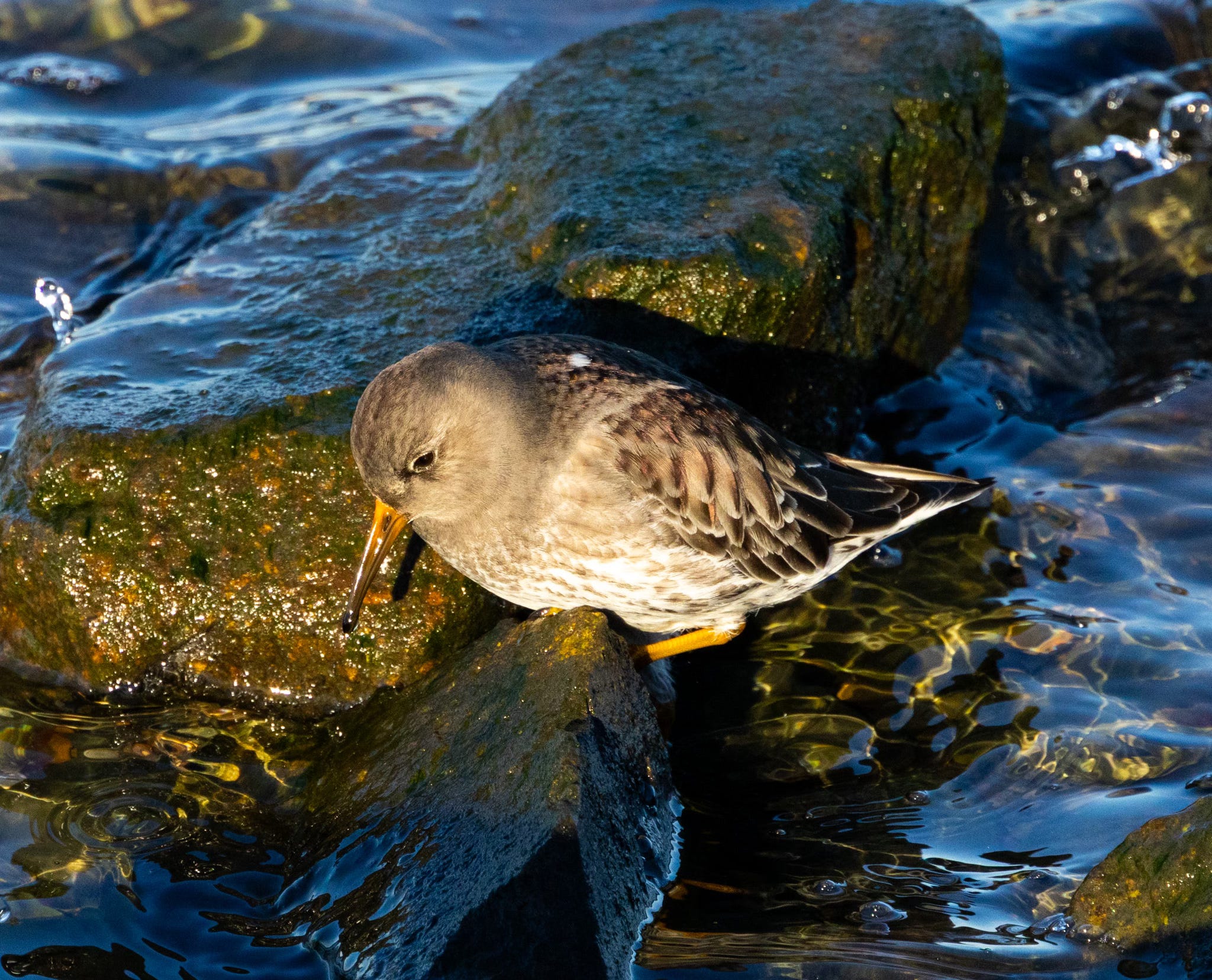
By Hap Ellis, Purple Sandpiper - Boston Harbor, Boston MA.
3. Audubon's wish list for 2026: January 5th is National Bird Day, which is coinciding with the close of the annualChristmas Bird Count. It’s a moment to celebrate the beauty of birds that grace our skies and landscapes, and to spotlight what’s needed to halt the decades-long decline in their populations, as documented by scientists. The day also reminds us why birds matter. Protecting them helps safeguard the natural and sustainable systems we all depend on – clean water, healthy forests, productive farmland, and resilient coastlines – as well as the billion-dollar birdwatching industry that supports local economies across the hemisphere. (via Audubon)
4. A lovely paean to winter birding and stress-free resolutions from the heartland: Much-loved short-eared owls attract large crowds as they make crepuscular and sometimes daytime appearances, giving their viewers quite a show as they swoop and dive, interacting like giant moths. Every few years, we experience an invasion of majestic snowy owls. These breathtaking white giants of the north irrupt southward during years when their prey is scarce, or when they have had an exceptionally productive breeding year and the resulting youngsters feel the need to disperse. This year is shaping up to be a snowy owl winter with many individuals having already been reported. I resolve to make an effort to get a good look at a snowy owl this winter, should one find its way into northeastern Ohio. (via Farm and Dairy)
5. From the University of Helsinki, this PhD thesis aims to improve the existing bird sound classification models for passive acoustic monitoring (and for app's like "Muuttolintujen Kevät" which means "Merlin" in Finish - no, just kidding): In a study conducted at the University of Helsinki, AI was trained to classify bird sounds with increasing accuracy. The results of the study have been used, among others, in the “Muuttolintujen kevät” (Spring of Migratory Birds) mobile application, which has become a substantial platform for collecting bird recordings. In hisdoctoral thesis, Doctoral Researcher Patrik Lauha demonstrates that bird sound classification models can be improved by adapting them to specific monitoring contexts. Fine-tuning and localizing improves the accuracy of the classification models. (via Phys Org)
6. For the botanists among us, why poison ivy matters: The holly and the ivy. The rising of the sun, and the running of the deer. The feeding of the birds, too. Add the poison ivy and the sumac, the hawthorn and bittersweet to the sweet singing in the choir. They all add to the winter feast that keeps the world winging. I come to this after a year of leaving my bird feeders stored away and unfilled. This year, the feeders are back in place with the usual bird-and-squirrel suspects gathering daily for their sunflower seed-and-suet nosh. I do this for myself. I like watching them. But the birds don’t need my daily specials. When I didn’t feed them, they did just fine. This is because through sloth and by-chance design, by letting things grow rather than clearing them away, my unmade bed of a yard is a winter bird smorgasbord. The mess is all right. (via The Connecticut Post)
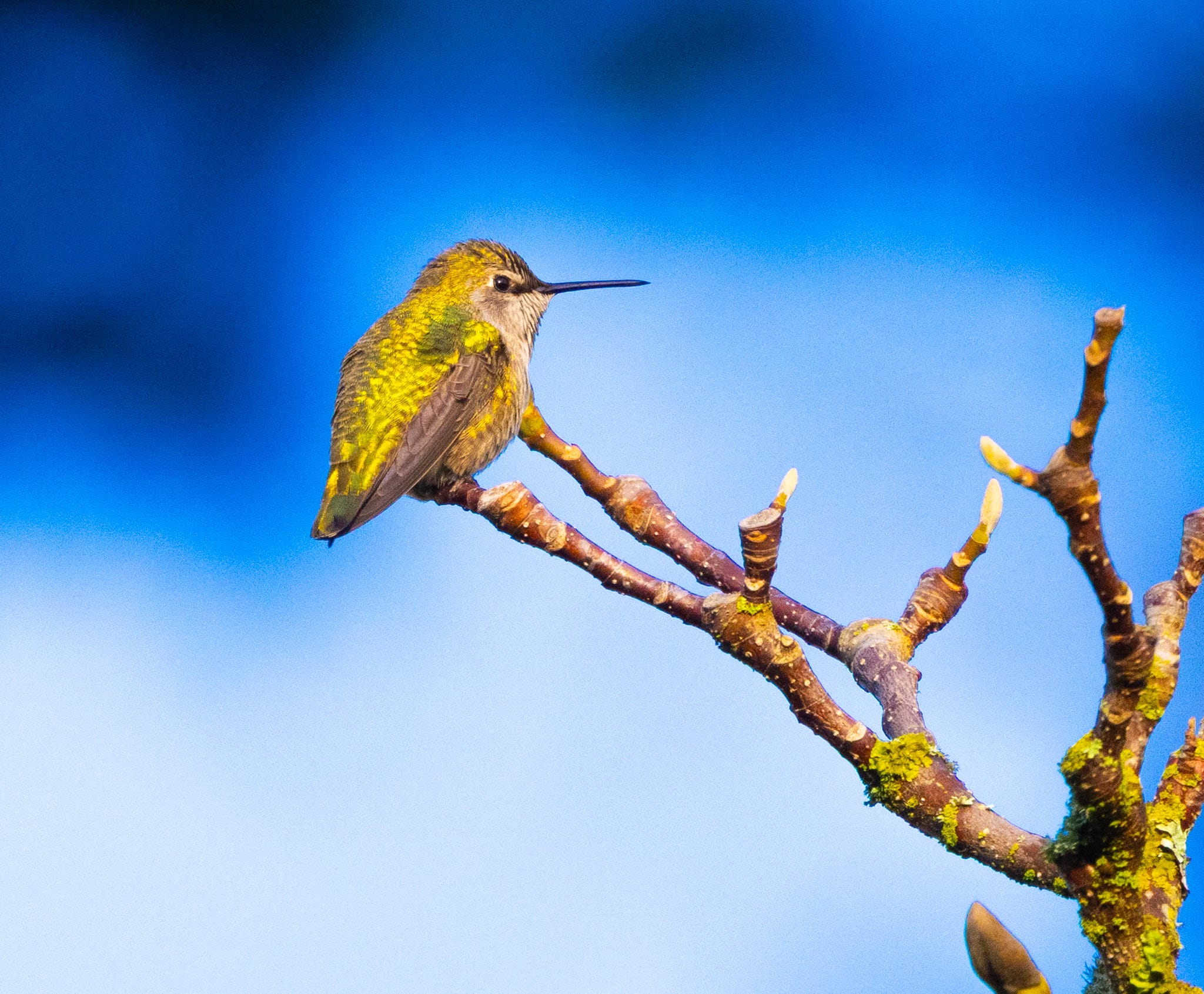
By Hap Ellis, Anna's Hummingbird - Portland, OR.
7. San Francisco Bay blues: The Bay Area is losing birdsong. The San Francisco Bay State of the Birds report, a new set of studies by private and federal wildlife researchers, found that the region’s bird species have seen steep declines in recent decades. The report, the first since 2011, indicated that shorebirds — which rely heavily on the Bay Area as a stopping point during the winter migration season — have seen especially dramatic declines over the last 20 years. The trends could have troubling implications for the rest of the ecosystem. (via San Francisco Chronicle)
8. "Magical minutes" with a Northern Saw-Whet Owl: The Christmas Bird Count season has finally come to a close, so with any luck I’ll stop talking about them in a few weeks or so. But not now – now is a time to reflect on birds seen, not seen, heard, not heard, as well as dead birds that someone wired to a tree branch for some reason. More on that later. For now, I want to reflect on some of my owling highlights across the five Christmas Bird Counts I helped with this season. The owling, which involves targeted owl surveys between about 4AM and sunrise, was as slow as it’s ever been across most of my counts, including the Truro, Mid-Cape Cod, Plymouth, and Taunton-Middleboro counts. Even the “gimme” owl, the Eastern Screech-Owl, was downright demure on some of my counts. (via NPR: Cape and Islands)
9. The Florida Grasshopper Sparrow update - progress in preventing extinction: The buzzzz of a Florida grasshopper sparrow is one of the rarest avian sounds in America. However, the fact that its insect-like trill can be heard at all is a sign of progress and hope. This species was on the precipice of extinction just decades ago, but a band of researchers combined resources and knowledge to save them. Among them was an unlikely cohort of scientists, who assisted with transporting fledgling sparrows born in captivity to Welaka National Fish Hatchery. The hatchery has been involved with grasshopper sparrow conservation since 2019, but efforts go back to 2002, when a group of volunteers banded together to start the Florida grasshopper sparrow working group. (via Sierra Club)
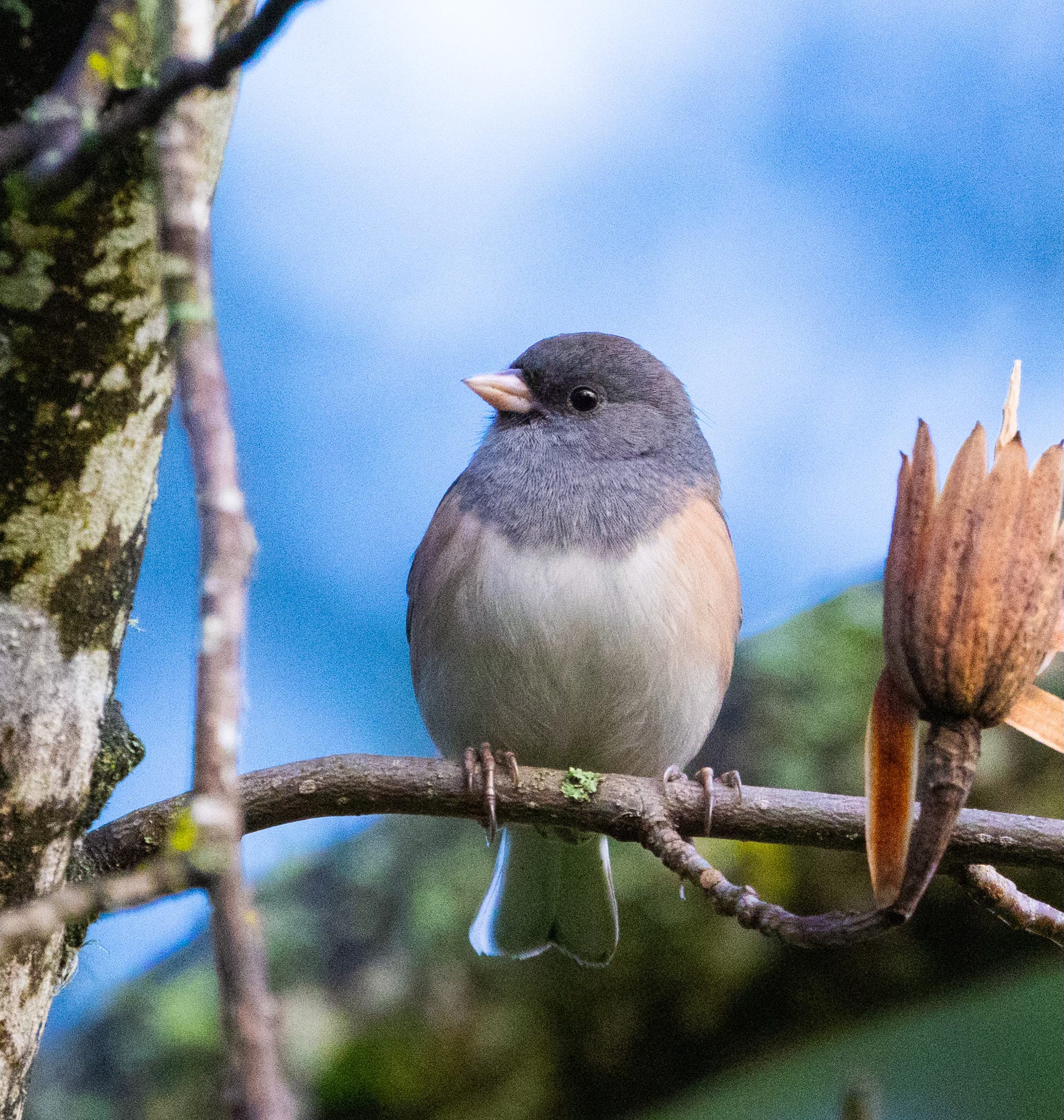
By Hap Ellis, Dark-eyed Junco- Portland, OR.
10. We've cited articles on birds and wind turbines regularly - this year's first such article deals with turbine siting in China: Terry Townshend is a British bird conservationist who has spent years working in China’s environmental sector. He says existing tools could be used to help site new wind farms where they impact birds less. These include Nature Conservancy India’sSiteRight tool, and BirdLife International’s AViStep, whichuses spatial and geographic data to assess possible impacts.Meteorological radar, designed to monitor metrics like humidity and wind speed, can also be used to provide real-time monitoring of birds in flight. That information could be used to stop turbines turning when large numbers of migratory birds are about to pass by – a tactic used successfully in Denmark, Germany and the Netherlands. (via Dialogue Earth)
11. If you have red hair, you have at least one thing in common with zebra finches - who knew?: A pigment that makes feathers and hair orange helps prevent cellular damage by removing excess cysteine from cells. Pheomelanin is an orange-to-red pigment that is built with the amino acid cysteine and found in human red hair and fair skin, as well as in bird feathers. Previous research has shown that pheomelanin is associated with increased melanoma risk, raising questions about why evolution has maintained genetic variants that promote pheomelanin production. Published in PNAS Nexus, Ismael Galván and colleagues studied 65 adult zebra finches divided into treatment and control groups. In the treatment group, male zebra finches received dietary cysteine and ML349, a drug that blocks pheomelanin synthesis. (via Phys Org)
12. The heroic effort to save the Tooth-Billed Pigeon (known locally as "manumea") on two Samoan islands: Conservationists are feeling cautiously optimistic after spotting a critically endangered bird in the wild in Samoa. During a recent field survey, experts with the Samoa Conservation Society recorded numerous sightings of the manumea, also known as the tooth-billed pigeon. They’re hopeful they can still save the elusive bird from extinction. The last confirmed sighting was in August 2020, according to Save the Manumea, a joint campaign from the Samoa Conservation Society and Samoa’s Ministry of Natural Resources and Environment. The most recent known evidence of breeding was in December 2013, when a juvenile was spotted and photographed in a tree. (via Smithsonian Magazine)
* For more on the Manumea: Tooth-billed Pigeon - Didunculus strigirostris (via Birds of the World)
13. Why don't these three African birds sing on cold mornings, you ask?: Three species of the melodic African warbler bird refuse to get up early and sing their customary daybreak songs when the weather is cold. This new discovery was made recently by a team of soundscape ecologists in South Africa’s mountainous Golden Gate Highlands National Park. The team’s research co-leader, Mosikidi Toka, studies how animals and the environment make and use sounds, especially in mountains, and is currently completing a Ph.D. on the sounds of natural habitats. He deployed automated audio recorders to record the birdsong and find out how the birds were affected by freezing temperatures. (via Phys Org)
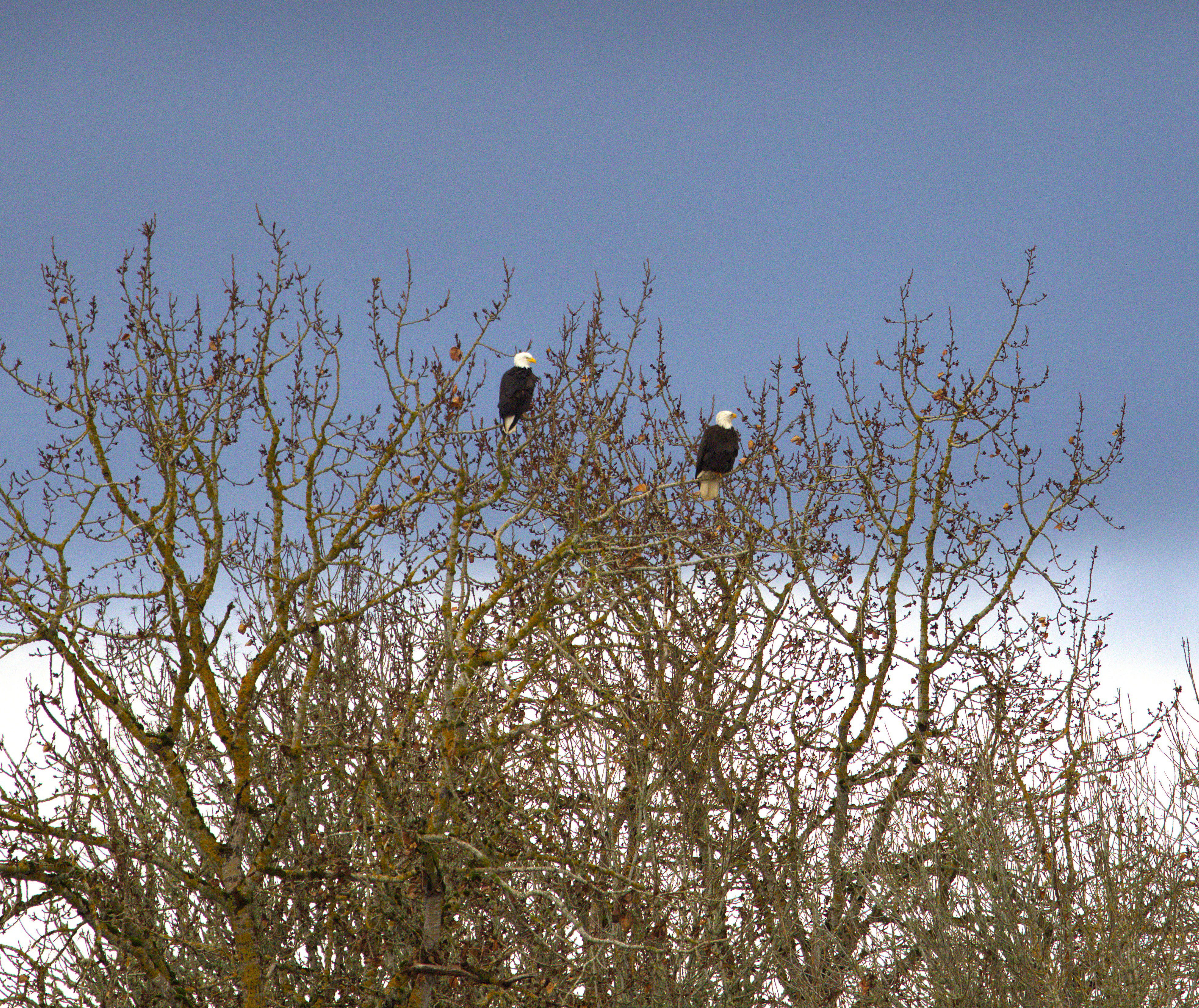
By Hap Ellis, Typical Scene on Sauvie Island in the Columbia River, northwest of Portland, OR.
14. Interesting Q&A on Bald Eagles and bird flu research in Iowa: A spike in wild bird flu cases across Iowa has researchers watching migration patterns, testing carcasses, and swabbing beaks daily at the State Veterinary Diagnostic Laboratory in Ames. Since 2022, more than 30 million poultry and wild birds have died from highly pathogenic avian influenza (HPAI) in Iowa. As the virus settles into a fall-and-winter cycle, one species is drawing particular interest from scientists: the bald eagle. Despite frequently scavenging infected carcasses, adult bald eagles appear to be surviving at higher rates than many other birds. Researchers believe understanding why could help unlock new insights into the disease. (via KCCI News)
15. Birders love "irruptions" and this year is shaping up to be a pretty good year for winter finches: New England birders with a keen eye and fully stocked feeders this winter might be rewarded with some special finch sightings. The Finch Research Network, a nonprofit focused on the study and conservation of finches, has predicted a small to moderate irruption of boreal finches in its annual Winter Finch Forecast. Anirruption is when large numbers of birds migrate beyond their normal range. In the finches’ case, it happens when a poor crop of wild food sources in Canada’s boreal forest drives them elsewhere in search of winter sustenance. They may move into New England, the Great Lakes region and sometimes as far south as the Carolinas. Though there may not be huge groups of these birds pushing south, this year is notable because it’s a multi-species event, said Matt Young, president and founder of the Finch Research Network. (via Vermont Public Radio)
16. Not a distinction Santa Cruz strives for: On Aug. 20, Connie Maschan rushed to New Brighton State Beach on a rescue mission. A volunteer with Live Oak-based wildlife rehabilitation clinic Native Animal Rescue, Maschan was responding to a call about birds in need of help. At the beach she found an exhausted-looking brown pelican slumped on the sand, entangled in fishing line and with fish hooks lodged in the back of its neck. As Maschan looked closer, she saw there were three more birds ensnared with the pelican — they were sooty shearwaters, an oceangoing seabird related to albatrosses, and two were dead. Netting the birds with the help of a park ranger, she cut the fishing line and transported the birds back to the clinic on 17th Avenue.Native Animal Rescue is the only facility in the county licensed to care for injured seabirds. By Dec. 5th, Native Animal Rescue had treated 48 birds last year for fishing gear-related injuries, about the same number that it treated in 2024. The number does not include birds that were found dead or birds freed by fishermen. (via Santa Cruz Local)
17. A new species of Tinamou in Brazil but ...at risk of extinction: A team of scientists based in Brazil recently reported that they discovered a new species of Tinamou in the mountains of the Serra do Divisor National Park (SDNP) in Brazil, a large national park and international conservation area located on Brazil-Peru border. According to their published report, these birds are only found in a narrow elevational band in the Serra do Divisor — a tiny range located in the extreme western reaches of Brazil and of eastern Peru. “The species was observed exclusively on the steep forest floor within a narrow transitional zone between 310 and 435 meters a.s.l., representing a gradient between submontane and stunted forest. (via Forbes)
18. Finally, enjoy the Macaulay Library's best bird photos of 2026: More than 30,000 photographers have contributed images to the Macaulay Library through their eBird checklists. Sometimes a photographer finds a bird staring right back at the camera, such as when photographer Toby Carter caught the intense glare of a young Osprey about to be released during a licensed banding session on the coast of northern England. Osprey and other predatory birds (such as jaegers, Shoebills, owls, herons, and eagles) have forward-facing eyes, an adaptation for zeroing in on prey. At the other end of the spectrum, the American Woodcock’s eyes are set so far back on its head that you can see both eyes from behind, as in the photo by Karim Bouzidi below. It’s as if the bird is staring directly at you while facing the other direction. (via All About Birds)
Bird Videos of the Week
Video by Bob Duchesne, “DON’T Start a Birding Life List!”

New Heights Podcast - This is what happens when Jason takes “Go Birds” too literally.

Cornell Live Bird Cam - Northern Cardinals.

Cornell Live Bird Cam - Northern Royal Albatrosses.
What an incredible roundup of conservation work happening everywhere! Reading about the Florida Grasshopper Sparrow recovery reminded me of spotting arare finch during an irruption year, and it made me appreciate how delicate these populations realy are. The San Francisco Bay data is sobering, cause if major ecosystems like that are struggling then smaller habitats must be worse off. Conservation needs constant attention dunno how anyone keeps up.