
Sense of Direction.
Bird News Items
1. Let’s lead off with a very rare sighting indeed - in Delaware: Delaware has long been renowned for its stellar birdwatching opportunities, with more than 400 different avian species recorded across the state over the decades—and just a few days ago, the city of Wilmington celebrated the arrival of a bird never before seen on First State soil. On November 19th, local birdwatching groups were flooded with images of a yellow-headed caracara, an eye-catching bird of prey that’s typically found in Central and South America. One of just a few recorded sightings in the United States, this lone raptor has made waves in the Delaware birding community, providing residents with an opportunity to spot a species they may otherwise never encounter. (via Forbes)
2. Five very important forests get help in a new study from the Wildlife Conservation Society and the Cornell Lab of Ornithology: Every spring, the familiar songs of Wood Thrushes and warblers return to the parks and backyards of eastern North America. But their journey begins far to the south—in the lush, remote forests of Central America that sustain them throughout most of the year. A new study from the Wildlife Conservation Society (WCS) and the Cornell Lab of Ornithology (Cornell Lab),published in Biological Conservation, reveals that the Five Great Forests of Central America—which stretch from southern Mexico to northern Colombia—are indispensable lifelines for dozens of migratory bird species that link the Americas. (via Cornell Chronicle)
PFF (Photos from Friends) - A video taken by a birding guide in Guyana of a Common Potoo and shared with Christopher Ellis - Kourou, Guyana (Bird was of course released unharmed.)
3. “Yelp Reviews” avian style in Washington: After joining Great Peninsula Conservancy, a nonprofit land trust outside Seattle, Adrian Wolf wanted to know what birds thought of the group’s forest restoration work. Birds are invaluable indicators of ecological health. Their presence or absence can help to gauge the condition of restored habitats, where dense trees had been thinned to create space for other plants, or standing dead trees had been left in place for cavity-dependent species like woodpeckers. But traditional bird counts can be expensive, inexact and take ages. Often, when people try to monitor the birds they hear or spot, their presence alone scares the birds off. The Listen Up Collaborative, as the project came to be known, has collected more than 400,000 recordings from 92 study sites and is using artificial intelligence to discern bird calls. (via The New York Times)
4. Who would have thought – check this report from Detroit out: Vast swaths of vacant Detroit land are unexpectedly rich in bird life, Axios Detroit’s Joe Guillen writes from a new study: Researchers hope this bird diversity will provide a blueprint for “deindustrialized” cities like Detroit to leverage vacant land in ways that benefit both residents and the natural surroundings. Decades of population loss since the 1950s left Detroit with more than 18 square miles of vacant land. These overlooked spaces can support more kinds of birds and get people outdoors, researchers at Michigan State and Carleton University in Ottawa, Ontario, found. (via ScienceDirect)
Case in point: Over the course of the four-year study, researchers saw local groups transforming vacant lots into gardens, meadows and learning spaces. “That was the coolest thing to watch. ... People just being like, ‘You know what? We’re taking things into our own hands and we’re making this neighborhood shine in a way that we want to see,” Rachel Buxton, a study co-author from Carleton, told Axios. (via Axios)
5. Good piece on the importance of controlled burns (and there’s the Cornell Lab of Ornithology again): The Cornell Lab of Ornithology’s Land Trust Bird Conservation Initiative has been a truly incredible partner to ALC over the past two years. Their grant program has directly supported various habitat restoration activities that have had a tremendous impact on both birds and people. And the support continues. Aiken Land Conservancy joined the Burning for Birds Conservation Collaborative in 2023, which currently consists of six conservation partners throughout the Southeast that are working together to restore habitats for declining, fire-adapted bird species such as the Eastern towhee, Bachman’s sparrow, brown-headed nuthatch, and Northern bobwhite. This partnership comes with funding, and that funding was put to good use over the past year. (via Aiken Land Conservancy)
6. The power of MOTUS (a theme BNI has highlighted for years) – such an important network: This past summer, a Wilson’s Phalarope nicknamed Mateo found social media acclaim after he traveled more than 8,000 miles from Utah’s Great Salt Lake to Argentina and back. The discovery of the shorebird’s feat was possible thanks to the international Motus Wildlife Tracking System, a program of Birds Canada that has revolutionized scientific knowledge about animal migration since it debuted in 2014. Tracked birds, bats, and insects wear tiny tags that “ping” thousands of cell-tower-like Motus stations when they fly past, enabling tracking in near-real time. Mateo is one of 28 Wilson’s Phalaropes tagged by Utah’s Tracy Aviary over the last two years as part of a study examining the movements of shorebirds at Great Salt Lake and beyond. (via ABC Birds)
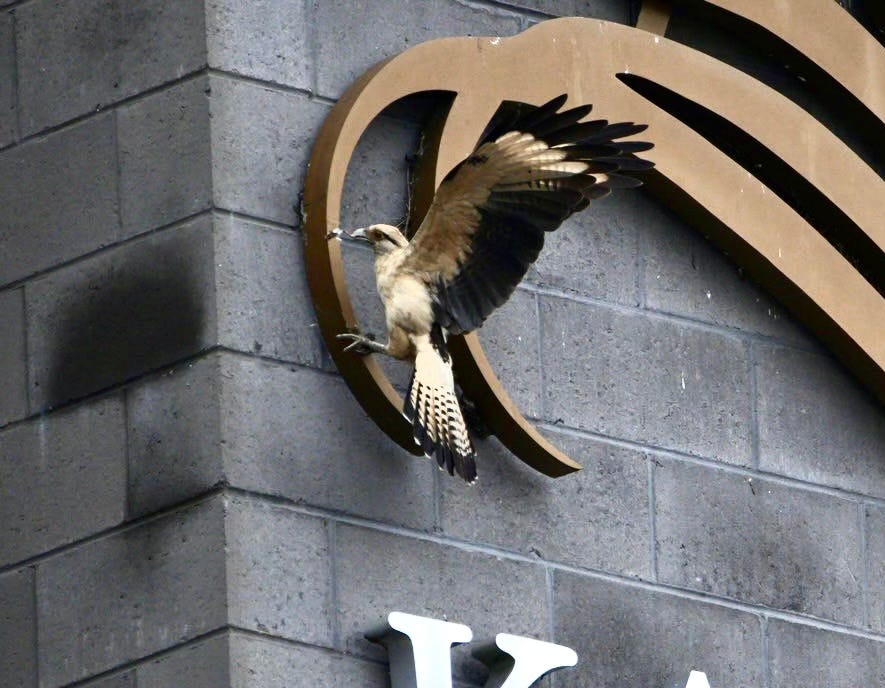
PFF (Photos from Friends) - The above mentioned Yellow-headed Caracara pictured at the Kalmar Nyckel shipyard in Wilmington, DE. The Kalmar Nyckel is a tall ship replica and more information is here (www.kalmarnyckel.com). Thanks to BNI friend Lauren Morgens for the photo that was taken by Captain Sharon Dounce.
7. New research on how a pigeon knows (hint…where it’s going): Pigeons can sense Earth’s magnetic field by detecting tiny electrical currents in their inner ears, researchers suggest. Such an inner compass could help to explain how certain animals can achieve astonishing feats of long-distance navigation. The team performed advanced brain mapping as well single-cell RNA sequencing of pigeon inner-ear cells. Both lines of evidence point to the inner ear as the birds’ ‘magnetoreception’ organ. Studies have suggested that various animals, including turtles, trout and robins, can sense the direction and strength of magnetic fields, although the evidence has sometimes been contested — and the mechanisms have remained controversial. (via Nature)
8. We’ll pass on this soup, thanks: An anthropologist explores how nests made from the saliva of swiftlets—long valued within some Asian medicinal and culinary traditions—have reached a growing global market. SWIFLETS’ NESTS (yan‑wo; 燕窩) have been a highly prized delicacy and prestige food in China and other parts of Asia since ancient times. In traditional Chinese medicine, the nests, usually served boiled in a soup, are thought to act on the pulmonary, gastrointestinal, and renal meridians; the late 16th-centuryBen Cao Gang Mu (Compendium of Materia Medica) describes the food as good for the lungs and for treating respiratory ailments.The actual nests come from Southeast Asia, and unsurprisingly,the history of the nest trade with China is just as old—reaching back to the Tang (A.D. 618–907) and Song (A.D. 960–1279 ) dynasty periods. (via Sapiens)
9. What it takes, in this case to protect wetlands in the Philippines: TheAsian Development Bank has secured $3 million for the second Regional Flyway Initiative project, the Philippines Flyway Project. The Global Environment Fund (GEF) funded the grant that will be implemented by the Philippines Department of Environment and Natural Resources. This project will not only help many migratory birds, but will also support livelihoods and improve climate resilience at a time when the region has been plummeted by typhoons made worse from climate change. The announcement comes off the back of the East Asian-Australasian Flyway Partnership Meeting of the Partners held last week in the Philippines. (via BirdLife)
10. New study details bird population increases from Europe’s ban on neonicotinoid: The European Union will ban the world’s most widely used insecticides from all fields due to the serious danger they pose to bees. The ban on neonicotinoids, approved by member nations on Friday, is expected to come into force by the end of 2018 and will mean they can only be used in closed greenhouses. Bees and other insects are vital for global food production as they pollinate three-quarters of all crops. The plummeting numbers of pollinators in recent years has been blamed, in part, on the widespread use of pesticides. (via The Guardian)
11. Sign us up for finding young shearwaters in O’ahu: It’s peak seabird fallout season and animal rehabilitation leaders are urging folks to look out for fallen birds across the state. Young ʻuaʻu kani, or shearwater birds, tend to take their first flights away from their nests between September and December. They learn to fly toward the light of the moon and stars, but the increase in artificial lights, especially on Oʻahu, has caused the baby birds to be misled on their flight paths. Many of them end up flying into something and are unable to get back up and take flight again. Rae Okawa, the development director at the Hawaiʻi Wildlife Center (HWC), said the team is urging people to bring these birds into a drop-off location if they are found on the ground. (via Hawaii Public Radio)
12. Look who is in the birding news – the reigning Super Bowl champs: The Philadelphia Eagles are teaming up with the National Marine Sanctuary Foundation in a new effort to protect seabirds and the ocean environments they depend on. The “Birds Supporting Birds” initiative will back research in NOAA’s Stellwagen Bank National Marine Sanctuary, where scientists are studying migration patterns of great shearwaters, long-distance seabirds that travel thousands of miles across the Atlantic each year. The project uses lightweight, solar-powered tags to track the birds’ movements and better understand how climate and ocean conditions affect their behavior and food sources. (via MSN)
13. Celeb item #1 - The Cornell Lab’s Merlin app captures Wicked’s leading lady: As anyone who has seen Wicked knows, Ariana Grande is a woman of many talents. She can sing, she can dance, she can Method act. She has a knack for impeccable comic timing and also a transatlantic accent. And if that’s not ambitious enough, now it sounds like she’s honing another skill. In an episode of Amy Poehler’s Good Hang podcast on Tuesday, Grande revealed she’s been getting into bird-watching. In the interview, Grande spoke about a secret talent she wishes she could have. “I wish I were a person who, like, had endless entomology knowledge,” she said. “I could look at a bug and be like, ‘Ah, Lepidoptera Pieridae,’” she said, deploying the scientific term for moths and butterflies, which she apparently just knew right off the top of her head. (via The Cut)
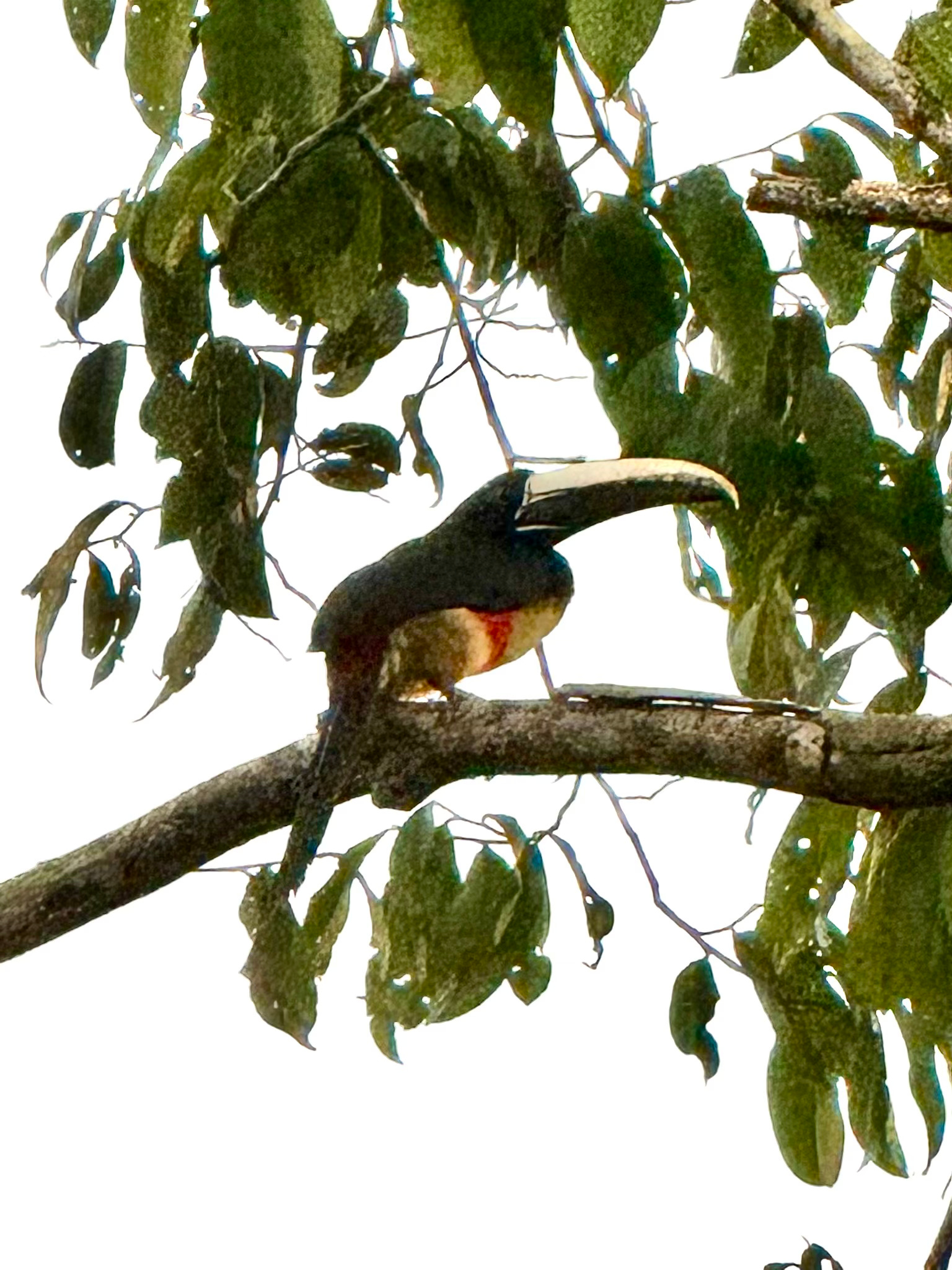
PFF (Photos from Friends) - By Christopher Ellis, Black-necked Aracari (iPhone photo) - Kourou, Guyana.
14. Celeb Item #2 - a new Netflix series has an important birding angle: The Beast in Me, the 8-part episodic Netflix series with Claire Danes and Matthew Rhys, the death/disappearance of “Maddie,” the former wife of billionaire Nile Jarvis (played by Rhys) several years ago, lies at the heart of the psychological game going on in the plot. And Maddie’s interest in birding, and sketching the birds she saw, turns out to be related to the “MacGuffin” that will ultimately unravel all the myriad pyramid of mysteries in the story. (via Town and Country Magazine)
15. And finally, check this out. BNI has focused on the miniaturization (is that actually a word?) of the tracking devices used to track birds during migration. These devices are now routinely used to track even the smallest songbirds. So maybe it should not be a surprise to read that researchers have recently come up with a tracking device so small it can be attached to Monarch butterflies!: For the first time, scientists are tracking the migration of monarch butterflies across much of North America, actively monitoring individual insects on journeys from as far away as Ontario all the way to their overwintering colonies in central Mexico. This long-sought achievement could provide crucial insights into the poorly understood life cycles of hundreds of species of butterflies, bees and other flying insects at a time when many are in steep decline. The breakthrough is the result of a tiny solar-powered radio tag that weighs just 60 milligrams and sells for $200. Researchers have tagged more than 400 monarchs this year and are now following their journeys on a cellphone app created by the New Jersey-based company that makes the tags, Cellular Tracking Technologies. (via The New York Times & Cellular Tracking Industries)
Bird Videos of the Week
Video by BBC, “David Attenborough: How the platypus made us rethink evolution”.

Cornell Live Bird Cam - First Canada Jays of the season.

Cornell Live Bird Cam - Male Crimson-backed Tanager.
Ha! Hard-wired intelligence with no need for travel agents. Maybe Ai gets you/us to this state! Thanks for reading!
This piece really made me think how some birds have a better travel agent than I do, navigating such great distancse.