
Sky is Sky.
Bird News Items
1. Let's begin with a fun piece in The Atlantic - Birding no longer for retirees: Not long before the sun rose on a Saturday in May, five men in their mid-20s were standing alongside an unassuming wetland in New Jersey, searching for birds. Ryan Zucker, a 23-year-old who could do an impressive impersonation of an eastern screech owl, had just taken a small branch to the eye, but still the group was exuberant. And these days, birders in their 20s (and 30s and 40s) are showing up not just at birding competitions, but seemingly everywhere. Some of my friends who, like me, are in their early 30s now bring binoculars on vacation; so do a number of my sister’s friends, who are younger and cooler than mine. Young birding influencers are all over TikTok and Instagram. The National Audubon Society had 10 college chapters in 2019; today, it has 117. (via The Atlantic)
2. Finding a "lost" lark in Chad: The morning of Feb. 2, 2026, started like many others for Pierre Defos du Rau and Julien Birard: It was hot and sunny with a gentle breeze, ideal birding weather. The two French ornithologists, who have been birding since their teens and have traveled the world in search of birds, were at Abou Telfane Game Reserve in central Chad, looking for migratory birds that visit Sahelian wetlands. The duo has surveyed birds in Chad since 2016, they said, keeping detailed records of the winged visitors that fly across the Mediterranean and the Sahara Desert to overwinter in the Sahel every year, and catch any signs of trouble. (via Mongabay)
* Rusty Lark - Calendulauda rufa - (via Birds of the World)
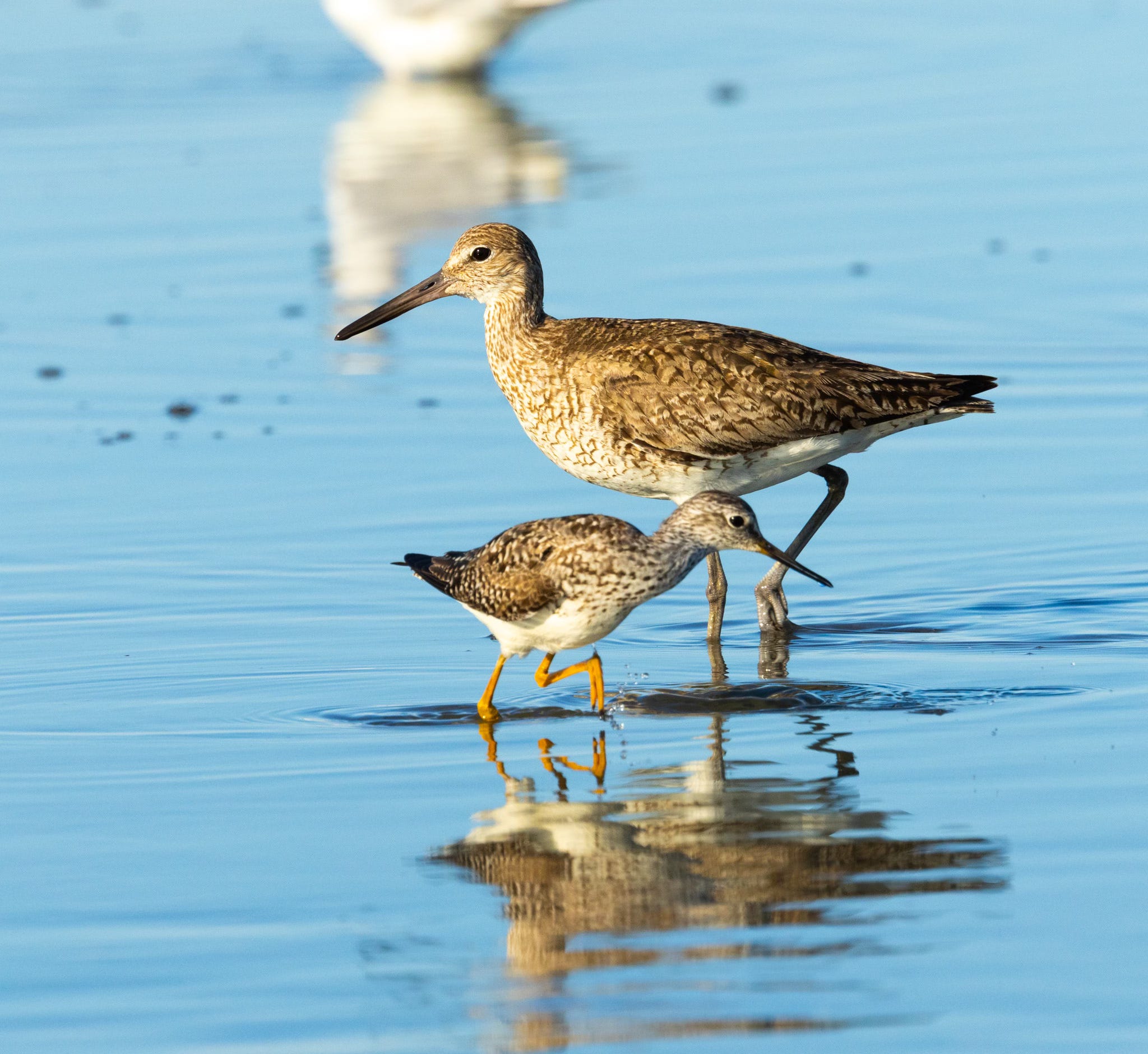
By Hap Ellis, Morning on the flats (Willet & Lesser Yellowlegs) - Cape Porpoise Harbor, ME.
3. From a UK column we like - a "magical encounter": It’s little wonder that sightings of the fairy bird feel magical. The red-necked phalarope is a pelagic species, spending most of the year out at sea feeding on plankton. It generally nests on Arctic tundra – Annagh Marsh is its most southerly breeding location in the world. Unusually, females are the more brightly coloured sex, and they compete for males , which do all the parental care once the clutch is laid. Indeed, during the week that I observed her mate, the female – her job done – could have crossed the north Atlantic to begin her migration. Joining flocks that breed across the western hemisphere, the Irish phalaropes migrate south along the eastern seaboard of North America, flying over the isthmus of Panama to winter in the tropical Pacific. (via The Guardian)
* More on the Red-necked Phalarope here - Red-necked Phalarope - Phalaropus lobatus - (via Birds of the World)
4. Birding Brooklyn: Spring migration generally runs from March 1 to June 15, with April being a peak month. Three hundred and fifty or more (350+) species of migratory birds are involved in this movement, experts say. If you want to watch this happen in Brooklyn, the borough offers plenty of places to do so. Each offers hundreds of species of birds and copious numbers of birds per species (Yes, there are experts and volunteers who actually count them.) There’s not a tree branch in sight that doesn’t have Mr. and Mrs. Name Your Favorite Species busily building their nests or hanging out once the eggs are laid and the fledglings have taken off. Let’s start with the birds everyone sees, whether they notice them or not. (via The Brooklyn Eagle)
5. There is an old saying "all politics is local". Well it appears that for birds, all environmental change is local too, says this study: A sweeping new Cal Poly study of North American birds reveals that environmental change does not affect all species equally and that a bird’s traits can explain whether populations rise or fall as local conditions change. The peer-reviewed research in the journal Current Biology, titled “Avian traits link divergent population responses to environmental change across North America,” of more than half a million bird captures collected across North America over nearly 30 years, found that the same bird species can fare very differently depending on where they live. (via Cal Poly News)
6. Rock on - the Purple Martin parties are back on in Austin: Since 2009, bird watchers have set up lawn chairs, picnic blankets and umbrellas in parking lots around Austin to watch the purple martins, according to Caley Zuzula, the program manager at the Travis Audubon. Thousands of these birds roost in the area during their migration between North and South America. As the birds return to their roost each evening, it’s considered a spectacle for the hundreds of people who show up to watch the show. Zuzula said the organization estimates 4,000 people showed up to last year’s parties across multiple weekends. (via KUT News)
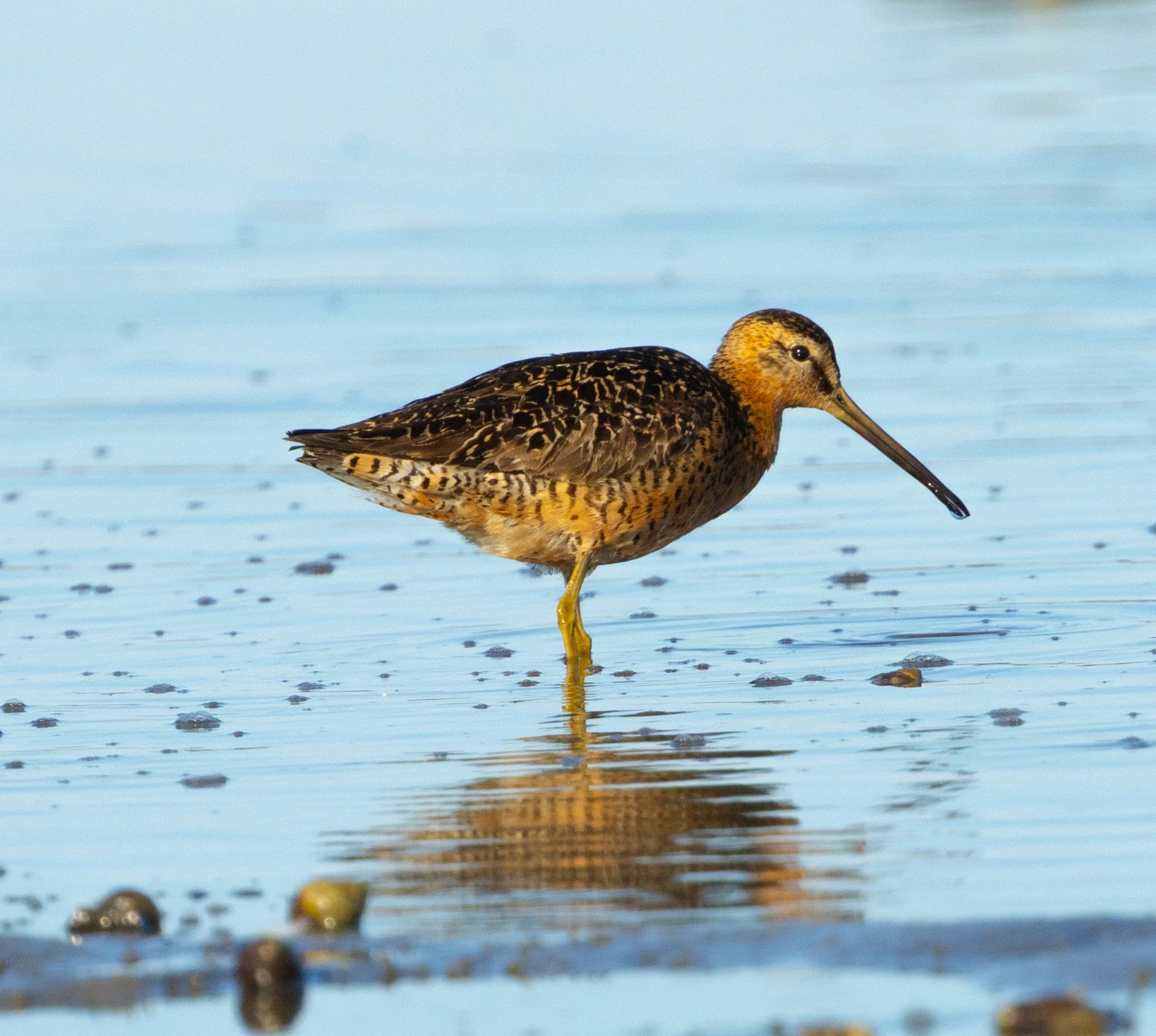
By Hap Ellis, Morning on the flats (Short-billed Dowitcher) - Cape Porpoise Harbor, ME.
7. The importance of "cognitively simple techniques": Homing pigeons have the remarkable ability to find their way back to their coop, even when released many miles away in a new location. If they are released from the same location multiple times, they can become more efficient on each flight. However, scientists are investigating how the birds make these improvements. When pigeons fly together, can inexperienced birds actually learn from birds who have flown the route before, and find shorter paths home? In a new paper published in eLife earlier this year, a team of researchers from UMass Boston used computational models to simulate different learning mechanisms that homing pigeons could use for navigation. (via UMass Boston)
8. No surprise here with this study's findings: Who hasn’t dreamed of flying like a bird? But do birds actually enjoy flying as much as we imagine? A new study by researchers at Utrecht University shows that galahs, Australian cockatoos, almost always choose to fly when given the opportunity. And after several days of flying, the birds make more optimistic choices. These findings suggest that flying leads to positive emotions in the cockatoos. The study was conducted at Vogelpark Avifauna and was recently published in the journal Behaviour. (via Phys Org)
9. From New Zealand, this rare fossil goose shakes things up: Scientists have discovered a previously unknown fossil goose that challenges a decades-old theory about the evolution of New Zealand’s birds. The find suggests the country’s giant flightless geese evolved from much more recent arrivals, revealing a far more dynamic evolutionary history than once believed. The research, published in Historical Biology, was carried out by an international team from the University of Otago, the Museum of New Zealand Te Papa Tongarewa, and the University of Cambridge (UK). The scientists examined fossil material recovered from the well known St Bathans fossil deposits. (via Science Daily)
10. For protecting grassland birds, turns out "no-mow" is only part of a successful strategy: There may be a shift coming in how biologists protect Vermont’s grassland birds. Recent strategies to protect nests have centered around letting fields grow. Biologist Kevin Tolan from the Vermont Center for Ecostudies inspected a field at the base of Mt. Philo to see what might change. Tolan spent his day surveying a 40-acre field of private land being conserved for grassland birds. It takes roughly two hours to transect 10-by-100-meter sections, writing down dominant plants every two meters. The research will help calculate how much of the land that has been conserved to help birds is now hindering them. (via WCAX News)
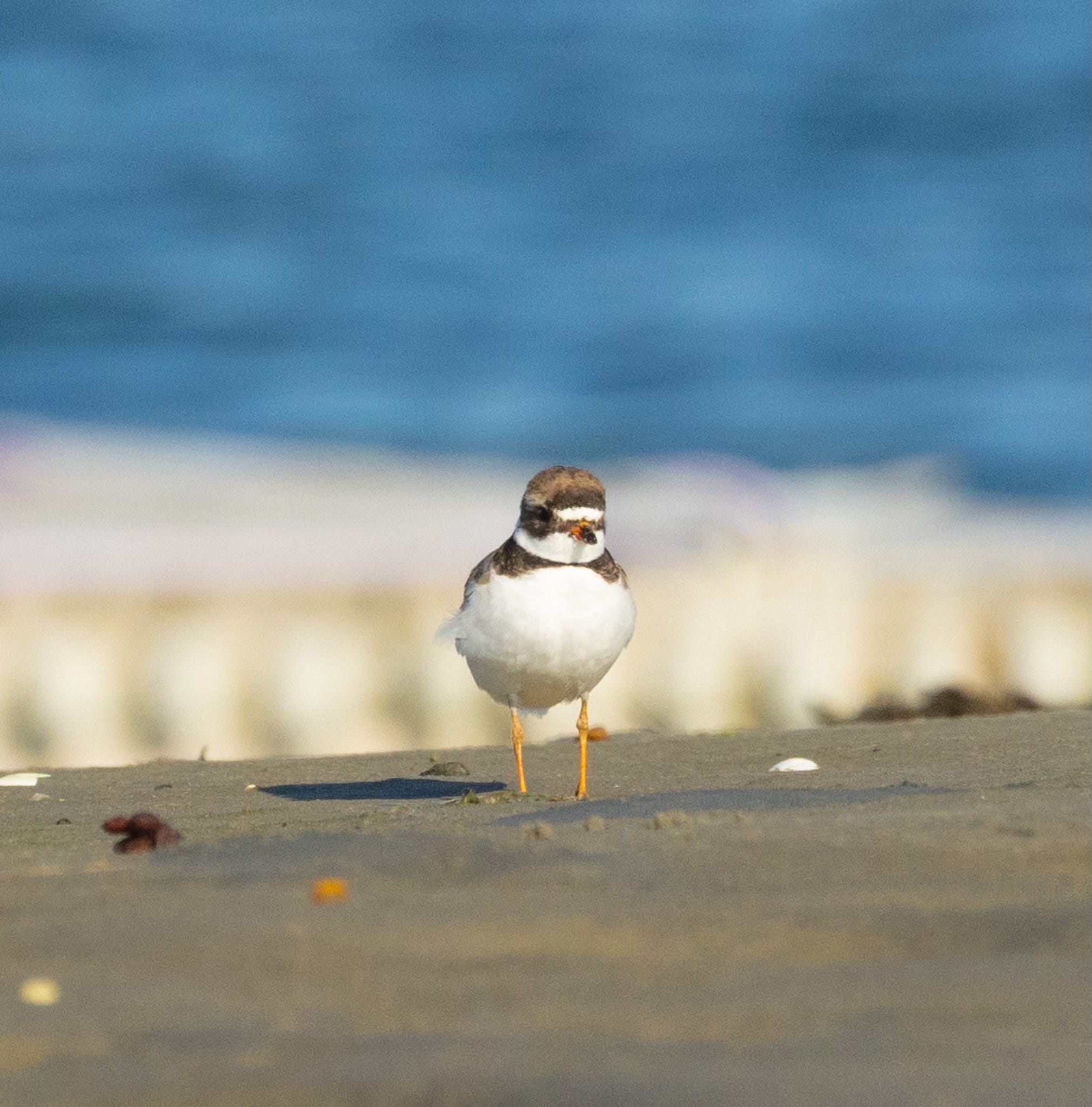
By Hap Ellis, Morning on the flats (Semipalmated Plover) - Cape Porpoise Harbor, ME.
11. Power of eBird - 99,000 eBird checklists helped researchers reach this conclusion: When Canadian wildfire smoke turned the sky over New York orange in June 2023, people noticed the color. Birdwatchers noticed something stranger. Warblers stopped turning up. Not in one park or one county, but across a state’s worth of checklists, the small forest songbirds that birders find almost entirely by ear went missing from the record. An analysis of nearly 99,000 birdwatching lists suggests those birds may have gone quiet. (via Study Finds)
12. Avian flu news, this from NZ: The deadly H5N1 bird flu has been confirmed in New Zealand for the first time, sparking alarm that some of the country’s most beloved and vulnerable native birds could be wiped out if it spreads. A single ocean-going seabird, a brown skua, returned a confirmed positive test on Wednesday, after it was found on Petone beach in Wellington on 10 July, said Andrew Hoggard, the biosecurity minister. In New Zealand, where birds hold a significant place in the culture and ecosystem, the virus has the potential to be catastrophic. However, New Zealand has been preparing for the possible arrival of bird flu for years and a vaccination programme is under way for five species of endangered birds in captive breeding programmes, including the charismatic kākāpō and takahē. (via The Guardian)
13. One cool bookstore: One morning in April 2024, a tractor trailer holding 5,500 books parked beside a low stucco building in California. Waiting inside among empty shelves and used furniture, Lyzy Lusterman found herself in shadow, excited but wondering what she’d gotten herself into. Until then, Lusterman had been immersed in the music world as a pianist and publisher of specialized magazines such as Ukulele and Acoustic Guitar. Now she was the new owner of Buteo Books, the country’s largest bookseller focused on birds. “I think of myself as a pragmatic, risk-averse person,” Lusterman says. Launching into another niche business while using savings to open the brand’s first physical location? This seemed anything but. (via Audubon Magazine)
14. Rare bird alerts - one very cool bird appears in Alberta: ‘Conservation success story’: It’s hard to miss a five-foot-tall bird with bright white plumage. When Calgary birder Jonah O’Brien heard a whooping crane had been seen along a rural road about an hour northeast of the city Tuesday morning, he was quick to make his way there. “It’s really cool,” said O’Brien, who has documented more than 270 bird species in his birding career. It was his first time seeing a whooping crane, which is among the most coveted Canadian species for birdwatchers to find. Birdwatchers keen on finding whooping cranes in Canada typically have to go to Saskatchewan to catch the birds during their fall migration, which is why this summertime sighting in Kneehill County was a welcome surprise for Calgary-area birders. (via CBC News)
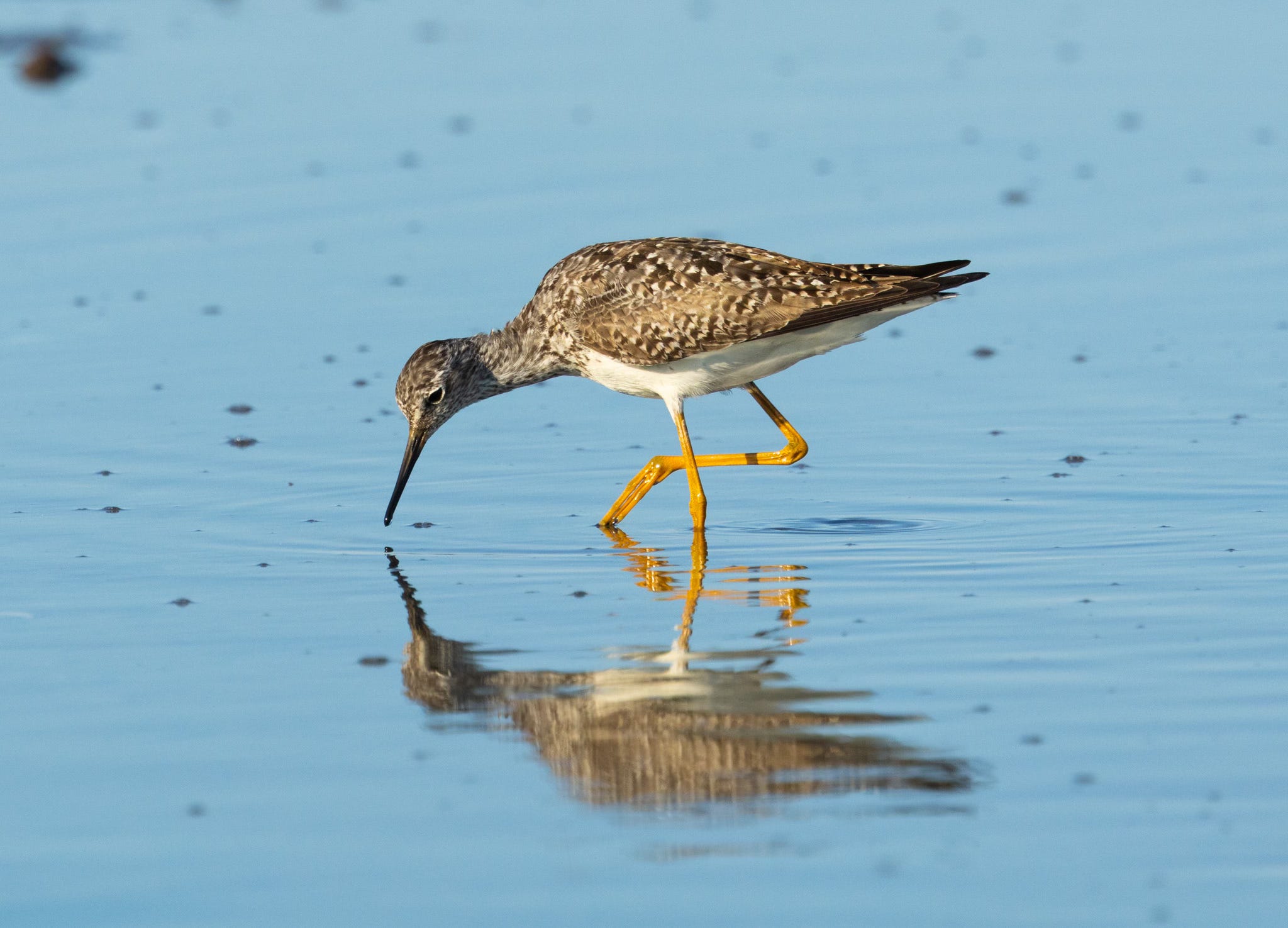
By Hap Ellis, Morning on the flats (Lesser Yellowlegs) - Cape Porpoise Harbor, ME.
15. But even more "rare" is this bird that appeared on the tip of Cape Cod: This week the rare bird gods were feeling generous, granting me two hard to believe bird stories in the region. One is so ridiculous it sounds more like a Disney movie than an actual rare bird occurrence, complete with an unlikely friendship between a bird and a dog – I’m not making that up- but that one will have to wait. Local seabird expert Peter Flood was doing one of his weekend vigils out at Race Point in Provincetown on Saturday and seeing some of the usual summer suspects – a few shearwaters, Wilson’s Storm-Petrels, Common, Roseate, and Least Terns. It was a slow morning by Race Point standards until he noticed a kerfuffle among the loafing gulls – suddenly, they all took flight. He surmised the cause was a Bald Eagle, generally the only bird intimidating enough to rouse the large gulls. In his notes he said, with his usual deadpan humor, that the cause was “just a Crested Caracara”. (via Cape and Islands)
16. No surprise here: Four African protected areas have been ranked among the world’s top 20 birdwatching destinations, highlighting the continent’s growing position in the global birdwatching tourism market. Kenya accounts for two of Africa’s four parks in the rankings. The new study by UK travel insurance company AllClear ranked 115 internationally recognized birdwatching destinations across six continents using eight indicators, including bird species diversity, notable species, climate, accessibility, distance from airports, and daily travel costs. (via The Independent)
17. Travel tips for Alaskan birding: Alaska’s incredibly diverse landscapes – from vast wetlands to coastal islands to rolling tundra – provide habitat for almost 500 species of birds, both resident and migratory. Each year, 5 billion birds migrate to Alaska to feed, breed, and nest. With birding hotspots located throughout the state, from our largest cities to remote islands, and birding festivals held spring through fall, Alaska is one of the top destinations in the U.S. for birding enthusiasts looking to combine excellent birding with stunning scenery and adventure. Independent birding can be fun and rewarding, especially in easily accessible communities and national parks. For more remote locations, birding tours are available with professional guides who organize logistics and can help you identify rare species to add to your life list. There’s no shortage of stunning locations to catch a glimpse of Alaska’s birds. (via Travel Alaska)
18. Finally, Audubon offers a glimpse into the dark side (spoiler alert - night time birding): Spring birding can be an unforgettable experience, with surges of brilliant tanagers, warblers, and orioles brightening your local birding patch. But while most birders call it a day when the sun sets, the birds don’t stop—much of migration happens unseen at night. Now, more and more birders of all abilities are discovering the joy of listening to and recording the nocturnal flight calls, or NFCs for short, that birds make as they migrate. With user-friendly technology and the help of a flourishing community, it’s easier than ever to start identifying the birds that pass overhead at night. Among the hobby’s biggest draws: Nocturnal migrants aren’t dependent on the habitat below, so it’s possible to encounter a whole new suite of species you’re not used to seeing. And it doesn’t matter if you live in the quiet country or in a noisy city, since bird calls rarely share frequencies with urban noise. “Sky is sky,” says Joe Gyekis, moderator on the Nocturnal Flight Calls Facebook group. (via Audubon)
19. P.S. Do click on the Jamie Wyeth video on gulls below - short and wonderful!
Go Birding!