
Summer Birdsong.
Bird News Items
1. Let’s begin with a neurobiologist’s efforts to understand birdsong: Imagine a chicken that could speak or a pigeon with a voice rivaling that of the most musical songbirds. Granted, the world probably doesn’t need any gossiping chickens or pigeons breaking out in song. But why some birds learn to create a deep repertoire and others are unable to has long been a research focus of the neurobiologist Erich D. Jarvis. He studies the small group of species capable of speech, focusing on birds and mice, and he has long hoped to genetically engineer an animal that can vocalize in new ways. Introducing manipulated genes into the brain of a bird or a mouse that doesn’t vocalize could create that ability and provide new clues into the origins of speech. (via The New York Times)
2. Jan Brueghel the Elder figured this out in 1611: Last year, scientists presented chilling evidence that helped solve a long-standing murder mystery. Europe’s largest bat species—the greater noctule—had been suspected of feasting on birds, but no one knew exactly how they caught and ate their prey. This past fall, a team reported the first known recordings of the bats nabbing, dismembering and chomping on migrating songbirds during night flights. But it turns out that the recent revelation for scientists may have been recognized hundreds of years ago by a Northern Renaissance painter. (via Smithsonian Magazine)
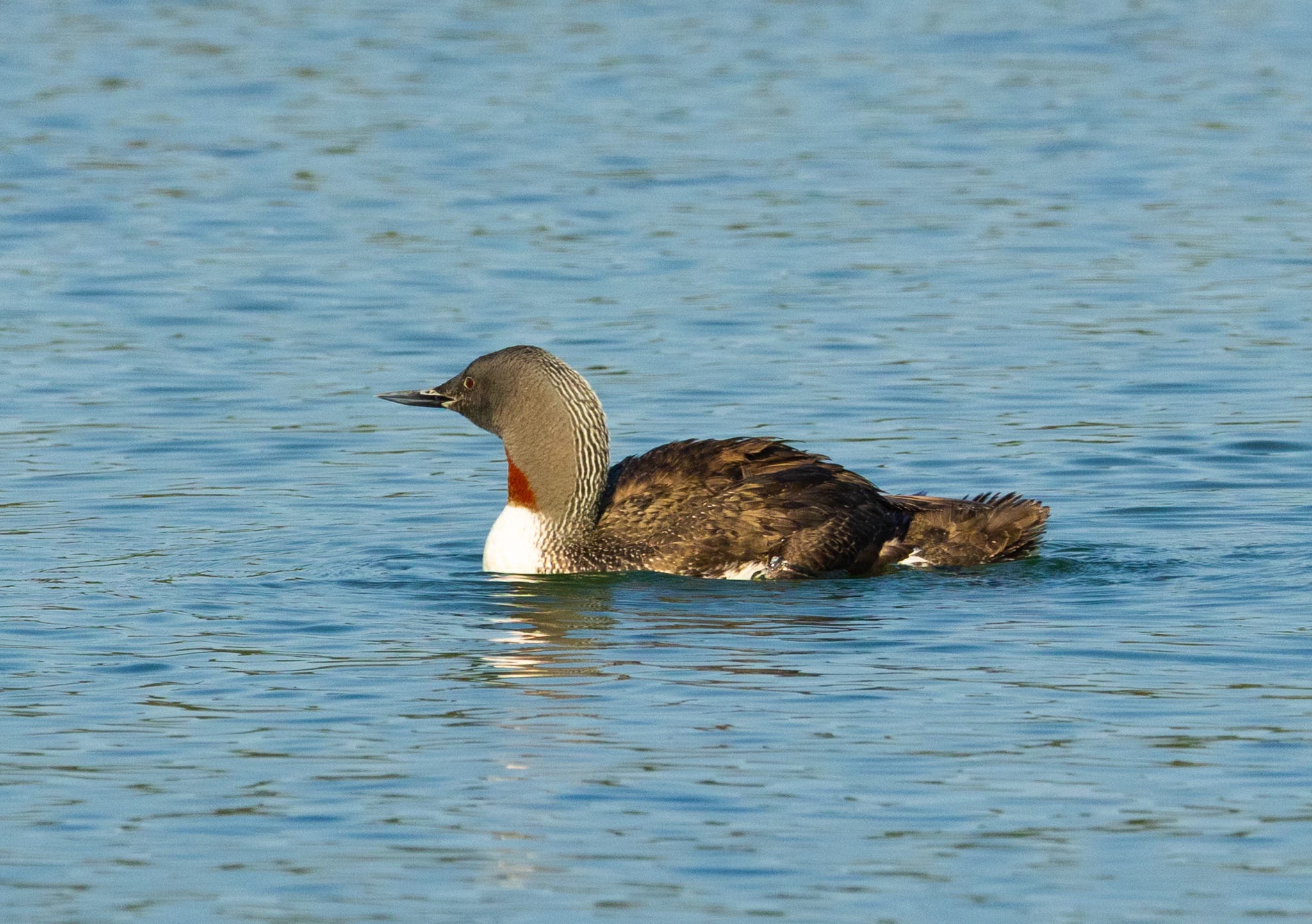
By Hap Ellis, Red-throated Loon - Cape Porpoise Harbor, ME.
3. From an MIT lab, designing a robot to mimic a puffin (no easy task!): Mechanical engineer Raphael Zufferey’s lab at MIT contains a giant tank filled with bright turquoise water, an array of fans that can whip up a powerful wind, and small flying robots perched everywhere you look. It’s the robots that are the stars of the show here and they’re inspired by diving seabirds like the Atlantic puffin, which uses its wings to both fly and swim. “These puffins solve this really challenging task of moving in air, in water despite the huge difference in density,” says Zufferey. He and his colleagues wanted to see if they could build a bird-sized robot that could also move through both mediums and transition between them. It’s something no one had ever done before. (via National Public Radio)
4. From Ukraine, birders find ways to manage: “There’s a jay... That’s a bluethroat... Do you see the hen harrier? We’re lucky,” the 37-year-old photographer told AFP. Threatened in peacetime by deforestation, intensive agriculture, urbanisation, pollution, hunting and climate change, Russia‘s 2022 invasion has wrought yet more suffering on Ukraine‘s birdlife. The constant aerial bombardments have devastated wildlife and wrecked a delicate ecosystem across a 1,200-kilometre (750-mile) frontline – including birds‘ nesting grounds and migratory routes. Every dawn or dusk, Sevidov leaves his grey apartment block on the outskirts of Kryvyi Rig, an industrial city in central Ukraine, to see what birds he can spot. (via RFI)
5. While birds in Ukraine make the best out of a terrible situation: The war in Ukraine is also reshaping its natural environment. Sebastian Shukla explains. Watch video here. (via CNN)
6. A master class on the speed of animals (and birds): The most comprehensive analysis of body masses and speeds—including nearly 500 species (mammals, fish, birds, reptiles, mollusks, and arthropods) with body masses ranging from 3 x 10⁻⁸ kilograms to 108,400 kilograms—found that the hump-shaped relationship between mass and speed can best be explained by the fact that maximum acceleration is limited because of restrictions on quickly available energy. Running and flying animals have an initially similar power-law increase of maximum speed with body mass (v = Mb, speed = mass raised to the power of b) but flying animals are nearly six times faster (exponent b is higher). (via LitHub)
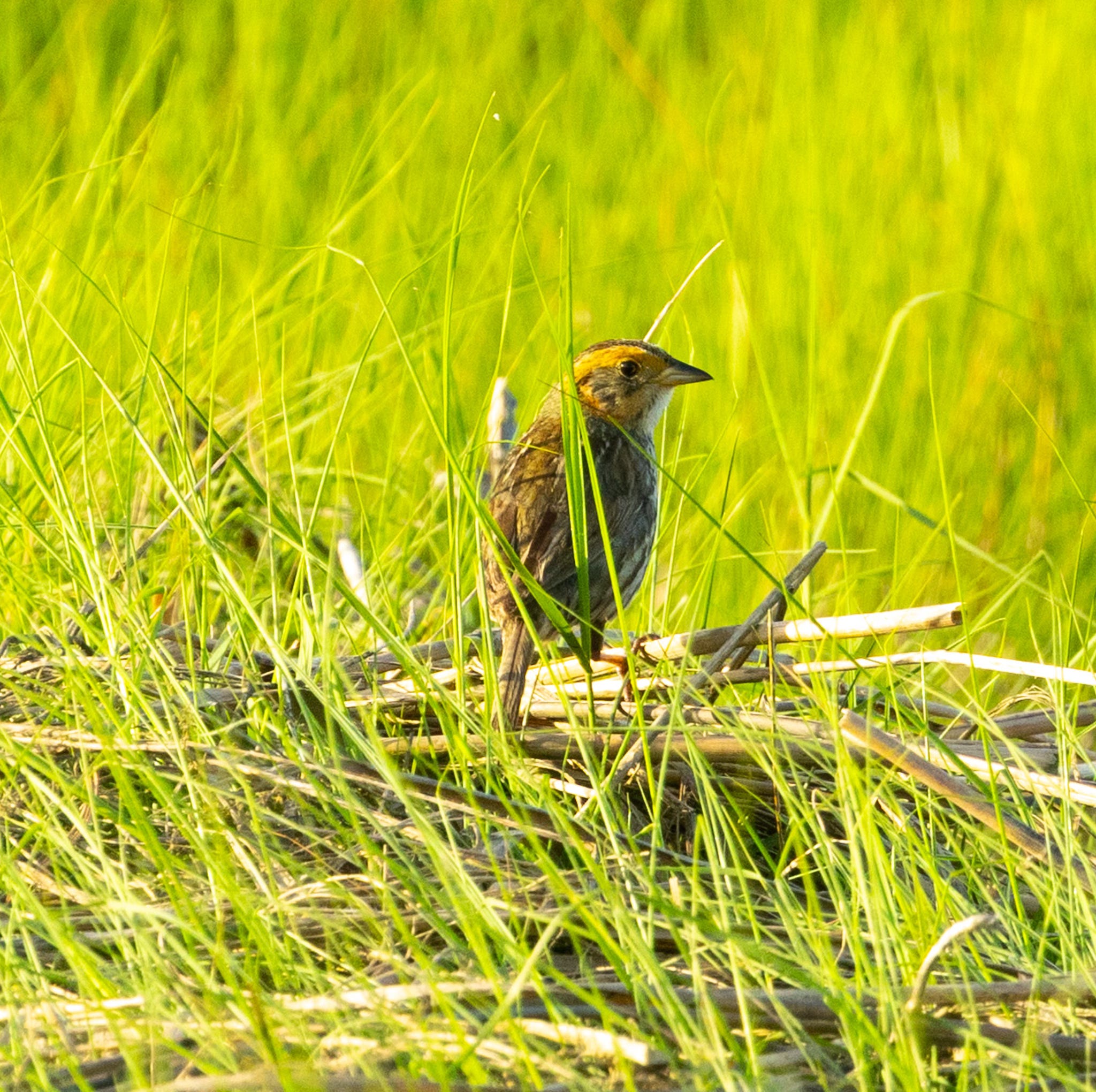
By Hap Ellis, Saltmarsh Sparrow - Scarborough Marsh, Scarborough, ME.
7. Better mating through plastics?: Last summer, Cornell University undergraduate Jaden Salett ’27 walked, net in hand, through the grasslands of Lake Samsonvale in Queensland, Australia. Tropical shrubs filled the landscape with rainbow blooms, and tiny, long-tailed birds called fairywrens fluttered around him. It was a typical day of catching and tagging fairywrens as part of a long-term study of their social and mating behavior, until a flash of black and orange shot into his net. An ornamented male Red-backed Fairywren had darted toward a female caught moments earlier. When Salett and his fellow researchers retrieved the bird, they noticed a bright orange object clutched in its beak. It turned out to be a fragment of flagging tape—the brightly colored plastic strips that scientists use to mark nest locations during field studies. (via All About Birds)
8. A paean to one of our favorite birds: Hiking through mud, thick and slippery, puts a damper on anyone’s enthusiasm. Such was the case for my intern and me on a humid summer morning, making our way to our first Western Yellow-billed Cuckoo survey point. Slogging silently and grumpily down a soggy riverbed, my intern suddenly brightens, as if lit from within, and practically shouts and points hopefully “is that a cuckoo?” No, I reply, it is a Yellow-breasted Chat. Deflated, we walk on for three more vocalizations and inquiries—“a cuckoo?” Me: nope, a Chat. It got to the point that the intern would just look at me and point to some crazy array of sounds and I’d shake my head. Chats, all. (via Audubon)
9. A detailed look at bird strikes at airports: For millennia, humans gazed at the birds in the sky with an unquenchable envy. How could we learn to fly like them? This question dogged us until the Wright Brothers answered it in the early 20th century. Since then, human beings have been able to fly alongside the birds, sharing the same airspace. When creatures and machines collide, however, disaster can quickly ensue. Common sense led airport staff to keep birds off the runways to prevent accidents. A recent meta-analysis, published in PLOS One, confirmed a positive correlation between higher bird abundance and more frequent bird strike accidents. However, this correlation comes with some caveats. (via Yahoo! News)
10. Hong Kong crime report: Hong Kong customs officers have arrested two women at the border for allegedly smuggling animals after they were separately found with a dog worth HK$3,000 (US$380) and two endangered birds that could be sold for a total of HK$5,000. The Customs and Excise Department said on Friday that it had intercepted a 57-year-old mainland Chinese woman at the Lo Wu checkpoint’s arrival hall a day earlier and discovered the dog concealed inside her sling bag. The dog was estimated to have a market value of about HK$3,000. Customs said they arrested the suspect and handed the case over to the Agriculture, Fisheries and Conservation Department (AFCD). Customs officers also arrested a 46-year-old local woman at the Lok Ma Chau Spur Line checkpoint on Thursday, seizing two birds collectively worth about HK$5,000 from her backpack. (via South China Morning Post)
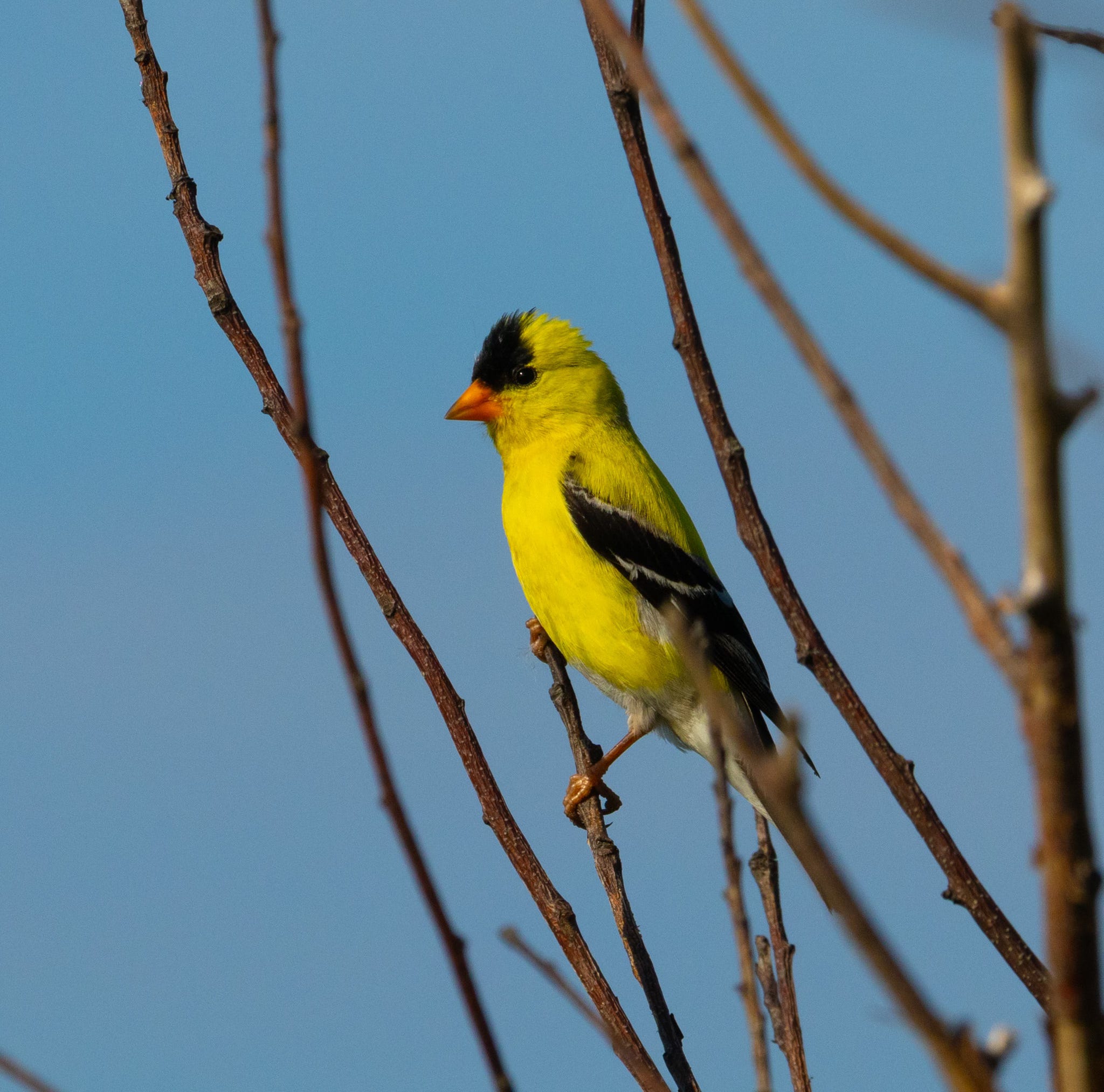
By Hap Ellis, American Goldfinch - Biddeford Pool, ME.
11. More on “forever chemicals”: New research has found young birds living near contaminated industrial and military sites in suburban Melbourne carry especially high concentrations of PFAS, so-called “forever chemicals.” In a study just published in Environmental Science and Technology, researchers from Macquarie University and Environment Protection Authority Victoria took blood samples from introduced house sparrows (Passer domesticus) captured at 16 locations in Melbourne’s southwest, including sites around the Williams Laverton Royal Australian Air Force (RAAF) base and near the Altona Wastewater Treatment Plant, the Qenos chemical plant in Altona, and the Mobil oil refinery, also in Altona. (via Phys Org)
12. When in Missouri: There are many ways to mark the passing of time in your life: the arrival of wrinkles and gray hair, the new readers you keep stashed in your bag, or the tendency to feel like you might need hospitalization after one single night of sleeping funny. For me, it was a sudden and all-encompassing affinity for backyard birds that arrived somewhere around my 35th birthday. I discovered a little family of tufted titmice in a boxwood outside my home, and I fell in love. I’ve always passively enjoyed birds (especially crows, those little geniuses), but the day I dropped untold amounts of money on an extensive bird feeder system for my backyard and started to spend my free time staring at it with a Birds of Missouri illustrated guidebook in my hands? Well, there was no turning back from that. (via 417 Magazine)
13. UK twitcher’s notes: With hindsight, the late June heatwave was not the ideal time for my (very) old schoolmates and me to be cycling around Suffolk. Yet, despite the searing heat and the lateness of the season, the woods and hedgerows were still awash with birdsong. Chirping chiffchaffs, melodic blackcaps and warbling whitethroats were everywhere, while swallows twittered over fields and swifts screamed past rooftops in the towns and villages we rode through. I even saw a cuckoo – which I momentarily mistook for a sparrowhawk – flying fast and low across the road. But the biggest surprise was the number of yellowhammers we heard, each delivering their characteristic song: a rapid warble followed by a final flourish, often rendered as “a-little-bit-of-bread-and-no cheeeese”. (via The Guardian)
Don’t know Yellowhammers? Yellowhammer - Emberiza citrinella (via Birds of the World)
Photos from friends - By Chris Ellis - All smiles after finding singing Eastern Whip-poor-wills at 11pm at Kennebunk Plains, Kennebunk, ME.
14. From India, a look at artificial islands as a conservation tool: For thousands of years, wetlands have provided natural nesting, feeding, and resting habitat for waterbirds. However, owing to changes in urbanization, agriculture, and water systems around the world, many species of birds have lost their homes. As a result, conservationists in countries such as the U.S. have begun building artificial islands in wetlands to give birds safer places to breed. Although artificial habitats cannot replace natural wetlands, studies suggest they can be important conservation tools. (via Times of India)
15. Some photography tips from a pro: When the Something Wild team is out in the field, host Grace McCulloch always brings at least one camera. So when extreme birder Gino Ellison came by the studio, it was an opportunity to learn Ellison’s methods for spotting elusive birds and capturing close-up bird portraits. In 2024, Ellison completed an American Birding Association (ABA) Big Year, documenting a staggering 803 bird species. Whether you are in your back yard with a basic pair of binoculars or carrying a mobile photography studio, Ellison has advice on sharpening your field skills. (via New Hampshire Public Radio)
16. For the back yard birders, innovation comes to… bird baths: Rachel Cericola is a writer covering smart home. In addition to testing hundreds of smart devices, she has also tested dozens of ice cream sandwiches. Ever since my son went to college, I’ve been missing something. Taking care of another living being becomes your everything, and when that’s gone, you’re left with a giant void. So I filled that void with birds. I started testing smart bird feeders, and the empty nest is now filled with actual birds. Instead of driving to hockey practice, clearing the always-present dirty dishes from the sink, and preparing family dinners, I’ve been hosing off the deck, scrubbing feeders, and filling seed bins. (via The New York Times)
17. Finally, check out the detail in these amazing quilts: Retired biologist Tracy McLellan stitches together her loves of bird photography, travel, and fiber arts into vibrant, hyper-realistic quilts. “It all started because I wanted to find a way to do something with my bird photos other than just letting them sit on my computer,” she says. McLellan has the photos printed onto fabric, then uses sewing techniques like free-motion quilting and thread painting to create lush textures, such as the hairlike feathers on a Rufous-necked Hornbill’s neck (based on a photo she took in Royal Manas National Park in southern Bhutan). McLellan has a collection of thread containing nearly 500 colors and shades, so she can match just about any hue in the avian spectrum. (via All About Birds)
Bird Videos of the Week
Video by CBS News, “Nature: Puffins in Maine”.

Cornell Live Bird Cam - A Cooper's Hawk decides to try for lunch at the Cornell Lab feeders.

Cornell Live Bird Cam - Based on the available evidence, we believe it was the youngest fledgling from the Cornell Hawks Cam, P3.